

Cash flow refers to the movement of cash and cash equivalents in a business, showing how cash is generated and used during a specific period. It includes both cash inflows, which increase cash and cash equivalents, and cash outflows, which decrease them. A Cash Flow Statement is a financial statement that records these inflows and outflows over a particular period. It classifies cash transactions into three main categories: Cash Flow from Operating Activities, which relates to the core business operations; Cash Flow from Investing Activities, which includes purchase and sale of assets and investments; and Cash Flow from Financing Activities, which covers transactions with owners and lenders such as issue of shares, repayment of loans, and payment of dividends. Apart from these main categories, a Cash Flow Statement may also include certain special items or adjustments as required under accounting standards to ensure proper reporting of cash movements
Treatment of Some Other Special Items in Cash Flow Statement:
1. Purchase of Business:
Sometimes a company purchases an ongoing business along with its fixed and current assets and liabilities. The purchase consideration may be discharged either in cash or by issuing shares and debentures. While preparing the Cash Flow Statement, goodwill or capital reserve is calculated by comparing the purchase consideration with the net assets acquired. Net assets are calculated as total assets taken over minus liabilities assumed. If the purchase consideration is more than the net assets, the difference is treated as goodwill, and if it is less, the difference is treated as capital reserve.
In case shares or debentures are issued against current assets, it is considered a source of cash flow under financing activities because current assets are capable of generating cash. However, if shares or debentures are issued against fixed assets, it is treated as a non-cash transaction and is not shown in the Cash Flow Statement, as no actual cash movement takes place.
2. Under or Over Valuation of Stock:
The valuation of stock has a direct effect on the reported profit of a company, although it does not involve any actual cash flow. Sometimes stock may be valued below cost or above cost, which is known as undervaluation or overvaluation of stock. These adjustments are necessary while preparing the Cash Flow Statement because profit is adjusted to derive cash flow from operating activities.
When closing stock is undervalued, it results in a lower reported profit even though there is no actual cash outflow. Therefore, the amount of undervaluation is added back to the profit while making adjustments. On the other hand, when closing stock is overvalued, it increases the reported profit without any real cash inflow, and therefore, the excess amount is deducted from the profit. These adjustments ensure that only real cash effects are reflected in the Cash Flow Statement.
3. Fixed Assets:
While preparing a Cash Flow Statement, an increase in non-current assets is treated as purchase of fixed assets, resulting in cash outflow under investing activities. A decrease in non-current assets may be due to either sale of assets or depreciation. If the decrease is significant, it is treated as sale of assets, but if it is small, it is considered depreciation.
When detailed information is available, Fixed Assets Account and Provision for Depreciation Account are prepared to find actual purchase and sale of assets. These are then correctly shown in the Cash Flow Statement under investing activities.
Case 1: When Provision for Depreciation A/c is not maintained:

i. To find out the cost of fixed assets purchased, when there is no information regarding depreciation:
For Example: From the extracts of the Balance Sheet of Shreya Ltd.
Opening balance of Land and Building ₹80,000. Closing balance of Land and Building ₹1,20,000. Also, there is no information regarding depreciation. Prepare Land and Building A/c.
Solution:

ii. To find out the cost of fixed assets purchased, when the amount of depreciation is given:
For Example, From the extracts of the Balance Sheet of Vanshika Ltd.
Opening Balance of Land and Building ₹1,00,000. Closing Balance of Land and Building ₹1,60,000. Depreciation for the year ₹20,000. Prepare Land and Building A/c.
Solution:

iii. To find out the amount of depreciation when information regarding the additional purchase of an asset is given:
For Example, From the extracts of the Balance Sheet of Shradha Ltd.
Opening Balance of Land and Building ₹60,000. Closing Balance of Land and Building ₹80,000. Purchase of Land and Building during the year ₹30,000. Prepare Land and Building A/c.
Solution:
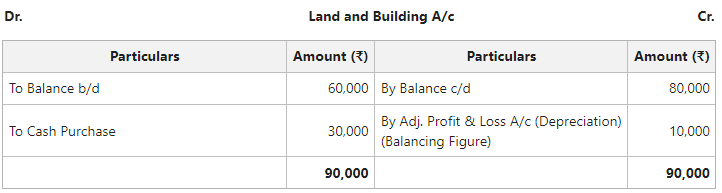
iv. To find out the sale value of fixed assets, when there is no information regarding depreciation:
For Example, From the extracts of the Balance Sheet of Tarun Ltd.
Opening Balance of Land and Building ₹80,000. Closing Balance of Land and Building ₹50,000. No further information regarding depreciation is given.
Solution:
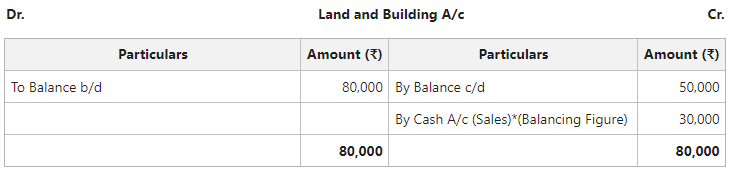
* If the difference between the opening and closing balance of Land and Building (₹30,000) is considered as Depreciation instead of Sales, then, in that case, the ultimate effect on the cash flow statement will be the same. It is because if the amount is considered as Sales it will be recorded as a source of cash, and if it is considered as Depreciation it will be shown on the debit side of Adjusted Profit & Loss A/c and by this amount Cash from Operations in Operating Activities will be increased.
v. To find out the cost of a fixed asset purchased, when the opening balance of the asset, closing balance of the asset, depreciation for the year, and profit or loss on assets sold are given:
For Example, From the extract of the Balance of Stacy Ltd.
Opening Balance of Land and Building ₹1,25,000. Closing Balance of Land and Building ₹1,50,000. Depreciation during the year excluding the Assets Sold is ₹5,000. During the year Land and Building costing ₹10,000 (accumulated depreciation ₹2,500) is sold for ₹6,000.
Solution:

Case 2: When Provision for Depreciation A/c is maintained:

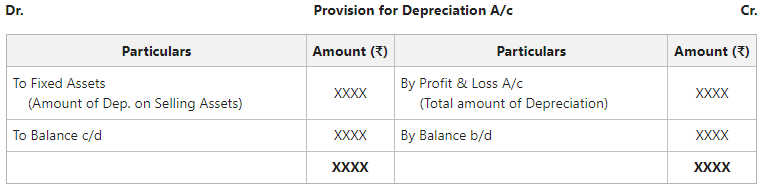
i. To find out the cost of assets purchased when opening and closing balances of asset are given and opening and closing balances of provision for depreciation are given in adjustment.
For Example, From the extracts of the Balance Sheet of Prayag Ltd.

Provision for depreciation on Plant & Machinery stood ₹27,000 on 31st March 2020 and ₹36,000 on 31st March 2021. Find out the Cost of Assets Purchased and Depreciation during the year.
Solution:
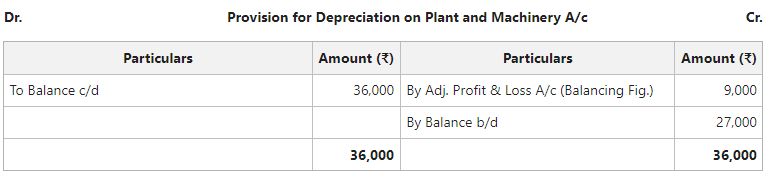

Note: In the above example, the opening and closing balances of Plant and Machinery are not shown; instead the balance is shown after depreciation. Therefore, to determine the opening and closing balances of Plant and Machinery, we have to add opening and closing balance of provision to the opening and closing balances of Plant and Machinery, respectively.
ii. To find out the cost of the asset purchased, when the opening and closing balance of the asset (before depreciation), the opening and closing balance of provision for depreciation and profit on the sale of the asset is given:
For Example, From the extract of the Balance Sheet of Nisha Ltd.

Additional Information: A Machinery costing ₹5,000 (accumulated depreciation₹3,000) is sold for ₹1,250. Find out the total amount of depreciation and cost of Machinery purchased.
Solution:
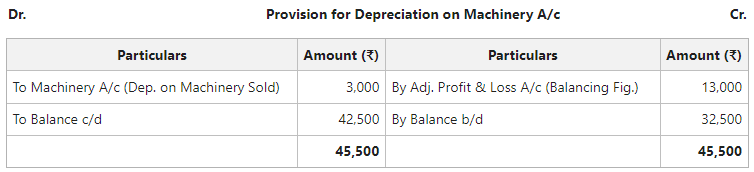

iii. To find out the cost of assets purchased when the opening and closing balance of asset, opening and closing balance of provision for depreciation, depreciation for the year, and gain or loss on asset sold is given:
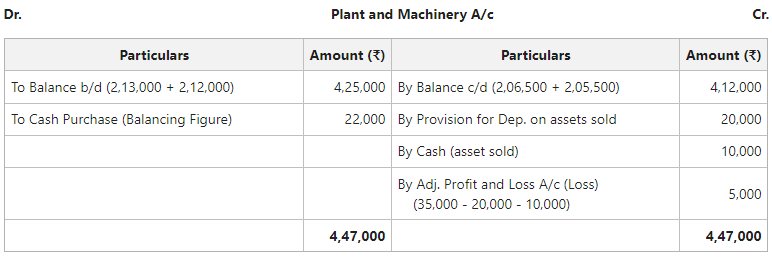
For Example, From the extract of the Balance Sheet of Vidya Ltd.
The Plant and Machinery for 2019 and 2020 are 2,13,000 and 2,06,500 respectively.
Additional Information: Provision for Depreciation on Plant and Machinery amounts to ₹2,12,000 as on opening balance and ₹2,05,500 as the closing balance. Depreciation for the year is ₹13,500. A machine was sold for ₹10,000 at the time of sale. The net book value of the machine was ₹15,000 (cost ₹35,000 and accumulated depreciation ₹20,000). Find out the cost of the asset purchased.
Solution:

4. Increase or Decrease in the Value of Goodwill:
Goodwill is an intangible asset, and its value may increase or decrease over time. An increase in the value of goodwill is treated as purchase of goodwill and is considered a cash outflow under investing activities in the Cash Flow Statement. On the other hand, a decrease in goodwill indicates that it has been written off, and since it is a non-cash expense, the amount of decrease is added back to profit while computing cash flow from operating activities.
5. Profit before Tax and after Tax:
Profit before tax is generally taken as the starting point for preparing cash flow from operating activities. However, if profit after tax is given, it is first converted into profit before tax by adding provision for taxation and provision for dividends. This adjustment is made because cash flow is calculated based on operating profit before considering tax and dividend payments, which are treated separately in the cash flow statement.
6. Cash and Cash Equivalent Items:
Cash equivalents of a firm are extremely liquid investments and can be readily converted into cash with little or no risk of change in their values. Therefore, all the investments whose maturity period is too low (3 months or less) will be included in cash equivalents.
Note: A company does not keep Cash Equivalents with the motive of investment.
Some examples of Cash Equivalents are as follows:
- Short-term Investments
- Short-term Deposits
- Marketable Securities
- Cash Credit
- Treasury Bills
- Opening Bank Overdrafts
- Cash Credit at the beginning
Accounting Treatment of Cash Equivalents:
1. Items to be added to the total of Operating, Investing, and Financing Activities:
- Opening Balance of Cash
- Opening Balance of Bank
- Opening Short-term Deposit
- Opening Balance of Cash Credit (Debit)
- Opening Marketable Securities
- Opening Treasury bills
2. Items to be Deducted:
- Opening Balance of Cash Credit (Credit)
3. Other Matters:
- If the amount of only last year is given and not of the current year, then it indicates a decrease in the value.
- If the amount of only the current year is given and not of last year, then it indicates an increase in the value.
- If only one year's amount is given and the question does not clearly say as to which year's amount it is, then it will be considered as the current year's amount.
Kindly refer to Treatment of Special Items in Cash Flow Statement for accounting treatment of more special items in Cash Flow Statement.