

A Cash Flow Statement is a financial statement that shows the movement of cash and cash equivalents into and out of a business during a specific period. The increase in cash and cash equivalents is known as cash inflow, while the decrease is known as cash outflow. It helps in understanding how a company generates and uses cash in its operations. A cash flow statement can be prepared using the information available from two comparative balance sheets along with other financial data. According to Accounting Standard (AS)–3 (Revised) issued by the Institute of Chartered Accountants of India, cash flows are classified into three categories: Operating Activities, Investing Activities, and Financing Activities. Operating activities relate to the main business operations, investing activities involve the purchase and sale of long-term assets and investments, and financing activities deal with changes in capital and borrowings. With the introduction of the Companies Act, 2013, the preparation of a Cash Flow Statement has become mandatory for all companies except One Person Companies (OPCs) under Section 2(40). It is an important tool for assessing a company's liquidity, financial flexibility, and overall cash management.
Financing Activities
The activities that bring a change in the capital and borrowings of a company are covered under Financing Activities. Cash Flow from Financing Activities helps the lenders of funds in estimating their claims on cash flows in the future. It is calculated by analysing the change in Equity and Preference Share Capital, Debentures, and other short-term and long-term borrowings. The activities under financing activities include:
Cash Inflows
- Issue of equity shares.
- Issue of preference shares.
- Issue of debentures.
- Raising long-term or short-term loans.
- Borrowings through bonds, cash credit, bank overdraft, etc.
Cash Outflows
- Repayment of loans and debentures.
- Redemption of preference shares.
- Buy-back of equity shares.
- Payment of interest on borrowings.
- Payment of dividends and dividend distribution tax (where applicable).
Note:
Financing Activities will not include Issue of Bonus Shares, Conversion of Debentures into Shares, and Issue of Share Capital, Debenture against purchase of fixed assets, as they do not involve cash.
Format of Cash Flow from Financing Activities:
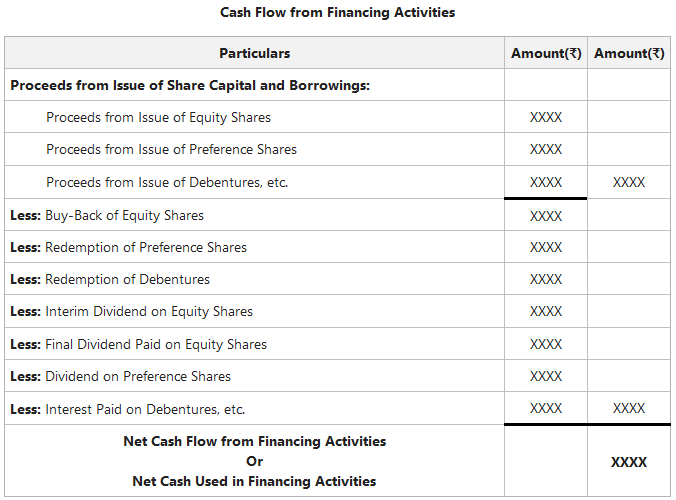
Illustration 1:
From the following Extract of Balance as on 31st March 2021 of a company, calculate Cash Flow from Financing Activities:

Additional Information:
1. Interim Dividend on Equity Shares at the end of the current year was paid @ 10%.
2. Dividend on Preference Shares was paid.
3. Preference Shares were redeemed at a premium of 6% on 31st March 2021.
4. New Shares and Debentures were issued on the last date of the current year.
Solution:
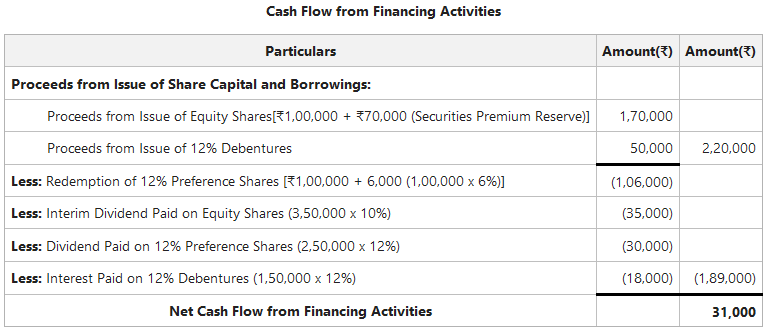
Illustration 2:
Compute Cash Flow from Financing Activities from the following information:

Additional Information:
1. Dividend Paid ₹40,000
2. Interest on Cash Credit Paid ₹15,000
3. Interest on Debentures Paid ₹50,000
4. Issue of Bonus Shares to shareholders at par in the ratio of 1 share for 6 shares held during the year.
Solution:

*Issue of Bonus Shares =
= 1,00,000