

Cash flow refers to the movement of cash and cash equivalents into and out of a business. Transactions that increase cash and cash equivalents are known as cash inflows, while those that decrease them are called cash outflows. A Cash Flow Statement is a financial statement that summarizes the inflows and outflows of cash and cash equivalents during a specific accounting period. It can be prepared using the comparative balance sheets of a company and classifies cash transactions into three categories: operating activities, investing activities, and financing activities. In India, the preparation of Cash Flow Statements is governed by Accounting Standard (AS) 3 (Revised) issued by the Institute of Chartered Accountants of India (ICAI). Furthermore, under Section 2(40) of the Companies Act, 2013, the preparation of a Cash Flow Statement is mandatory for all companies except One Person Companies (OPCs).
Investing Activities
The sale and purchase of investments and fixed assets, which are not held by a company for resale purposes are covered under Investing Activities. Cash flow from investing activities also discloses the expenditures incurred for the resources intended to generate future income and cash flows of the company. Some examples of cash flows arising from investing activities are as follows:
Cash Inflows (Receipts):
- Sale of fixed assets (including intangible assets such as patents and trademarks).
- Sale of shares, warrants, or debt instruments of other companies (except those classified as cash equivalents).
- Insurance compensation received for damaged or destroyed property.
- Repayment of loans and advances made to third parties.
- Interest and dividends received (for non-financial companies).
Cash Outflows (Payments):
- Purchase of fixed assets (including intangible assets).
- Purchase of shares, warrants, or debt instruments of other companies (except cash equivalents).
- Loans and advances granted to third parties.
Special Treatment for Financial Organizations
- Loans and advances given or recovered are treated as operating activities, not investing activities.
- Interest and dividends received are also treated as operating activities because they arise from the entity's main business operations.
Format of Cash Flow from Investing Activities:

Illustration 1:
Calculate Cash flow from Investing Activities from the following information:
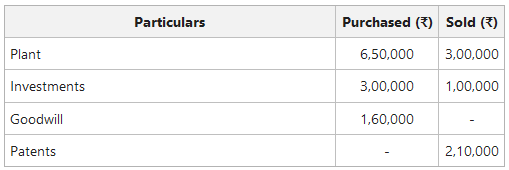
Additional Information:
1. Interest Received on debentures held as investment ₹5,000
2. Dividend paid on Equity Shares ₹30,000
3. Dividend received on Shares held as investment ₹40,000
4. Interest paid on debentures issued ₹12,000
5. The firm also purchased land out of the surplus funds for investment purposes and was let out for commercial use. Rent received for the same was ₹50,000
Solution:

Note: We will not record Interest Paid (₹12,000) and Dividend Paid (₹30,000) in Cash flow from Investing Activities. It will be recorded in Cash flow from Financing Activities.
Illustration 2:
Calculate Cash Flow from Investing Activities from the following information:

Additional Information:
1. During the year, a machine costing ₹50,000 with accumulated depreciation of 20,000 was sold for ₹40,000.
2. Patents written off were ₹30,000, and some patents were sold at a profit of ₹10,000.
Solution:

Working Note 1:
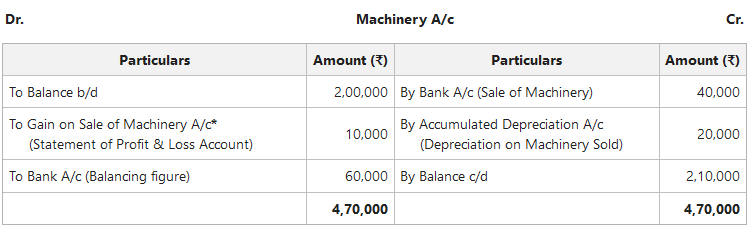
*Gain on Sale of Machinery = Sale Price - Book Value of Machinery
= ₹40,000 - ₹30,000 (₹50,000 - ₹20,000)
= ₹10,000
Working Note 2:
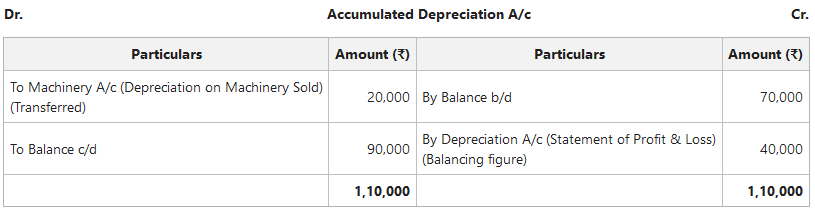
Working Note 3:
