

Cash Flow refers to the movement of cash and cash equivalents in a business, including both cash inflows and cash outflows. Cash inflows are transactions that increase cash and cash equivalents, whereas cash outflows are transactions that decrease them. A Cash Flow Statement is a financial statement that shows the inflow and outflow of cash and cash equivalents during a specific accounting period. It can be prepared with the help of two comparative balance sheets and other relevant financial information. The Cash Flow Statement classifies cash transactions into three categories: Operating Activities, Investing Activities, and Financing Activities. In India, the preparation of a Cash Flow Statement is governed by Accounting Standard (AS)–3 (Revised) issued by the Institute of Chartered Accountants of India. Further, under the Companies Act, 2013, the preparation of a Cash Flow Statement is mandatory for all companies except a One Person Company (OPC) as defined under Section 2(40) of the Act.
Cash Flow from Operating Activities:
These are the principal revenue-generating activities of a company. These activities relate to the normal day-to-day operations of the business and help in determining the net profit or net loss of the enterprise. In simple words, operating activities include all transactions that are directly connected with the main business operations and revenue-earning process of the organisation. Some of the cash flows arising from operating activities are as follows:
- Cash receipts from the sale of goods and rendering services.
- Cash receipts from fees, royalties, commissions, and other revenue.
- Cash payments to and on behalf of employees.
- Cash payments to suppliers for goods and services.
- Cash payments or refunds on income taxes unless they can be identified specifically with financing and investing activities.
- Cash receipts and cash payments of an insurance enterprise for premiums and claims, annuities, and other policy benefits.
- Cash receipt and payments that relates to future contracts, option contracts, forward contracts, and swap contracts when the contracts are held for dealing or trading purposes.
Illustration 1:
Calculate Cash Flow from Operating Activities from the following information:

Notes:
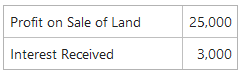
1. Other Income:
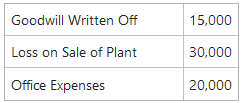
2. Other Expenses:
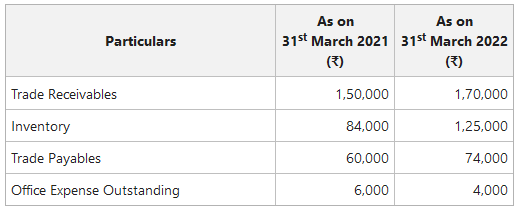
Additional Information:
Solution:
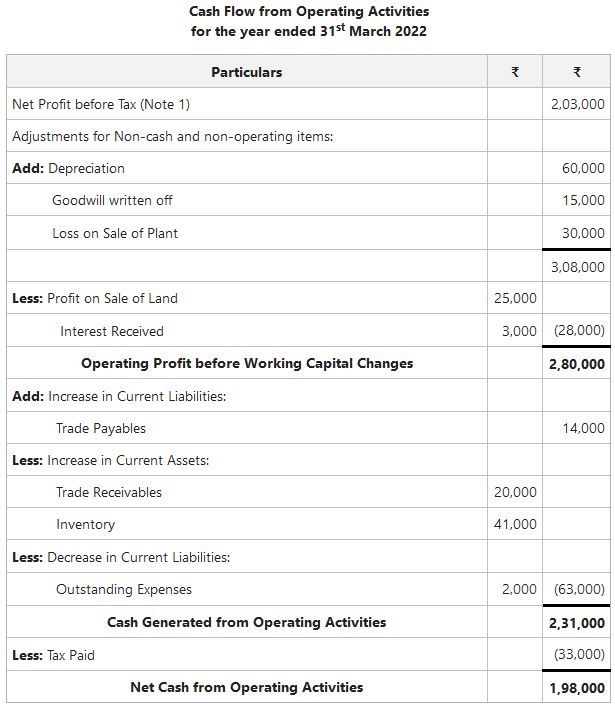
Note 1: Calculation of Net Profit before Tax:

Illustration 2:
The following is the Statement of Profit & Loss of Yuvraj Ltd. for the year ended March 31, 2021:

Additional Information:
i) Trade receivables decreased by ₹40,000 during the year.
ii) Prepaid expenses increased by ₹6,000 during the year.
iii) Trade payables decreased by ₹16,000 during the year.
iv) Outstanding expenses increased by ₹1,000 during the year.
v) Operating expenses included depreciation of ₹30,000
Compute Cash Flow from Operating Activities for the year ended March 31, 2021, by indirect method.
Solution:

Illustration 3:
Calculate the Cash Flow from Operating Activities from the Balance Sheet of Satyam Ltd.

Notes:

Additional Information:
1. Debentures were issued on March 31, 2021
2. Investments were made on March 31, 2021
Solution:

Note 1: Calculation of Net Profit before Tax:
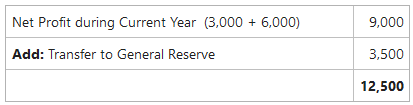
It should be noted that the negative balance of ₹6,000 of the Profit & Loss Statement appearing in the Balance Sheet on March 31, 2020, represents the loss amount. In the current year, Satyam Ltd. has made a profit of ₹3,000 after covering the loss of the previous year. Therefore, the net profit during the current year will be 3,000 + 6,000 = 9,000.