

Dynamic Programming (DP) is one of the most important topics in coding interviews because it helps solve optimization and counting problems efficiently. Interviewers often ask theoretical questions to evaluate whether candidates understand the core principles of DP, state design, and optimization techniques.
- Covers the most commonly asked theoretical Dynamic Programming interview questions.
- Explains core DP concepts with practical examples and interview-oriented answers.
Theoretical Interiew Question
1. What is Dynamic Programming?
Dynamic Programming (DP) is an algorithmic technique used to solve problems by breaking them into overlapping subproblems, solving each subproblem once, and storing the results for reuse.
- Solves each subproblem only once.
- Stores intermediate results to avoid recomputation.
- Improves efficiency compared to naive recursion.
- Commonly used for optimization and counting problems.
2. When should Dynamic Programming be used?
Dynamic Programming should be used when a problem satisfies both of the following properties:
- Overlapping Subproblems: The same subproblems are solved multiple times.
- Optimal Substructure: The optimal solution can be built from optimal solutions of smaller subproblems.
3. What are overlapping subproblems?
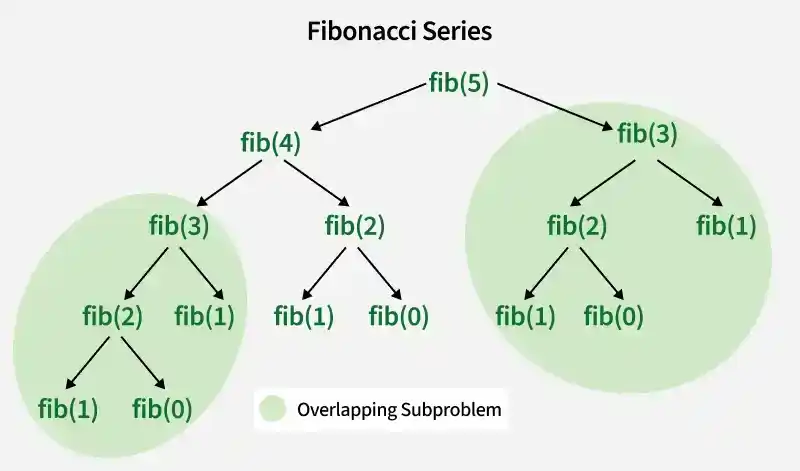
Overlapping subproblems are smaller problems that are solved repeatedly while solving a larger problem. Dynamic Programming stores their results to avoid repeated computations.
- The same subproblems appear multiple times.
- Previously computed results can be reused.
- Eliminates redundant recursive calls.
- Improves the overall execution time.
Example: In the recursive Fibonacci algorithm, fib(3) is computed repeatedly. DP stores the result after the first computation and reuses it.
4. What is optimal substructure?
Optimal substructure is a property where the optimal solution to a problem can be constructed from the optimal solutions of its smaller subproblems.
- The problem can be divided into smaller subproblems.
- Each subproblem has an optimal solution.
- Combining these solutions gives the overall optimum.
- It is a key requirement for applying Dynamic Programming.
Example: In the shortest path problem, the shortest path from A to C passes through the shortest path from A to B.
5. What is the difference between Dynamic Programming and Divide and Conquer?
Dynamic Programming solves overlapping subproblems and stores their results for reuse, whereas Divide and Conquer solves independent subproblems and combines their solutions. These are the key differences.
| Dynamic Programming | Divide and Conquer |
|---|---|
| Solves overlapping subproblems. | Solves independent subproblems. |
| Stores intermediate results for reuse. | Does not store previously computed results. |
| Avoids repeated computations. | May recompute similar work in recursive calls. |
| Examples: Fibonacci, Knapsack. | Examples: Merge Sort, Quick Sort. |
6. What are Memoization and Tabulation?
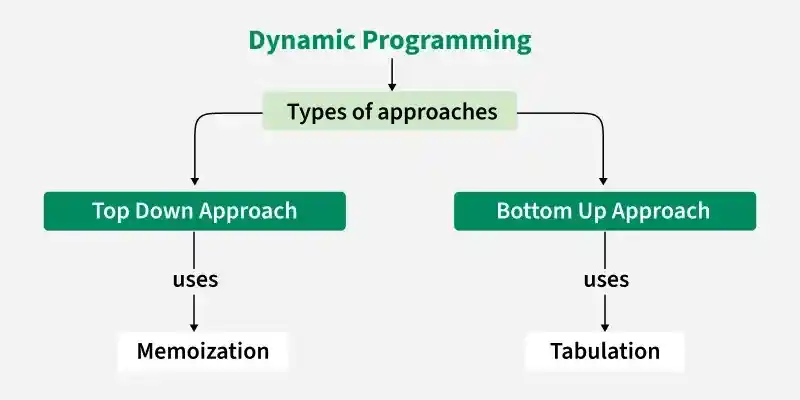
Dynamic Programming can be implemented in two ways:
- Memoization (Top-Down): Uses recursion and stores previously computed results.
- Tabulation (Bottom-Up): Solves smaller subproblems iteratively and builds the final answer.
7. What are the advantages of Memoization?
Memoization improves the performance of recursive algorithms by storing previously computed results and reusing them whenever the same subproblem occurs again.
- Eliminates repeated computations.
- Significantly reduces execution time.
- Easy to implement with recursive solutions.
- Efficient for problems with overlapping subproblems.
8. What are the advantages of Tabulation?
Tabulation solves problems iteratively by filling a table from the base cases upward, avoiding the overhead of recursive calls.
- Avoids recursion and stack overflow.
- Computes each subproblem only once.
- Often provides better runtime performance.
- Easy to optimize for space in many problems.
9. What is a DP state?
A DP state is a variable or set of variables that uniquely represents a subproblem in Dynamic Programming. Each state stores the result needed to solve larger problems.
- Represents a unique subproblem.
- Stores the computed result for that state.
- Helps avoid solving the same subproblem repeatedly.
- Defines the structure of the DP solution.
Example: In Fibonacci, the state is the current index n. In Longest Common Subsequence (LCS), the state is represented by two indices (i, j).
10. What is a DP transition?
A DP transition is the rule or formula used to compute the value of the current DP state from one or more previously solved states.
- Defines how one state depends on others.
- Combines results of smaller subproblems.
- Determines the recurrence relation of the solution.
- Used to fill the DP table or memoization cache.
Example: For Fibonacci:
dp[i]=dp[i−1]+dp[i−2]
11. How do you determine the dimensions of a DP table?
The dimensions of a DP table are determined by the number of variables required to uniquely define a DP state. Each state variable typically corresponds to one dimension.
- One state variable -> 1D DP table.
- Two state variables -> 2D DP table.
- More state variables -> Multi-dimensional DP table.
12. What is the difference between 1D DP and 2D DP?
The difference between 1D DP and 2D DP depends on the number of variables required to represent a DP state.
| 1D DP | 2D DP |
|---|---|
| Uses a one-dimensional array. | Uses a two-dimensional table. |
| State depends on one variable. | State depends on two variables. |
| Requires less memory. | Requires more memory. |
| Example: Fibonacci, Climbing Stairs. | Example: Longest Common Subsequence, 0/1 Knapsack. |
13. What is Space Optimization in Dynamic Programming?
Space Optimization is a technique used to reduce the memory required by a Dynamic Programming solution by storing only the states that are needed at the current step.
- Eliminates storage of unnecessary DP states.
- Reuses previously computed values whenever possible.
- Reduces space complexity without changing the result.
- Commonly converts O(n) or O(n²) space into O(1) or O(n).
14. Can every recursive problem be converted into Dynamic Programming?
No. A recursive problem can be converted into Dynamic Programming only if it has overlapping subproblems and optimal substructure.
- Requires overlapping subproblems.
- Must satisfy the optimal substructure property.
- Problems without repeated subproblems gain little benefit.
- Some recursive problems are better solved using simple recursion or Divide and Conquer.
15. Why is Dynamic Programming usually faster than plain recursion?
Dynamic Programming is usually faster than plain recursion because it stores the results of solved subproblems and reuses them instead of solving the same subproblems repeatedly.
- Avoids repeated recursive computations.
- Solves each subproblem only once.
- Reduces the overall time complexity.
- Improves performance for large inputs.
16. What are some common Dynamic Programming problem patterns?
Dynamic Programming problems often follow recurring patterns where the solution is built from smaller subproblems.
- Fibonacci and linear sequence problems.
- Knapsack and subset-related problems.
- Longest Common Subsequence (LCS) and string matching.
- Grid, path counting, and interval DP problems.
17. What is the difference between Greedy Algorithms and Dynamic Programming?
Greedy Algorithms make the best local choice at each step, whereas Dynamic Programming evaluates multiple possibilities and combines optimal solutions of subproblems to obtain the global optimum. These are the key diference.
| Greedy Algorithm | Dynamic Programming |
|---|---|
| Makes locally optimal choices. | Computes the globally optimal solution. |
| Does not reconsider previous decisions. | Stores and reuses intermediate results. |
| Faster for suitable problems. | Solves a wider range of optimization problems. |
| Example: Huffman Coding, Kruskal's Algorithm. | Example: 0/1 Knapsack, Longest Common Subsequence. |
18. What are the limitations of Dynamic Programming?
Dynamic Programming is not suitable for every problem and may require significant memory and careful state design.
- Applicable only to problems with optimal substructure and overlapping subproblems.
- Can consume large amounts of memory for complex states.
- Designing DP states and transitions can be difficult.
- May be slower than Greedy Algorithms for suitable problems.
19. How do you identify that a problem can be solved using Dynamic Programming?
A problem is a good candidate for Dynamic Programming if it can be divided into overlapping subproblems whose optimal solutions can be combined to solve the original problem.
- The problem has overlapping subproblems.
- It satisfies the optimal substructure property.
- Recursive solutions repeat the same computations.
- Storing intermediate results can improve efficiency.
20. Why is identifying the DP state important?
Identifying the DP state is important because it defines how each subproblem is represented and determines the correctness and efficiency of the Dynamic Programming solution.
- Determines the structure of the DP table.
- Helps define valid state transitions.
- Avoids storing unnecessary information.
- Directly affects the time and space complexity.
Coding Problems on Dynamic Programming
Easy Problems
- Nth Catalan Number
- Minimum Operations
- Minimum steps to delete using palindrome substrings
- Minimum number of Coins
- Maximum Product Cutting
- Ways to Cover a Distance
- Minimum number of deletions and insertions to transform
- Minimum sum subsequence with one of every four
Medium Problems
- Subset Sum Problem
- Longest Common Subsequence
- Longest Increasing Subsequence
- Edit Distance
- Longest Path In Matrix
- Optimal Strategy for a Game
- 0-1 Knapsack Problem
- Shortest Common Supersequence
- Partition problem
- Rod Cutting
- Coin change problem
- Word Break Problem
- Dice Throw Problem
- Box Stacking
- Egg Dropping Puzzle
- Max length chain
- Longest Common Substring
- Interleaved strings
- Maximum sum increasing subsequence
- Minimum number of jumps
- Count subsequences of type a^i, b^j, c^k
- Get Minimum Squares
- Nth Fibonacci Number
- Longest Palindromic Substring
- Total Decoding Messages
- Unique BST’s
- Player with max score
- Form a palindrome
- Word Wrap Problem
- Count Palindromic Subsequences
- Minimum time to finish tasks without skipping two consecutive