Benzene is an important aromatic hydrocarbon with the molecular formula C6H6. Despite having a high degree of unsaturation, benzene shows unusual stability and does not undergo addition reactions easily like alkenes.
- It is a colorless liquid widely used as a starting material in the preparation of many organic compounds such as dyes, drugs, and plastics.
- Its unique behavior of benzene is due to the presence of delocalized π electrons in its ring structure.
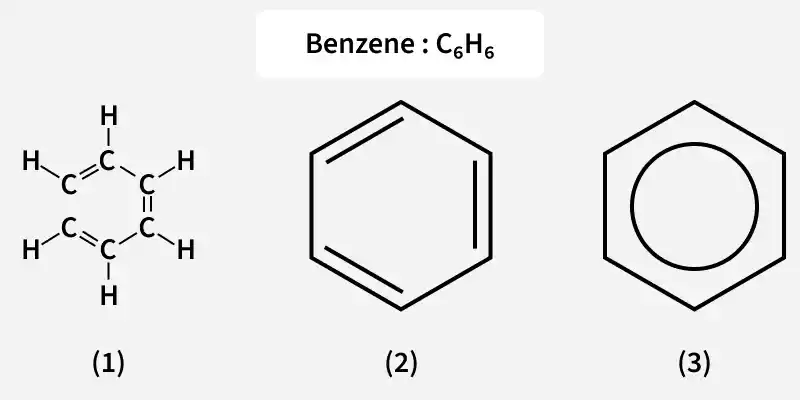
Structure of Benzene
Benzene has a cyclic hexagonal ring of six carbon atoms. Each carbon atom is sp² hybridized. Every carbon is bonded to two neighboring carbon atoms and one hydrogen atom.
- The molecule is planar with bond angles of about 120°.
- Each carbon has one unhybridized p-orbital, which overlaps with adjacent p-orbitals to form a π-electron cloud above and below the ring.
- This delocalization leads to the special properties of benzene.
Characteristics of Benzene
From its unique structure, benzene shows some special characteristic features:
- All the carbon–carbon bond lengths are equal (about 1.39 Å). This length is intermediate between a single bond (1.54 Å) and a double bond (1.34 Å), showing that all bonds in benzene are identical.
- Benzene is highly stable compared to other unsaturated hydrocarbons.
- Although benzene contains double bonds, it does not readily undergo addition reactions like alkenes.
- Instead, benzene mainly undergoes electrophilic substitution reactions, in which one hydrogen atom is replaced while the ring remains intact.
- Benzene is a planar and symmetrical molecule, which contributes to its uniform properties.
Resonance of Benzene
Benzene cannot be represented by a single fixed structure. Instead, it is described as a resonance hybrid of different contributing structures.
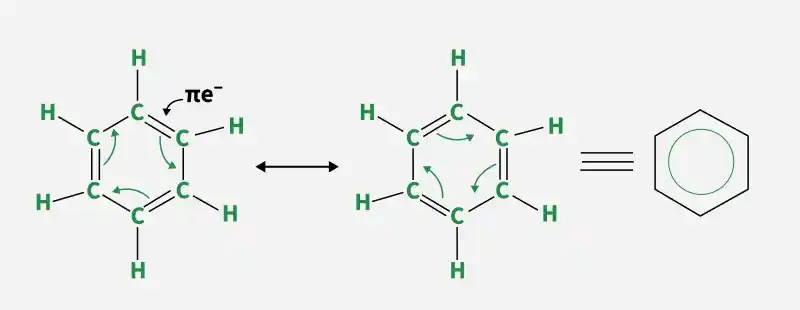
- The most common representations are the two Kekulé structures, in which the positions of double bonds alternate in the ring.
- These structures differ only in the arrangement of π electrons, not in the positions of atoms.
- The actual structure of benzene is a hybrid of these resonance forms, meaning that the electrons are not fixed between specific carbon atoms.
- The π electrons are delocalized over all six carbon atoms, forming a continuous electron cloud above and below the ring.
- Because of this delocalization, all C–C bonds become equal in length.
- Benzene gains extra stability, called resonance stabilization.
Aromaticity in Benzene
Benzene shows a special property called aromaticity, which is responsible for its unusual stability. A compound is said to be aromatic if it is cyclic, planar, and has a conjugated system of π electrons. Benzene satisfies all these conditions.
- Benzene contains 6 π electrons, which follow Hückel’s rule (4n + 2 π electrons), where n = 1.
- Due to this, the π electrons are delocalized over the entire ring, which gives extra stability to the molecule.
- This aromatic character is the reason why benzene prefers substitution reactions rather than addition reactions.
Properties of Benzene
Benzene shows characteristic physical and chemical properties due to its aromatic nature and stable ring structure.
1. Physical Properties
- It is a colorless liquid with a characteristic aromatic smell.
- It is insoluble in water but soluble in organic solvents like ether and alcohol.
- It is lighter than water.
- It is volatile and highly inflammable.
- Benzene is toxic, and prolonged exposure is harmful.
2. Chemical Properties
Due to its aromatic stability, benzene mainly undergoes electrophilic substitution reactions, in which a hydrogen atom is replaced while the ring remains intact.
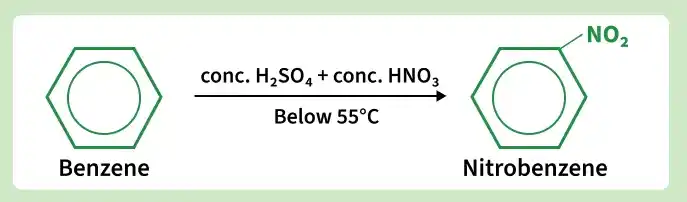
a) Nitration: Benzene reacts with concentrated nitric acid in the presence of concentrated sulfuric acid. Nitrobenzene is formed.
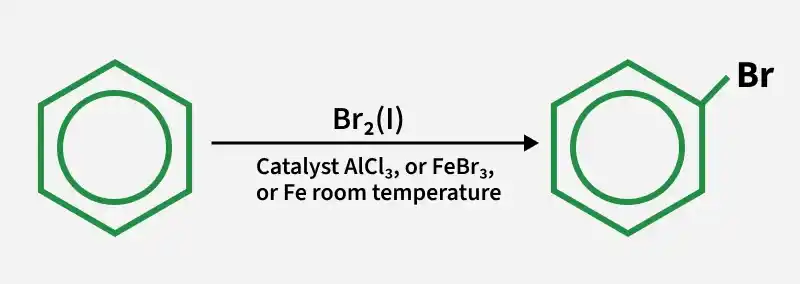
b) Halogenation: Benzene reacts with chlorine or bromine in the presence of a Lewis acid catalyst. Chlorobenzene is formed.
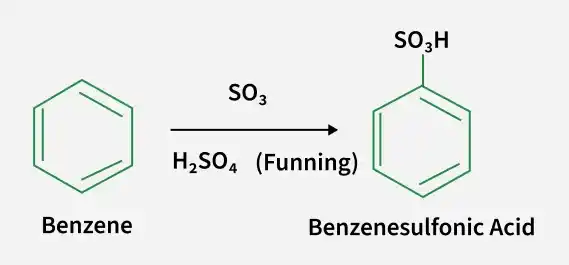
c) Sulfonation: Benzene reacts with fuming sulfuric acid. Benzene sulphonic acid is formed. This reaction is reversible.
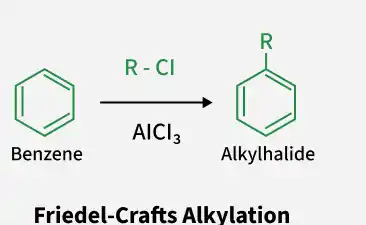
d) Friedel–Crafts Alkylation: Benzene reacts with alkyl halide in the presence of anhydrous AlCl₃.. Alkylbenzene is formed.
C6H6 + RCl → C6H5R + HCl (AlCl3)
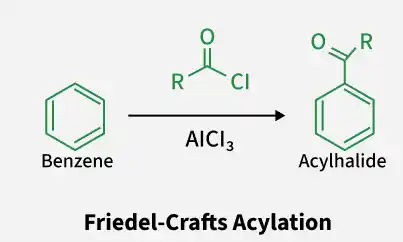
e) Friedel–Crafts Acylation: Benzene reacts with acyl chloride in the presence of AlCl₃.. Acyl benzene (ketone) is formed.
C6H6 + RCOCl → C6H5COR + HCl (AlCl3)