Electrophilic reactions are organic reactions in which an electrophile attacks an electron-rich species and accepts a pair of electrons to form a new covalent bond.
- These reactions occur mainly in compounds having high electron density, such as alkenes, alkynes, and aromatic compounds.
- Depending on the nature of the compound and reaction conditions, electrophilic reactions may proceed through addition or substitution mechanisms.
Types of Electrophilic Reactions
Electrophilic reactions are broadly classified into the following types:
1. Electrophilic Addition Reaction
Electrophilic addition reactions are those in which an electrophile adds across a double or triple bond of an unsaturated compound (like alkenes or alkynes).
- Alkenes have π (pi) electrons, which are electron-rich.
- These π electrons attract electrophiles.
- The double bond breaks, and new single bonds are formed.
Mechanism:
Electrophilic addition reactions generally follow three main steps:
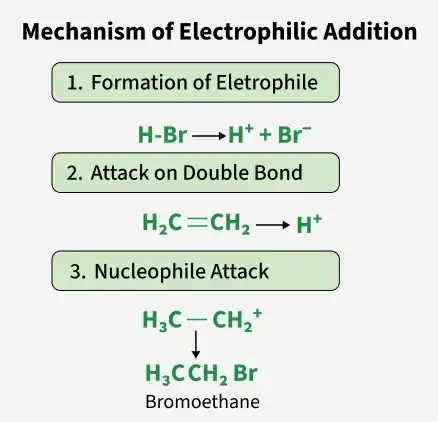
Step 1: Formation of Electrophile
- HBr → H⁺ + Br⁻
- H⁺ acts as the electrophile
Step 2: Attack on Double Bond
- The π electrons of ethene attack H⁺
- A carbocation (CH3–CH2⁺) is formed
Step 3: Nucleophilic Attack
- Br ⁻ attacks the carbocation
- Carbocation is unstable intermediate
- Product formed: Bromoethane (CH3–CH2Br)
2. Electrophilic Substitution Reaction
Electrophilic substitution reactions are those reactions in which an electrophile replaces a hydrogen atom of an aromatic compound such as benzene. Benzene contains delocalised π electrons, making it electron-rich.
- Instead of addition, benzene undergoes substitution to retain its aromatic stability.
- Thus, one hydrogen atom is substituted while the benzene ring remains intact.
Mechanism:
Electrophilic substitution reactions generally follow three main steps:
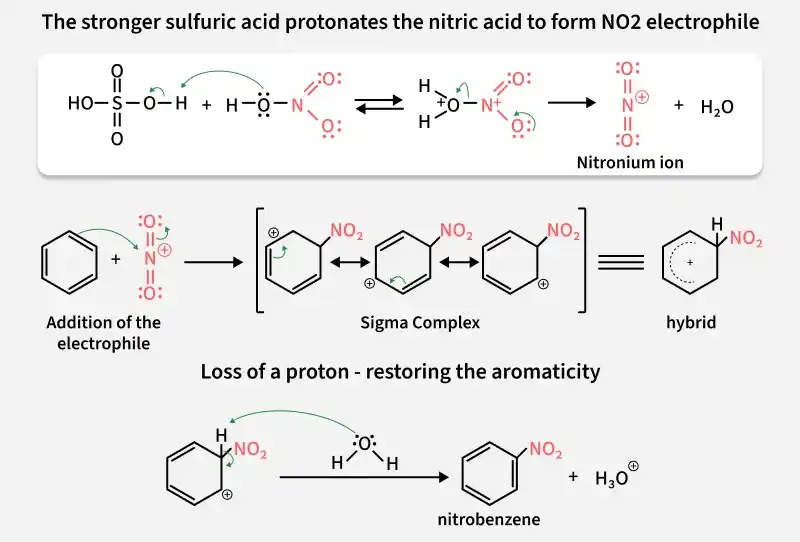
Step 1: Formation of Electrophile
- The electrophile is generated from reagents.
- Usually requires a strong acid or catalyst.
Example:
HNO3 + H2SO4 → NO2⁺ (electrophile)
Step 2: Attack on Benzene (σ-complex formation)
- The π electrons of benzene attack the electrophile.
- This forms an unstable intermediate called σ-complex (arenium ion).
- Aromaticity is temporarily lost in this step.
Step 3: Deprotonation (Restoration of Aromaticity)
- A proton (H⁺) is removed from the σ-complex.
- The benzene ring regains its aromatic stability.
- Final substituted product is formed.
Types of Electrophilic Substitution Reactions
Electrophilic substitution reactions in benzene mainly include:
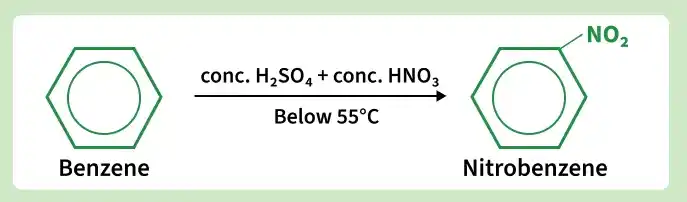
a) Nitration
- Introduction of –NO2 group into benzene.
- Electrophile: NO2⁺ (nitronium ion)
Example:
- Benzene reacts with conc. HNO₃ in presence of conc. H₂SO₄
- Product: Nitrobenzene
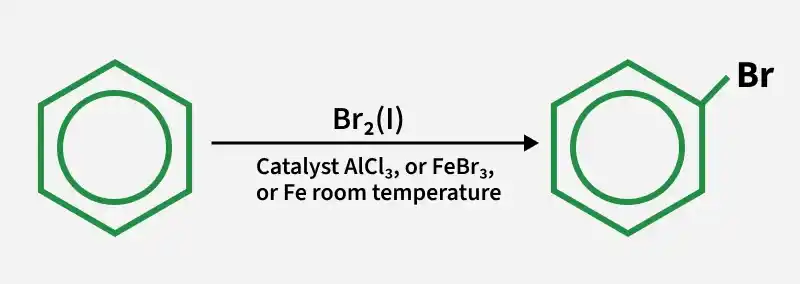
b) Halogenation
- Introduction of Cl or Br atom into benzene.
- Electrophile: Cl⁺ or Br⁺ (formed using FeCl3/FeBr3)
Example:
- Benzene reacts with Cl2/Br2 in presence of FeCl3/FeBr3
- Product: Chlorobenzene/Bromobenzene
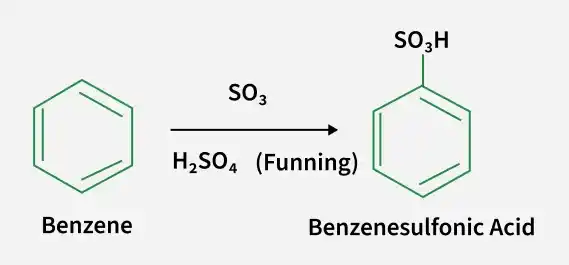
c) Sulphonation
- Introduction of –SO3H group into benzene.
- Electrophile: SO3 (or protonated form)
Example:
- Benzene reacts with fuming H₂SO₄ (oleum) at high temperature
- Product: Benzenesulphonic acid