

Plant growth is a continuous and irreversible biological process that increases the size, length, volume, and dry weight of a plant. It occurs through cell division, cell enlargement, and cell differentiation in actively growing meristematic regions of the plant body. During growth, newly formed cells pass through different phases that help them mature and become specialised for performing specific functions.
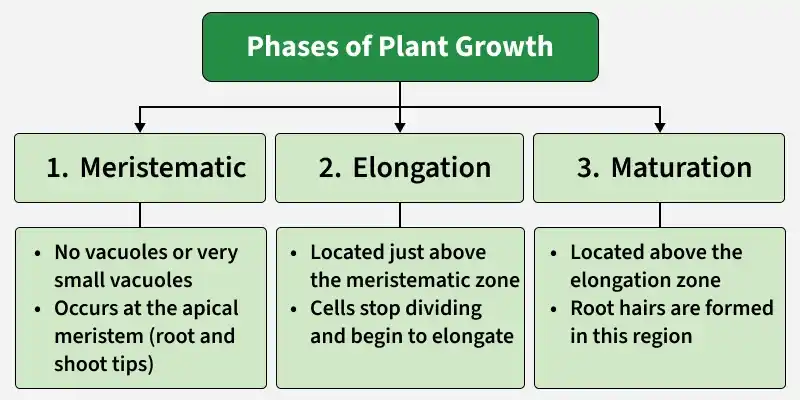
These phases occur sequentially and together ensure proper growth, differentiation, and development of plants. Plant growth occurs in three major phases:
1. Meristematic Phase
The meristematic phase is the first and most important phase of plant growth. It occurs in the regions of active cell division known as meristems. These meristematic regions are located mainly at the apices of roots and shoots and are therefore called apical meristems.
- During this phase, cells divide continuously through mitosis, producing a large number of new cells responsible for plant growth.
- The cells present in the meristematic phase possess several characteristic features that enable them to divide rapidly.
- These cells are small, compactly arranged, and isodiametric in shape.
- They have thin primary cell walls made mainly of cellulose and contain dense cytoplasm with prominent nuclei.
- Vacuoles are either absent or very small because the cells are actively dividing and metabolically very active.
- The rate of respiration in meristematic cells is extremely high because a large amount of energy is required for continuous cell division and synthesis of cellular materials.
- The cells remain immature and unspecialized during this phase. As the cells divide repeatedly, the number of cells in the plant body increases rapidly, contributing to plant growth.
2. Elongation Phase
The elongation phase occurs immediately behind the meristematic region. The newly formed cells produced during the meristematic phase enter this region and begin to increase rapidly in size. This phase is characterised mainly by cell enlargement and a rapid increase in cell length.
- Cell enlargement occurs due to the absorption of water into the vacuoles, which increases the turgor pressure inside the cells.
- As the vacuoles enlarge, the cells become elongated and increase significantly in size. Simultaneously, the cell walls become elastic and extensible due to the deposition of new cell wall materials such as cellulose, hemicellulose, and pectin.
- The process of elongation also involves active synthesis of protoplasm, proteins, carbohydrates, lipids, and other cellular components necessary for growth.
- Plant hormones, especially auxins, play a major role in stimulating cell elongation by increasing cell wall plasticity.
- The elongation phase contributes greatly to the increase in the length of roots and shoots. This phase allows roots to penetrate deeper into the soil and enables shoots to grow upward toward light.
3. Maturation Phase
The maturation phase is the final phase of plant growth. In this phase, the elongated cells attain their maximum size and become fully mature. The cells gradually lose their ability to divide and undergo differentiation, becoming specialised in structure and function.
- Differentiation is the process by which unspecialized cells develop into permanent tissues capable of performing specific functions.
- During maturation, cells undergo several structural and biochemical changes. The cell walls may become thicker, lignified, or modified according to the function of the tissue.
- Large vacuoles develop, and the cells acquire their final shape and organisation.
The mature cells differentiate into various permanent tissues, such as:
- Xylem for water conduction
- Phloem for food transport
- Parenchyma for storage
- Collenchyma for flexibility and support
- Sclerenchyma for mechanical strength
The maturation phase, therefore, leads to the formation of organised tissues and organs necessary for the proper functioning of the plant body.
Factors Influencing the Phases of Plant Growth
Several internal and external factors regulate the phases of plant growth.
- Light: Light influences photosynthesis, chlorophyll formation, and growth direction.
- Temperature: Temperature affects enzyme activity and metabolic processes.
- Water: Water is necessary for cell enlargement, transport, and metabolic reactions.
- Oxygen: Oxygen is essential for respiration and energy production.
- Mineral Nutrients: Minerals are required for the synthesis of proteins, nucleic acids, and chlorophyll.
- Plant Hormones: Plant growth regulators such as auxins, gibberellins, cytokinins, ethylene, and abscisic acid regulate cell division, elongation, and differentiation.