

Plant growth and development involve important processes such as differentiation, dedifferentiation, and redifferentiation, which help plants form specialised tissues and organs. Under certain conditions, mature cells can regain the ability to divide and later become specialised again. These processes are essential for plant growth, secondary growth, wound healing, tissue repair, and regeneration.
Differentiation
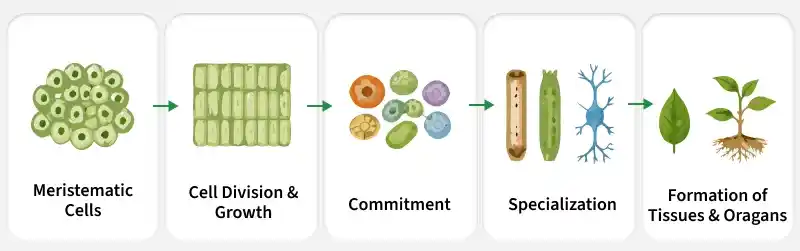
- Differentiation is the process by which unspecialized meristematic cells become structurally and functionally specialised to perform specific functions.
- During differentiation, cells change shape, size, structure, and chemical composition. As a result, various types of permanent tissues, including xylem, phloem, parenchyma, collenchyma, and sclerenchyma, are formed.
- In the process of differentiation, cells lose their ability to divide and attain maturity. The differentiated cells develop special characteristics according to the functions they perform.
- For example, xylem cells develop thick lignified walls for water conduction and mechanical support, while phloem cells become specialised for the transport of food materials.
- Differentiation mainly occurs during the maturation phase of plant growth. The cells formed in the meristematic region enlarge and finally become specialised into permanent tissues.
- Differentiation is important because it enables division of labour in plants. Different tissues perform different specialised functions efficiently, helping the plant body function in a coordinated manner.
- Differentiation also contributes to the formation of complex plant organs such as roots, stems, leaves, flowers, and fruits.
Dedifferentiation
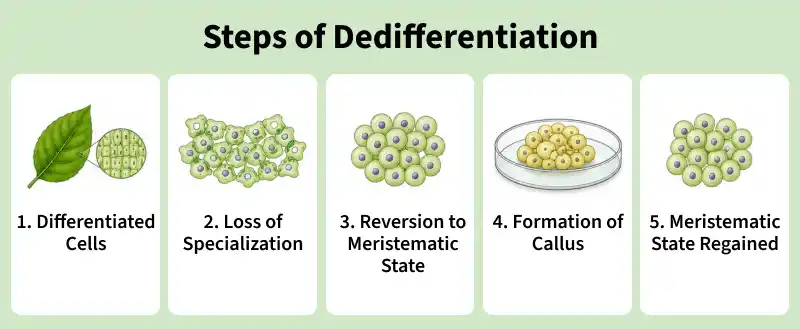
- Dedifferentiation is the process by which mature and differentiated permanent cells regain the ability to divide under certain special conditions.
- In this process, specialised cells lose their mature characteristics and become meristematic again. These dedifferentiated cells can actively divide and produce new cells.
- Dedifferentiation usually occurs during secondary growth, wound healing, and regeneration in plants.
- Certain living permanent tissues, such as parenchyma cells, can regain the power of division and form secondary meristems.
- These newly formed meristematic tissues then participate in further growth and repair processes.
- A common example of dedifferentiation is the formation of vascular cambium and cork cambium during secondary growth. Mature parenchyma cells become meristematic and start dividing actively.
- Dedifferentiation is important because it allows plants to repair damaged tissues, regenerate lost parts, and continue secondary growth.
- It provides plants with remarkable regenerative ability and helps them survive environmental injuries and mechanical damage.
Redifferentiation
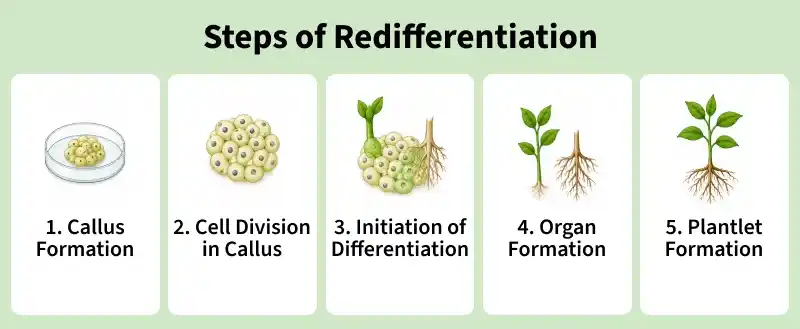
- Redifferentiation is the process by which dedifferentiated cells again become specialised and mature after division.
- In this process, the newly formed cells produced by dedifferentiated meristematic tissues lose the ability to divide and become permanent tissues with specific functions.
- Thus, redifferentiation is the conversion of dedifferentiated cells into mature, specialised cells.
- After wound healing or secondary growth, the newly formed cells differentiate into tissues such as xylem, phloem, cork, or sclerenchyma according to the needs of the plant.
- Redifferentiation helps restore normal structure and function in plant tissues after regeneration and repair.
- Redifferentiation is important because it restores functional tissues and maintains proper organisation in the plant body. It helps plants develop mature tissues necessary for transport, protection, support, and storage.
Relationship Between Differentiation, Dedifferentiation, and Redifferentiation
These three processes are closely related and occur sequentially during plant growth and development.
- In differentiation, meristematic cells become specialised permanent cells.
- In dedifferentiation, mature permanent cells regain the ability to divide.
- In redifferentiation, dedifferentiated cells again become mature and specialised.
Together, these processes help plants grow continuously, repair damaged tissues, regenerate organs, and adapt to changing environmental conditions.