

Mutualism is an important ecological interaction in which two different species live in close association and support each other in various ways. In this relationship, each organism provides something of value to the other, making it advantageous for both. Plays a crucial role in maintaining ecological balance, supporting survival, and driving evolutionary changes over time.
It can be classified into different types based on their dependency and the nature of the benefits exchanged.
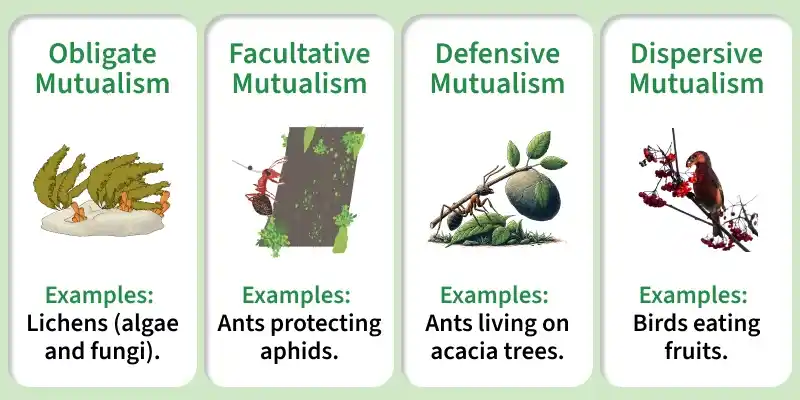
- Obligate Mutualism: In obligate mutualism, both species depend entirely on each other for survival. Neither can survive without the other. Example: Lichens (algae and fungi).
- Facultative Mutualism: In facultative mutualism, the relationship is beneficial but not essential for survival. Organisms can live independently but gain advantages when they interact. Example: Ants protecting aphids in exchange for honeydew.
- Defensive Mutualism: In this type, one species protects the other in return for food or shelter. Example: Ants living on acacia trees protect the plant from herbivores, while the plant provides food and shelter.
- Dispersive (Transport) Mutualism: One species helps in the movement or dispersal of another species' reproductive materials, such as pollen or seeds. Example: Birds eating fruits and dispersing seeds through their droppings; bees transferring pollen between flowers.
Characteristics
- Both organisms involved gain advantages such as food, protection, shelter, or reproduction.
- The two species depend on each other to some extent. In some cases (obligate mutualism), they cannot survive without one another.
- Unlike parasitism or predation, mutualism does not harm either organism.
- Many mutualistic relationships are highly specific, meaning certain species interact only with particular partners.
- Can Be Obligatory (both species must depend on each other) or Facultative (both benefit but can live independently)
- Organisms may exchange nutrients, protection, pollination, or other services.
- Mutualism increases the chances of survival, growth, and reproduction of both species.
- Found in many ecosystems such as forests, grasslands, and aquatic environments.
Examples
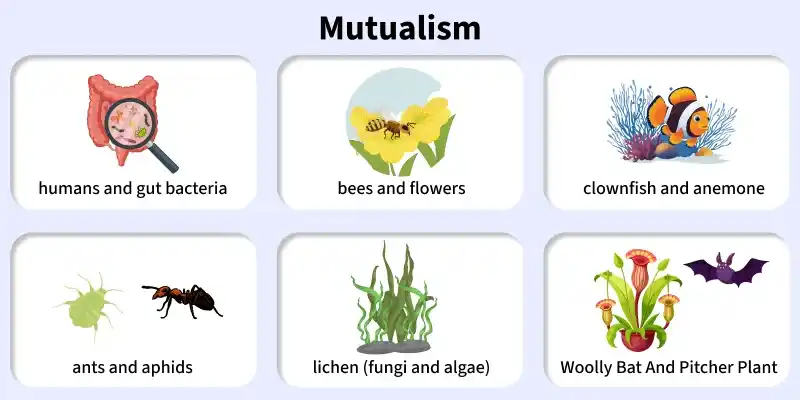
- Pollination: A classic example of mutualism is the relationship between flowering plants and pollinators such as bees, butterflies, and birds. Plants provide nectar and pollen as food, while pollinators transfer pollen from one flower to another, helping in fertilisation and reproduction.
- Mycorrhiza: This is a mutualistic association between fungi and plant roots. The fungi enhance water and nutrient absorption (especially phosphorus) for the plant, while the plant supplies carbohydrates to the fungi.
- Nitrogen Fixation: Certain bacteria (such as Rhizobium) live in the root nodules of leguminous plants. These bacteria convert atmospheric nitrogen into usable forms for plants, while the plant provides food and shelter to the bacteria.
- Lichens: Lichens are formed by a partnership between algae and fungi. The algae perform photosynthesis and produce food, while the fungus provides protection and absorbs water and minerals.
- Cleaner Fish: Cleaner fish remove parasites from larger fish. The cleaner fish get food, and the larger fish remain healthy.
Importance of Mutualism
- Enhances the survival and growth of species
- Helps in reproduction (e.g., pollination, seed dispersal)
- Improves nutrient availability (e.g., nitrogen fixation)
- Maintains ecological balance
- Drives co-evolution between species