

Issuing of Shares and Debentures are two of the most prominent source of finance for any business. By issuing shares and debentures, any public company can generate finance from the market. Finance required by the business to establish and run its operations is known as Business Finance. No business can function without an adequate amount of funds for undertaking various activities. To be able to produce goods or provide services, any business needs money.
Share
A share is the smallest unit into which the share capital of a company is divided and represents a proportionate ownership interest in the company. It grants the holder certain rights, such as voting rights and a share in the company's profits. According to Section 2(84) of the Companies Act, 2013, a share represents the interest of a member in a company. For example, if a company has a capital of ₹20,00,000 divided into 2,00,000 units of ₹10 each, each unit of ₹10 is called a share. Shares indicate the claim of shareholders on the company's equity and are issued to raise funds conveniently from a large number of investors. They are movable and transferable property that can be bought and sold easily. In the case of public companies, shares are freely traded on stock exchanges and are recognized as goods under the Sales of Goods Act, 1930. The value of shares fluctuates based on various factors such as the company's performance, market conditions, investor sentiment, and overall economic trends.
Shares are broadly classified into the following two categories:
- Equity Shares – These are ordinary shares that carry voting rights and entitle shareholders to receive dividends based on the company's profitability. Equity shareholders are the actual owners of the company and bear the highest risk as well as the potential for higher returns.
- Preference Shares – These shares provide shareholders with a preferential right to receive dividends at a fixed rate and repayment of capital before equity shareholders in the event of liquidation. However, preference shareholders generally have limited or no voting rights.
Debenture
A debenture is a long-term debt instrument issued by a company to raise funds from the public or investors and represents a form of debt capital. Unlike shares, debentures do not confer ownership rights but create a creditor-debtor relationship between the investor and the company. Debentures carry a fixed rate of interest, known as the coupon rate, which is payable at specified intervals irrespective of whether the company earns a profit or incurs a loss. They serve as an important source of finance for companies that wish to raise capital without diluting ownership or where obtaining secured bank loans may be difficult. A debenture is generally issued in the form of a certificate under the common seal of the company, specifying the principal amount invested, the rate and terms of interest payment, and the repayment schedule. According to Section 2(30) of the Companies Act, 2013, “Debenture includes debenture stock, bonds or any other securities of a company, whether constituting a charge on the assets of the company or not.” The Companies Act further provides that companies generally cannot issue debentures with a maturity period exceeding 10 years from the date of issue, although infrastructure companies are permitted to issue debentures with a maturity period of up to 30 years
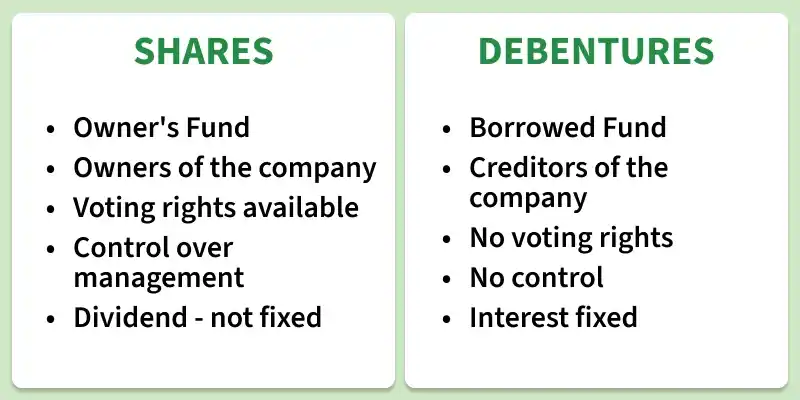
Difference between Share and Debenture
Basis | Shares | Debentures |
|---|---|---|
Meaning | A share is a unit(a part) of the capital of the company. | A debenture is a debt instrument issued to raise a borrowed fund. |
Nature | A share form an Equity capital. | A debenture form a debt capital. |
Holder | A holder of a share is known as a shareholder. | A holder of a debenture is known as a debenture holder. |
Return | A shareholder earns a dividend in return for their investment. | A debenture yields a fixed rate of interest(coupon rate) at a specified date. |
Dividend and Interest Payment | A dividend is paid only when there is a profit. | An interest on debenture is paid irrespective of whether the company is making a profit or incurring a loss. |
Voting Rights | A shareholder enjoys the right to vote at the company's meeting. | A debenture holder has no right to participate or cast a vote at the company's meeting. |
Redemption | A company, at its option, can buy back its own shares. | A debenture shall be redeemed at a fixed maturity date. |
Conversion | A share cannot be converted into debenture. | A debenture can be converted into shares as per the term of the issue. |
Priority of Repayment | At the time of winding up, payment to shareholders is made after the repayment to a debenture holder. | At the time of winding up, payment to the debenture holder is made before the payment to the shareholders. |
Issue at Discount | Section 53 of the Companies Act restricts the issue of shares at discount, except for the sweat equity shares. | A debenture can be issued at discount without any restrictions. |
Degree of Risk | High degree of risk is borne by the equity shareholders. | Debentures are the debt for the companies, hence debenture holders bear little risk. |