

A debenture is a written instrument or document issued by a company to acknowledge money borrowed from the public or other lenders. It contains the terms and conditions regarding the repayment of the principal amount and the payment of interest at a specified rate. According to Section 2(30) of the Companies Act, 2013, a debenture includes debenture stock, bonds, and any other instrument of a company that evidences a debt, whether secured by a charge on the company's assets or not. According to Topham, a debenture is a document given by a company as evidence of a debt to the holder, usually arising from a loan and commonly secured by a charge. The person who purchases or holds the debentures is known as a debenture holder.
Characteristics of Debenture:
- A debenture is a certificate or written document, which is an acknowledgement of debt taken by a company.
- It is borrowing of a company.
- It is issued under the seal of a company.
- Interests on Debentures is a charge against profit.
- It contains a contract for the repayment of the principal sum at a specified date.
- The funds raised by the issue of debentures are for a long period of time, such as 7 years, 10 years, or 12 years, and the loan raised by the issue of debentures is also called 'Loan Capital'.
Issue of Debentures:
A listed company can issue debentures to the public through public subscription, whereas an unlisted company cannot offer debentures to the general public. However, both listed and unlisted companies can issue debentures through private placement. The accounting procedures and journal entries for the issue of debentures are similar to those followed for the issue of shares. Debentures may be issued for cash, for consideration other than cash (such as purchase of assets or business), or as collateral security for a loan. They can also be issued at par, premium, or discount, regardless of whether they are issued for cash or for consideration other than cash.
Accounting Treatment of Issue of Debenture:
The journal entries passed for issuing debentures are the same as in the case of shares. Only 'Debenture A/c' is used in place of 'Share Capital A/c'. The rate of interest is usually pre-fixed with Debenture A/c.
1. On receipt of application money:

2. On transfer of application money to Debenture A/c:

3. On allotment due:

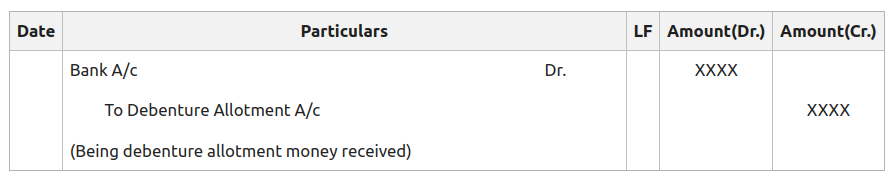
4. On receipt of allotment money:
5. On due of call money:

6. On receipt of call money:

Presentation of Debenture A/c in Balance Sheet:

Notes to Balance Sheet:
