

Soak Testing is a type of non-functional testing used to check how a software application performs when it runs continuously for a long period under a normal or expected workload. It helps identify issues like memory leaks, performance degradation, and system crashes that may appear over time.
- Tests the stability and performance of software over an extended duration.
- Helps detect memory leaks, slow response time, and resource exhaustion.
- Ensures the system can handle continuous real-world usage without failure.
Example: An example of soak testing is running an e-commerce or banking application continuously for several hours under a fixed load to verify its stability and performance over time.
Types of Soak Testing
Soak testing can be classified based on the workload, data volume, system configuration, and test environment used during long-duration execution. Each type helps identify issues such as memory leaks, performance degradation, and resource exhaustion that may appear over time.
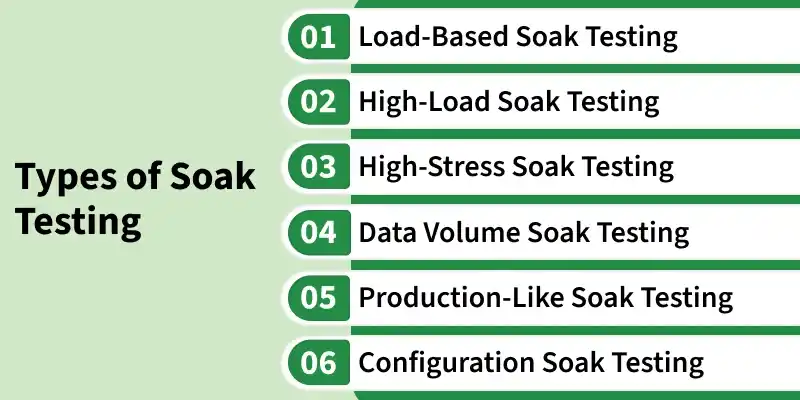
- Load-Based Soak Testing: The system is tested under a normal or expected workload for a long period to verify that it remains stable and performs consistently over time.
- High-Load Soak Testing: The application is tested under a high but expected workload for an extended duration to check whether it can sustain heavy usage without slowing down or failing.
- High-Stress Soak Testing: The system is run for a long duration under a workload near or above its normal capacity to identify long-term stability issues and resource exhaustion.
- Data Volume Soak Testing: This type checks how the system behaves when processing or storing large volumes of data continuously over an extended period.
- Production-Like Soak Testing: The application is tested in an environment similar to the real production setup to observe its long-term behavior under realistic operating conditions.
- Configuration Soak Testing: Different hardware, software, or network configurations are tested over time to ensure the application remains stable and reliable across multiple environments.
Process of Soak Testing
Soak testing evaluates an application’s stability and performance by running it continuously under a workload for an extended period.
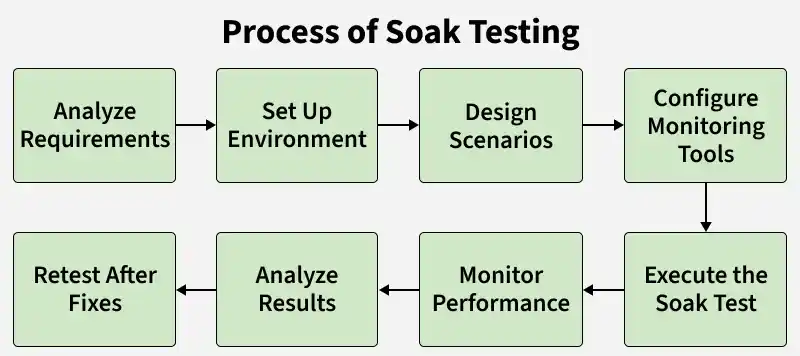
- Analyze Requirements: Define the expected workload, test duration, and performance goals for long-term application execution.
- Set Up Environment: Prepare a production-like environment with the required hardware, software, database, and network setup.
- Design Scenarios: Create realistic test scenarios and workloads that simulate continuous user activity over time.
- Configure Monitoring Tools: Set up monitoring tools to track CPU, memory, response time, and other system resources during the test.
- Execute the Soak Test: Run the application continuously under the defined workload for several hours or days.
- Monitor Performance: Observe the system throughout the test to detect slowdowns, memory leaks, or resource exhaustion.
- Analyze Results: Review the collected test data to identify performance degradation, failures, and their root causes.
- Retest After Fixes: Re-run the soak test after resolving issues to verify that the application remains stable over time.
Difference Between Soak Testing and Other Performance Testing Types
This image compares Soak Testing, Load Testing, Stress Testing, and Spike Testing based on how the system load changes over time.

- Load Testing shows the system running under a normal expected load for a certain period.
- Stress Testing shows the load gradually increasing beyond the system’s capacity to find its breaking point.
- Spike Testing shows a sudden sharp increase and decrease in load to test how the system reacts to traffic spikes.
- Soak Testing shows the system working under a constant load for a long duration to detect issues like memory leaks, slow response, or resource exhaustion.
Tools Used for Soak Testing
Various performance testing and monitoring tools are used in soak testing to simulate continuous load and track system behavior over a long period.
- Apache JMeter: Used to simulate multiple users and continuous workload for long-duration testing.
- LoadRunner: Helps perform large-scale soak and performance testing with detailed analysis.
- k6: Modern tools used for long-running performance and endurance testing.
- New Relic: A monitoring tool used to track application performance, memory usage, and system health during soak testing.
- AppDynamics: A performance monitoring tool used to observe application stability, transactions, and infrastructure behavior during long-running tests.
Advantages of Soak Testing
- Helps identify memory leaks and resource usage issues during long-duration execution.
- Ensures system stability and reliability over extended periods of continuous use.
- Detects performance degradation that may not appear in short-term testing.
- Improves the overall reliability and availability of the application.
- Evaluates how the application behaves under real-world long-term workload conditions.
Limitations of Soak Testing
- It can take a long time to complete because the application must run continuously for an extended period.
- It requires a proper test environment, monitoring tools, and supporting infrastructure for accurate results.
- It may increase testing costs due to long execution time and resource usage.
- Identifying the exact cause of failure can be difficult when issues appear only after many hours of execution.