

The Risk Management Process is a structured approach used to identify, assess, and control risks that may affect a project or organization. It helps reduce uncertainties and supports better decision-making.
- Identifies potential risks early.
- Helps minimize losses and disruptions.
- Improves project and business success.
Risk management process lifecycle
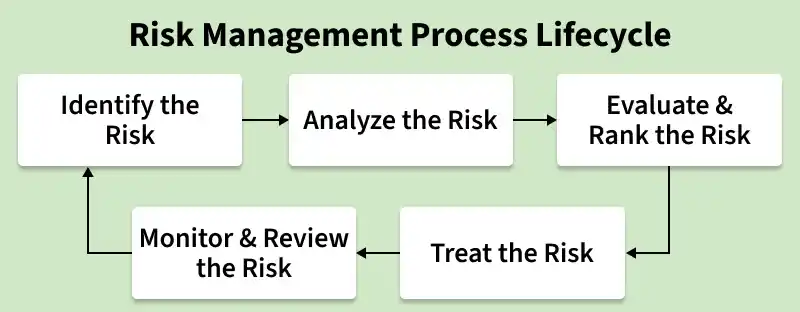
Step 1: Identify the Risk
Risk Identification is the first step in the Risk Management Process. It involves recognizing and documenting potential risks that may affect project objectives, business operations, or organizational goals.
Risks can originate from various internal and external sources:
- Technical Risk: Software defects, technology failures, or system issues.
- Financial Risk: Budget overruns, funding shortages, or market fluctuations.
- Operational Risk: Process failures, resource shortages, or human errors.
- External Risk: Natural disasters, regulatory changes, or economic conditions.
Risk Identification Techniques:
- Brainstorming: A group discussion technique used to generate ideas and identify potential risks from different perspectives.
- SWOT Analysis: A risk identification method that evaluates Strengths, Weaknesses, Opportunities, and Threats affecting a project or organization.
- Checklists: A predefined list of common risks used to systematically identify and ensure important risks are not overlooked.
Step 2: Analyze the Risk
Risk Analysis involves examining identified risks to understand their likelihood, impact, causes, and potential consequences. This helps organizations gain a clear understanding of each risk before prioritization.
- Determining Risk Scope: Evaluates the extent of a risk and its potential impact on project objectives and operations.
- Root Cause Analysis: Identifies the underlying cause of a risk to support effective mitigation and prevention.
Step 3: Evaluate and Rank the Risk
Risk Evaluation and Ranking involves comparing analyzed risks and prioritizing them based on their likelihood and impact. This helps organizations focus resources on the most significant threats.
- Likelihood: The probability that a risk will occur.
- Impact (Severity): The extent of damage or consequences if the risk occurs.
- Using a Risk Matrix or Heat Map: A visual tool that plots likelihood against impact to identify and prioritize risks.
- Prioritizing Risks: The process of ranking risks based on their likelihood and impact.
- High Priority Risk: A risk with high likelihood and/or high impact that requires immediate action.
- Medium Priority Risk: A risk that requires planned mitigation and regular monitoring.
- Low Priority Risk: A risk with limited impact or likelihood that can be monitored periodically.
Step 4: Treat the Risk (Risk Response)
Risk Treatment involves selecting and implementing appropriate actions to address identified risks based on their priority and potential impact.
- Avoidance Strategy: Eliminates a risk by changing plans or activities to prevent it from occurring.
- Mitigation Strategy: Reduces the likelihood or impact of a risk through preventive measures.
- Transfer Strategy: Shifts the responsibility or financial impact of a risk to a third party.
- Acceptance Strategy: Acknowledges a risk and accepts its consequences while monitoring it for changes.
Step 5: Monitor and Review the Risk
Risk Monitoring and Review is a continuous process that ensures risks remain under control and response strategies remain effective as conditions change.
- Continuous Tracking: Regularly monitors identified risks to assess changes in their likelihood, impact, and status.
- Risk Audits and Reporting: Reviews risk management activities and communicates risk information to stakeholders.
- Updating the Risk Register: Records new risks, status changes, and response actions to keep risk information current.
Types of Risks Organizations Commonly Face
- Financial Risk: Risk arising from market fluctuations, credit risk, and cash flow issues.
- Operational Risk: Risk caused by process failures, supply chain disruptions, and human errors.
- Strategic Risk: Risk resulting from poor business decisions, competitive pressure, and shifting market conditions.
- Compliance and Legal Risk: Risk associated with regulatory violations, lawsuits, and policy changes.
- Reputational Risk: Risk of public relations crises and loss of customer trust.
- Cybersecurity Risk: Risk related to data breaches, system outages, and ransomware attacks.
Common Risk Management Frameworks
Several established frameworks provide guidance and best practices for implementing an effective risk management process.
- ISO 31000: An international standard that provides principles and guidelines for effective risk management.
- COSO ERM: A framework that helps organizations identify, assess, and manage risks across the enterprise.
- PMBOK (Project Management Body of Knowledge): A project management framework that provides processes for managing project-related risks.
Benefits of an Effective Risk Management Process
- Fewer Costly Surprises and Disruptions: Identifies potential threats early to minimize unexpected business disruptions.
- Better-Informed Strategic Decisions: Supports decision-making through improved risk awareness and analysis.
- Improved Regulatory Compliance: Ensures adherence to legal, regulatory, and industry requirements.
- Stronger Stakeholder and Investor Confidence: Builds trust by demonstrating effective risk management practices.
- Greater Organizational Resilience During Crises: Enhances the ability to withstand and recover from unexpected events.
Common Challenges in Risk Management
- Incomplete Risk Identification: Failure to identify all potential risks, especially emerging or hidden threats.
- Overreliance on Intuition: Making risk decisions based on assumptions rather than data and analysis.
- Siloed Risk Management: Managing risks separately across departments without a unified approach.
- Static Risk Registers: Keeping risk records unchanged despite evolving business conditions.
- Underestimating Low-Probability, High-Impact Risks: Overlooking rare events that can have severe consequences.
Being aware of these challenges helps organizations strengthen their risk management practices and improve overall resilience.