

"Seals, Script, Weights" is a subpart of the Class 12 history. It falls under the chapter "Bricks, Beads, and Bones". This part gives us an idea of the "Seals, Script, Weights" of the Indus Valley Civilization. Seals of the Indus Valley Civilization were used to maintain the long-distance communication that was an identity instrument of the sender.
The scripts of the civilization were majorly written on the seals. The content of the scripts was majorly related to the name and the specific title of the seal owner. Seals, Script, and Weights are those references to the Indus Valley Civilization that give us an idea about the trade, social, economic, and stable central administration of it. Let us discuss them in detail.
In this article, we are going to discuss the Class 12 History Seals, Script, and Weights in detail.
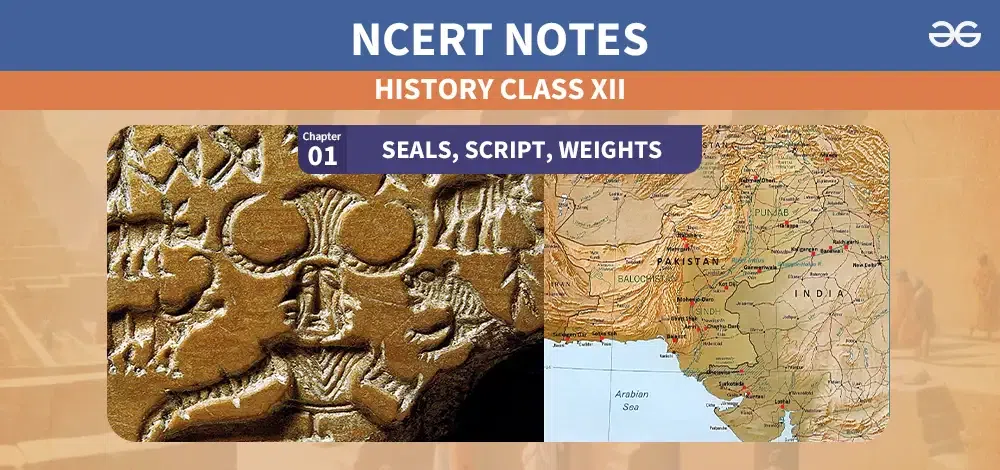
Seals Of Indus Valley Civilization
Seals and Sealings were the major instruments of the trade in Indus Valley civilization. They were used to maintain safety and transparency in the process of long-distance communication with the identity of the particular sender. Here are the important aspects of the Seals and Sealings used in the Indus Valley civilization as mentioned below.
- In the Indus Valley Civilization, the goods were generally sent in bags that were tied with the rope.
- The knot of the rope is sealed with wet clay where one or more seals are pressed to leave an impression. These impressions carried the identity of the owner.
- If the goods bag reaches the destination with the sealing intact that means the bag was not tampered with in the way.
- Every seal had a name and title of the owner which also contained the motif of an animal.
- The motif of an animal is mainly used for those who can not read.
- The seals were various in size and the most circulated seals were the Square-shaped seals.
- So many Indus Valley Civilization seals were found in the present Iraq and Arabian Peninsula. It simply says that the Indus Valley Civilization had a good trade relationship with Mesopotamia and Central Asia.
Seals and Sealings
Seals and sealings played a crucial role in enabling long-distance communication during ancient times. To illustrate, consider a scenario where a bag of goods needed to be sent from one location to another. The mouth of the bag would be securely tied with a rope, and onto this knot, wet clay would be applied. One or more seals would then be pressed onto the clay, leaving behind distinct impressions. If the bag arrived at its destination with the sealing still intact, it indicated that the contents had not been tampered with during transit. Additionally, the seals imprinted on the clay conveyed the identity of the sender, providing important information to the recipient.
An Enigmatic Script
Harappan seals typically feature a line of writing, likely indicating the name and title of the owner. Additionally, scholars propose that the motif accompanying the writing, often depicting an animal, may have conveyed meaning to those who were unable to read the script.
The inscriptions on Harappan artifacts are generally brief, with the longest containing approximately 26 signs. Despite extensive study, the script remains undeciphered. It is evident that the script was not alphabetical, as it consists of a large number of signs, estimated to be between 375 and 400. Moreover, the writing direction appears to be from right to left, as indicated by the wider spacing on the right and cramping on the left seen on some seals.
Writing has been found on a diverse array of objects, including seals, copper tools, jar rims, tablets made of copper and terracotta, jewelry, bone rods, and even an ancient signboard. This suggests that writing may have been widespread in Harappan society, possibly extending to perishable materials as well.
Weights
A precise system of weights regulated exchanges during the Harappan civilization. These weights were typically made of a stone called chert and were often cubical in shape, lacking any markings. The lower denominations of weights followed a binary system (1, 2, 4, 8, 16, 32, etc., up to 12,800), while the higher denominations adhered to the decimal system. It is likely that the smaller weights were used for measuring items like jewelry and beads. Additionally, metal scale-pans have been discovered, indicating the sophistication of the Harappan trading system.
Also Read: