

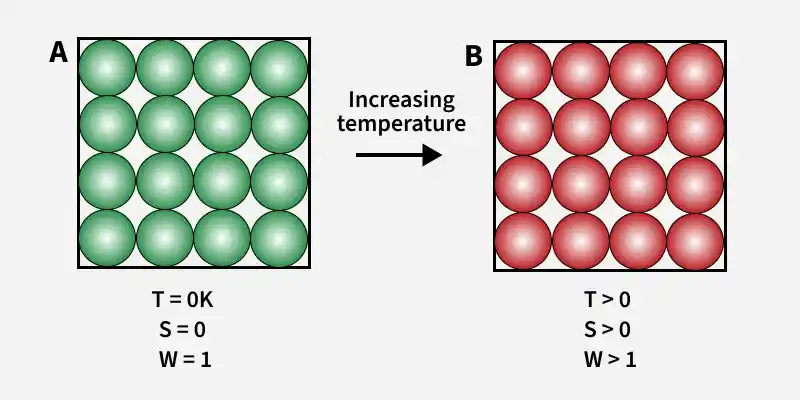
The Third Law of Thermodynamics states that the entropy of a perfect crystal becomes zero at absolute zero temperature (0 K). At this temperature, the particles of a perfect crystal are arranged in a completely ordered manner and possess only one possible microscopic arrangement. As a result, the disorder of the system becomes minimum and its entropy is zero.
Statement of Third Law of Thermodynamics
The Third Law of Thermodynamics may be stated as "The entropy of a perfect crystal is zero at absolute zero temperature (0 K)." This means that when a perfect crystalline substance is cooled to absolute zero, the crystal attains a state of maximum order and minimum entropy.
- The entropy of a perfect crystal at 0 K is zero.
- Absolute zero temperature represents the minimum possible thermal energy of a system.
- Absolute entropy values of substances can be calculated using this law.
- Absolute zero cannot be reached through a finite number of physical processes.
Mathematical Derivation Using Boltzmann Equation
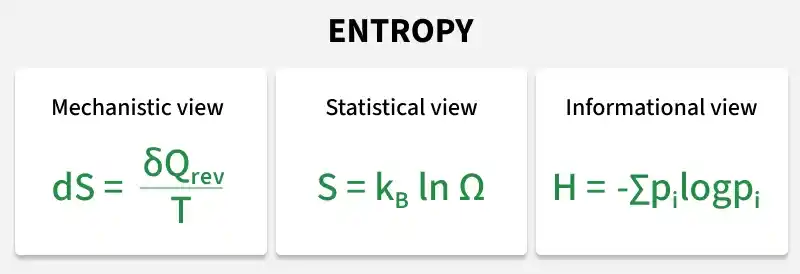
The Third Law can be explained using Boltzmann's entropy equation:
S = k ln Ω
where:
- S = Entropy
- k = Boltzmann constant
- Ω = Number of microstates
For a perfect crystal at absolute zero (0 K), only one microstate is available. Therefore,
Ω = 1
Substituting this value into Boltzmann's equation:
S = k ln(1)
Since ln(1) = 0,
S = 0
Hence, the entropy of a perfect crystal at absolute zero is zero, which verifies the Third Law of Thermodynamics.
Unattainability of Absolute Zero
An important consequence of the Third Law of Thermodynamics is that absolute zero temperature cannot be achieved by any finite number of physical processes.
- As the temperature of a substance decreases, removing the remaining thermal energy becomes increasingly difficult.
- The cooling required to lower the temperature by each additional degree becomes progressively greater.
- Therefore, although temperatures very close to absolute zero can be achieved in laboratories, absolute zero itself can never be reached.
- Thus, absolute zero can only be approached but never attained in practice.
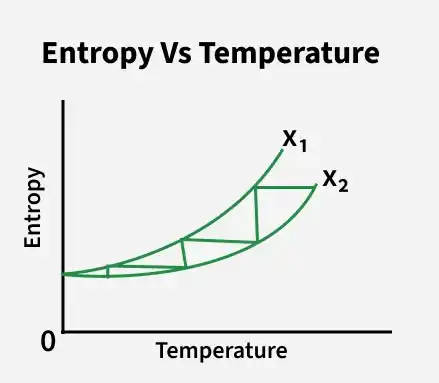
An entropy–temperature graph shows that entropy increases with temperature, while the effort required to achieve further cooling becomes progressively greater near absolute zero.
Applications of the Third Law of Thermodynamics
The Third Law of Thermodynamics has several important applications in science and engineering.
1. Calculation of Absolute Entropy: The law provides a reference point for determining the absolute entropy of substances at different temperatures.
2. Understanding Heat Capacity: It helps explain why the heat capacities of substances decrease significantly as the temperature approaches absolute zero.
3. Cryogenics: The Third Law is widely used in cryogenics, which deals with the production and study of extremely low temperatures.
4. Quantum Physics: It helps scientists understand the behavior of matter and quantum phenomena at temperatures close to absolute zero.
Limitations of the Third Law of Thermodynamics
Although the Third Law is fundamental, it has certain limitations.
- The law strictly applies only to perfect crystals. Real crystals may contain defects and impurities that contribute to residual entropy.
- The law describes the behavior of systems at absolute zero, but such a temperature cannot be attained experimentally.
- Some substances, such as glasses and certain crystalline solids, may possess a small amount of entropy even at very low temperatures due to structural disorder.
- Since absolute zero cannot be reached, the law can only be verified indirectly through experiments conducted at temperatures close to 0 K.