

Word embeddings have revolutionized the field of natural language processing (NLP) by enabling machines to understand the meaning and context of words. CBOW (Continuous Bag of Words) and Skip-Gram are two foundational architectures in Word2Vec for learning word embeddings. Both aim to capture semantic and syntactic relationships between words but differ in their approach, performance, and use cases.
Understanding Word Embeddings

Word Embeddings are essential in NLP as they convert text into numerical representations, enabling machines to understand and analyze human language. Popular approaches include Word2Vec, GloVe, and FastText. Word2Vec, developed by Mikolov and his team at Google, introduced the Continuous Bag of Words (CBOW) and Skip-Gram models, which significantly advanced text processing. CBOW predicts a target word from its context, while Skip-Gram predicts context words from a target word. These models are valued for their simplicity, computational efficiency, and ability to produce high-quality embeddings, making them foundational in modern NLP.
What is Continuous Bag of Words (CBOW)?
.png)
Continuous Bag of Words (CBOW) is a neural network model used for natural language processing tasks, primarily for word embedding. It belongs to the family of neural network architectures called Word2Vec, which aims to represent words in a continuous vector space.
In CBOW, the model predicts the current word based on the context of surrounding words. CBOW predicts the target word from its context. The architecture typically consists of an input layer, a hidden layer, and an output layer.
- Input Layer: It represents the context words encoded as one-hot vectors.
- Hidden Layer: This layer processes the input and performs non-linear transformations to capture the semantic relationships between words.
- Output Layer: It produces a probability distribution over the vocabulary, with each word assigned a probability of being the target word given its context.
What is Skip-Gram Model?
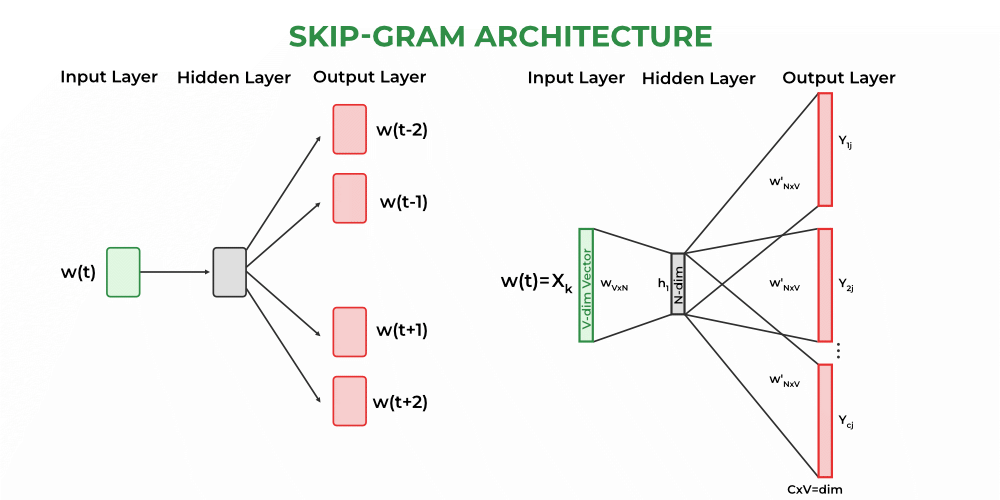
The Skip-Gram model is another neural network architecture within the Word2Vec framework for generating word embeddings. Unlike Continuous Bag of Words (CBOW), Skip-Gram predicts context words given a target word. It's designed to learn the representation of a word by predicting the surrounding words in its context.
- Input Layer: It takes a single word (the target word) encoded as a one-hot vector.
- Hidden Layer: This layer transforms the input word into a distributed representation in the hidden layer.
- Output Layer: It predicts the context words (surrounding words) based on the representation learned in the hidden layer.
How They Work
- CBOW: Predicts the target word given a set of context words (surrounding words). For example, with the sentence "India wins next world cup" and a window size of 3, CBOW would use the context
["India", "wins", "next"]to predict the target word"world". - Skip-Gram: Predicts the surrounding context words given a single target word. Using the same sentence and window size, if
"India"is the target word, Skip-Gram tries to predict its context words:["wins", "next", "world"].
Example with Window Size 3
Sentence:
["India", "wins", "next", "world", "cup"]CBOW Training Example
- Context:
["India", "wins", "next"]→ Target:"world"Skip-Gram Training Example
- Target:
"India"→ Context:["wins", "next", "world"]- Target:
"wins"→ Context:["India", "next", "world"]- Target:
"next"→ Context:["wins", "world", "cup"]
Key Differences Between CBOW and Skip-Gram
Aspect | CBOW (Continuous Bag of Words) | Skip-Gram |
|---|---|---|
Concept | Predicts a target word based on context words. | Predicts context words given a target word. |
Context Window | Typically smaller (2-5 words) | Can handle larger windows (5-20 words) |
Training Process | Minimizes cross-entropy loss to predict the target word. | Maximizes the likelihood of context words around a target word using techniques like negative sampling or hierarchical softmax. |
Training Speed | Faster (single prediction per context window) | Slower (multiple predictions per target word) |
Performance | Better for frequent words, syntactic relationship | Better for rare words, semantic relationships. |
Overfitting | Can overfit frequent words | Less prone to overfitting frequent words |
Model Size | Smaller | Larger |
Data Requirements | Needs less data | Needs more data, works well with large datasets |
Use Cases | Suitable for tasks requiring speed over detailed word representations, like text classification and sentiment analysis. | Ideal for tasks needing high-quality embeddings and detailed semantic relationships, such as word similarity tasks, named entity recognition, and machine translation. |
Python Code Example (Using Gensim)
The code uses the Gensim library to train Word2Vec models on a sample sentence. Gensim is a Python library for efficient topic modeling and creating word embeddings from large text data.
!pip install gensim
Output

Below is the code where it creates two models:
- CBOW model (
sg=0): Predicts a target word based on its surrounding context words. For example, given the context["wins", "next", "world"], it tries to predict"India". - Skip-Gram model (
sg=1): Predicts the context words given a target word. For example, given the target word"India", it tries to predict its surrounding words like"wins","next", and"world".
from gensim.models import Word2Vec

# Sample corpus
sentences = [["India", "wins", "next", "world", "cup"]]

# CBOW Model (sg=0)
cbow_model = Word2Vec(sentences, vector_size=100, window=3, sg=0, min_count=1)
print("CBOW vector for 'India':", cbow_model.wv["India"])

# Skip-Gram Model (sg=1)
skipgram_model = Word2Vec(sentences, vector_size=100, window=3, sg=1, min_count=1)
print("Skip-Gram vector for 'India':", skipgram_model.wv["India"])
Output


Advantages and Disadvantages of CBOW Model
Advantages
- Trains faster and is more efficient on large datasets.
- Performs well with frequent words and captures word similarity
Disadvantages
- Struggles with rare words and does not preserve word order.
- Prone to overfitting frequent words.
Advantages and Disadvantages of Skip Gram Model
Advantages
- Excels with rare words and captures better semantic relationships.
- Less sensitive to frequent word overfitting and can handle larger context windows.
Disadvantages
- Slower training and more computationally intensive due to multiple predictions per target word.
- Larger model size.