

A unit circle is a circle with radius 1 unit, centered usually at the origin (0, 0) on the coordinate plane.
- Equation is x² + y² = 1; every point (x, y) on it is exactly 1 unit away from the center.
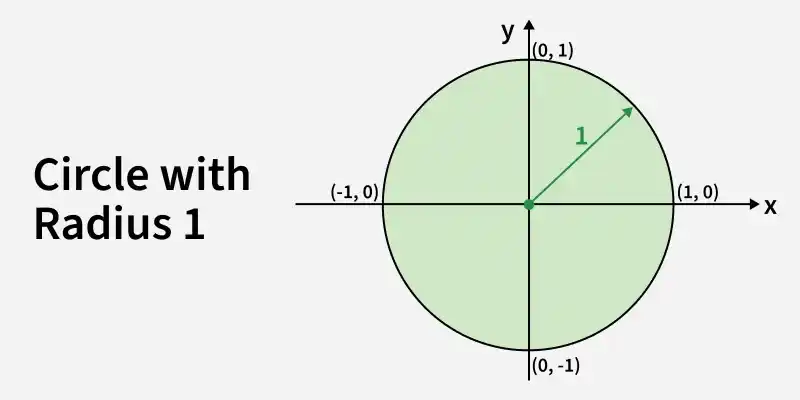
The unit circle is a key tool in trigonometry because it connects angles with coordinates:
For any angle θ (measured from the positive x-axis):
- x = cos(θ)
- y = sin(θ)
So each point on the circle represents the cosine and sine of an angle.
Unit Circle with Sin, Cos, and Tan
A unit circle can be used to understand trigonometric functions. For this, we consider a right triangle to be placed inside a unit circle. Since the radius of a unit circle is 1, it becomes the hypotenuse of the triangle.
Now,
- sin θ = y
- cos θ = x
- tan θ = sin θ cos θ = y/x
On substituting the values of θ, we can obtain principal values of all the trigonometric functions.
Unit Circle Chart
The unit circle chart is a chart that contains the values of the trigonometric functions sine and cosine for various angles.
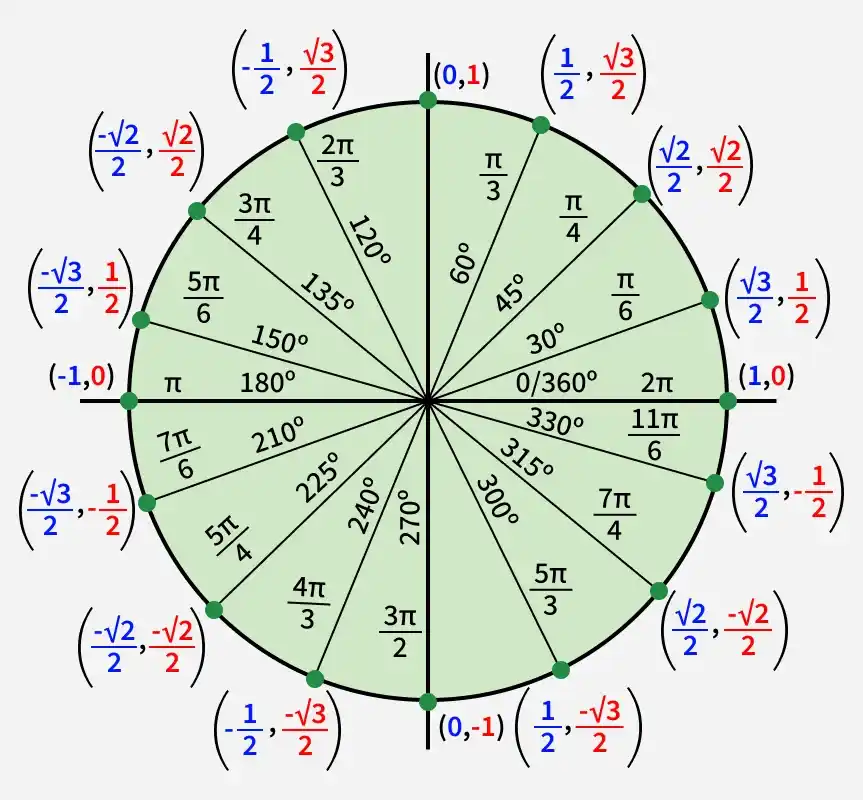
The trigonometric ratios used in the unit circle table are used to list the coordinates of the points on the unit circle that correspond to common angles.
Angles | 0° | 30° | 45° | 60° | 90° |
|---|---|---|---|---|---|
sin | 0 | 1/2 | 1/√(2) | √3/2 | 1 |
cos | 1 | √3/2 | 1/√(2) | 1/2 | 0 |
tan | 0 | 1/√(3) | 1 | √(3) | Not Defined |
csc | Not Defined | 2 | √(2) | 2/√(3) | 1 |
sec | 1 | 2/√(3) | √(2) | 2 | Not Defined |
cot | Not Defined | √(3) | 1 | 1/√(3) | 0 |
➢Practice: Solved Examples