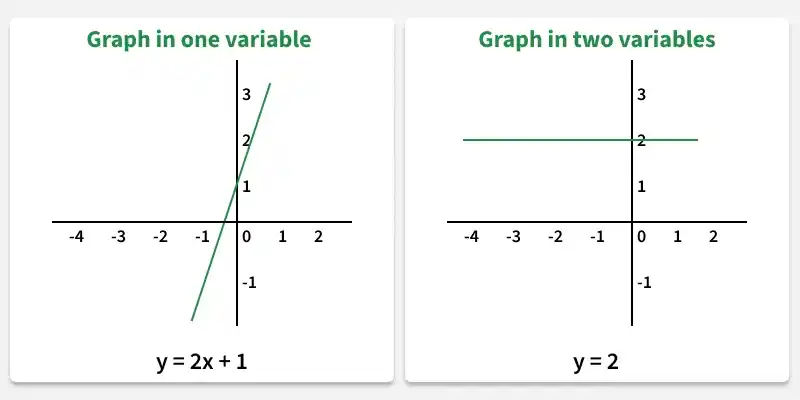
A linear equation is an equation in which the highest power (degree) of the variable is 1.
It represents a straight line when graphed.
It can have one, two, or more variables, but they do not include exponents or higher powers.
The linear equation in one variable represents a straight line parallel to either axis.
General Forms:
One variable: ax + b = 0 (a ≠ 0)
Two variables: Ax + By + C = 0
Here, a, b, c are constants and x, y are variables.
Examples of Linear Equations
1. One Variable: A linear equation involving one variable has the form ax + b = 0. It can be solved using a single equation. Example: x + 4 = 6
2. Two Variables: A linear equation involving two variables has the form ax + by = c. A single equation represents a line and has infinitely many solutions; two such equations are required to get a unique solution. Example: x + y = 6
3. Three Variables: A linear equation involving three variables has the form ax + by + cz = d. A single equation represents a plane and has infinitely many solutions; three independent equations are required to get a unique solution. Example : x + y + z = 6
Representations or Different Forms
There are various ways to represent the linear equations, such as
This linear equation in one variable represents a straight line passing through the point (-7, 0) and parallel to the y-axis. Similarly, linear equations in two variables also represent a straight line, and its graph can be plotted by following the steps discussed below.
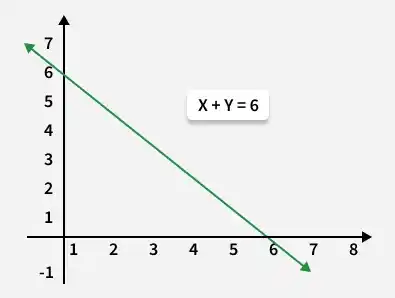
Example: Plot the graph for a linear equation in two variables, x + y - 6 = 0.
Use the following steps to plot the graphs
Step 1: Arrange the given equation of the line in the standard form as, x + y = 6
Step 2: Now change the equation in the intercept form by dividing 6 on both sides to make the RHS 1.
x/6 + y/6 = 1
Step 3: The denominator of x and y represents the intercept on the x and y axis respectively. The intercept on the x-axis is 6 and the intercept on the y-axis is 6.
Step 4: Find the point on the x-axis and the y-axis, i.e. the point on the x-axis is (6, 0) and the point on the y-axis is (0, 6). Join these points to get the line.