

Independent Sets, Covering, and Matching are fundamental concepts in graph theory that describe different ways to select vertices or edges in a graph. They are used to solve problems related to network design, scheduling, resource allocation, and assignments.
Question: For the following graph G:
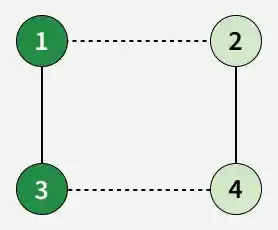
Example 1: Find an independent set
Solution:
Independent sets: I1 = {1}, I2 = {2}, I3 = {3}, I4 = {4}, I5 = {1, 3}, I6 = {2, 4}.
Maximum independent set: I5 = {1, 3}or I6 = {2, 4}
Independence number: α0(G) = 2
Example 2: Find a vertex cover in the same graph G:
Solution:
Vertex covers: V1 = {1, 3}, V2 = {2, 4}, V3 = {1,2,3}, V4 = {1,2,3,4}.
Minimum vertex cover: V1 = {1,3} or V2 = {2,4}
Vertex covering number: β0(G) = 2
Practice Problems
- Problem 1: A graph G has vertices labeled {1, 2, 3, 4, 5}. The edges are {(1, 2), (1, 3), (2, 4), (3, 5)}. Find the independence number α₀(G).
- Problem 2: For the same graph G in Problem 1, determine the maximum matching α1(G).
- Problem 3: A graph G has vertices labeled {A, B, C, D, E, F}. The edges are {(A, B), (B, C), (C, D), (D, E), (E, F), (F, A)}. Find the independent sets of G.
- Problem 4: Consider a complete graph K5 with vertices {1, 2, 3, 4, 5}. Find the independence number and minimum vertex cover.
- Problem 5: Consider a bipartite graph K3, 4K3, K4 with partition sets {A, B, C} and {D, E, F, G}. Determine the matching number and edge covering number.