

A geometric series is the sum of the terms of a geometric sequence, where each term is obtained by multiplying the previous term by the same constant number called the common ratio.
1 + 2 + 4 + 8 + 16 + . . .
Here, each term is multiplied by 2, so the common ratio is r = 2.
The general form of a geometric series is:
a + ar + ar2 + ar3 + ⋯
- a = first term
- r = common ratio
Below is the visual representation of Geometric series
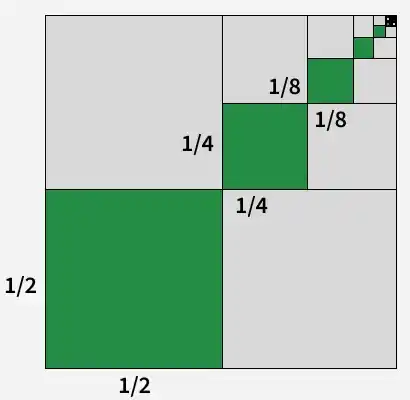
The large square represents a whole area of 1. It is repeatedly divided into smaller squares whose areas form the sequence:
\frac{1}{4}, \ \frac{1}{8}, \ \frac{1}{16},\ \frac{1}{32},\ \frac{1}{64}, \ \cdots \
So the shaded regions form the geometric series
\frac{1}{4}+\frac{1}{8}+\frac{1}{16}+\frac{1}{32}+\frac{1}{64}+\cdots
Convergence of Geometric Series
The convergence of a geometric series (infinite) depends solely on the value of the common ratio r:
- Convergent Series: The series converges if the absolute value of the common ratio is less than 1: ∣r∣ < 1
- Divergent Series: The series diverges if the absolute value of the common ratio is equal to or greater than 1: ∣r∣ ≥ 1
Formula
The Geometric Series formula for the Finite series is given as,
\bold{{S_n =\frac{a(1-r^n)}{1-r}}} Where
- Sn = sum up to nth term,
- a = First term, and
- r = common factor.
Derivation for Geometric Series Formula
Suppose a Geometric Series for n terms:
Sn = a + ar + ar2 + ar3 + .... + arn-1 . . . (1)
Multiplying both sides by the common factor (r):
r Sn = ar + ar2 + ar3 + ar4 + ... + arn . . . (2)
Subtracting Equation (1) from Equation (2):
(r Sn - Sn) = (ar + ar2 + ar3 + ar4 +. . . arn) - (a + ar + ar2 + ar3 + . . . + arn-1)
⇒ Sn (r-1) = arn - a
⇒ Sn (1 - r) = a (1-rn)
⇒
Note: When the value of k starts from 'm', the formula will change.
\sum_{k=m}^{n}ar^k=\frac{a(r^m-r^{n+1}}{1-r} , when r≠0
For Infinite Geometric Series
n will tend to Infinity, n ⇢ ∞, Putting this in the generalized formula:
S_\infty = \sum_{n=1}^{\infty}ar^{n-1} = \frac{a}{1-r}; -1<{r}<1
nth term for the G.P. : an = arn-1
Geometric Sequence vs Geometric Series
Some of the common differences between Geometric Sequences and Series are listed in the following table:
| Aspect | Geometric Sequence | Geometric Series |
|---|---|---|
| Definition | A sequence of numbers where each term is obtained by multiplying the previous term by a fixed, non-zero number (common ratio). | The sum of terms in a geometric sequence. |
| General Form | a, ar, ar2, ar3, ar4, . . . | a + ar + ar2 + ar3 + ar4 + . . . |
| Example | 2, 6, 18, 54, . . . | 2 + 6 + 18 + 54 + . . . |