

Euclidean distance is the straight-line distance between two points in a plane or higher-dimensional space.
- It is like measuring the straightest and shortest path between two points.
- Imagine you have a string and you stretch it tight between two points on a map; the length of that string is the Euclidean distance.
- It tells you how far apart the two points are without any turns or bends, just like a bird would fly directly from one spot to another.
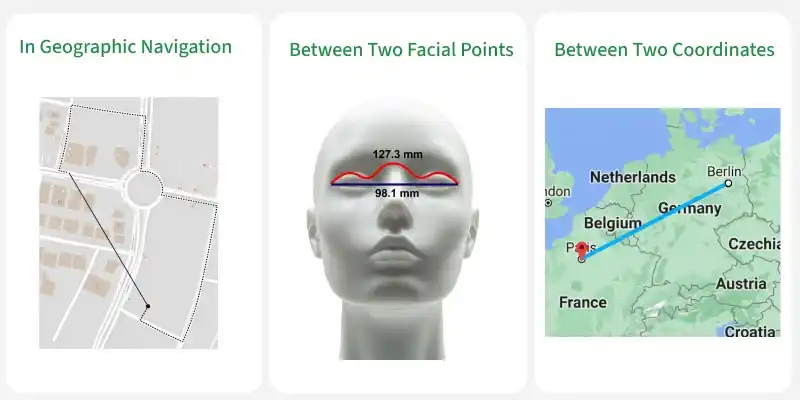
This metric is based on the Pythagorean theorem and is widely utilized in various fields such as machine learning, data analysis, computer vision, and more.
Formula
Consider two points (x1, y1) and (x2, y2) in a 2-dimensional space; the Euclidean distance between them is given by using the formula:
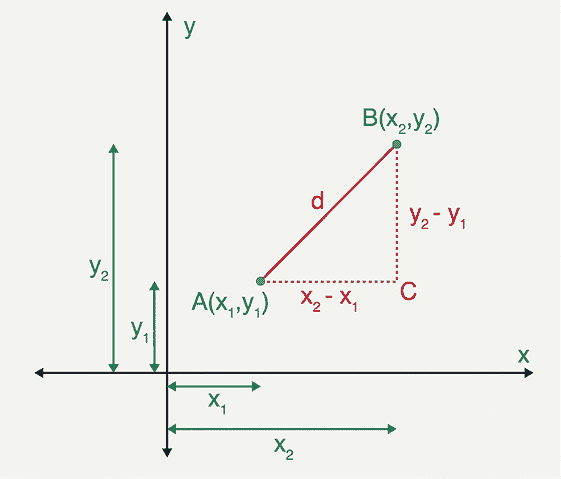
d = \sqrt{(x_2 - x_1)^2 + (y_2 - y_1)^2}
- d is Euclidean distance,
- (x1, y1) is the coordinate of the first point,
- (x₂, y₂) is the coordinate of the second point.
Euclidean Distance in 3D
If the two points (x1, y1, z1) and (x2, y2, z2) are in a 3-dimensional space, the Euclidean distance between them is given by using the formula:
d = \sqrt{(x_2 - x_1)^2 + (y_2 - y_1)^2+ (z_2 - z_1)^2}
Where,
- d is Euclidean distance,
- (x1, y1, z1) is the coordinate of the first point,
- (x₂, y₂, z₂) is the coordinate of the second point.
Euclidean Distance in nD
In general, the Euclidean distance formula between two points (x11, x12, x13, ..., x1n) and (x21, x22, x23, ..., x2n) in an n-dimensional space is given by the formula:
d = \sqrt{∑^{n}_{i=1}(x_{2i} – x_{1i})^2}
Where,
- i ranges from 1 to n,
- d is Euclidean distance,
- (x11, x12, x13, ..., x1n) is the coordinate of the first point,
- (x21, x22, x23, ..., x2n) is the coordinate of the second point.
Euclidean Distance vs. Manhattan Distance
| Aspect | Euclidean Distance | Manhattan Distance |
|---|---|---|
| Definition | Measures the shortest straight-line distance between two points. | Measures the distance between two points along axes at right angles. |
| Formula (2D) | d = [|x2 - x1| + |y2 - y1|] | |
| Path | Direct straight line. | The path that resembles city blocks or a grid pattern. |
| Metric Name | L2 norm or Euclidean norm. | L1 norm or Manhattan norm. |
| Use Cases | Used in scenarios where direct distances are needed (e.g., physics). | Commonly used in planning, urban design, and certain optimization algorithms. |
| Sensitivity to Scaling | More sensitive to outliers because differences are squared. | Less sensitive to outliers since it uses absolute differences. |
➢Practice: Solved Examples