

Partial orders and lattices are used to represent and analyze ordered relationships among elements of a set. A partial order defines an arrangement in which some elements may not be comparable, while a lattice is a special kind of partially ordered set with additional properties related to upper and lower bounds.
Partial Orders
A partial order is a binary relation ≤ over a set P that satisfies three properties:
- Reflexivity: For all a ∈ P, a ≤ a.
- Antisymmetry: For all a, b ∈ P, if a ≤ b and b ≤ a, then a = b.
- Transitivity: For all a, b, c ∈ P, if a ≤ b and b ≤ c, then a ≤ c.
A set P together with a partial order ≤ is called a partially ordered set (poset).
Example: Consider the set P = {1, 2, 3} with the relation ≤ defined as the usual numerical order:
- Reflexivity: 1 ≤ 1, 2 ≤ 2, 3 ≤ 3.
- Antisymmetry: If a ≤ b and b ≤ a, then a = b.
- Transitivity: If 1 ≤ 2 and 2 ≤ 3, then 1 ≤ 3.
The set P with this order is a partially ordered set (poset).
Lattices
A lattice is a special type of poset in which every pair of elements has the following:
- A least upper bound (join): The join of a and b, denoted by a ∨ b, is the least element greater than or equal to both a and b.
- A greatest lower bound (meet): The meet of a and b, denoted by a ∧ b, is the greatest element less than or equal to both a and b.
This means you can always find a unique join and meet for any two elements in the set.
Example: The set of integers with the divisibility relation (where a ≤ b if a divides b) is a lattice.
Example: Consider the set L = {1, 2, 3, 6} with the divisibility relation:
- Join: The join of 2 and 3 is 6 since 6 is the smallest number that is divisible by both 2 and 3.
- Meet: The meet of 2 and 6 is 2 since 2 is the largest number that divides both 2 and 6.
The set L with this order is a lattice.
| Concept | Key Properties | Example |
|---|---|---|
| Partial Order | Reflexive, antisymmetric, transitive | Subset relation on sets |
| Lattice | Partial order + each pair has join and meet | Power set ordered by inclusion |
The concepts of lattice and poset are explained in detail with the help of the example below:
This is a Hasse diagram of a lattice, a type of partially ordered set (poset) where every pair of elements has a least upper bound (join) and a greatest lower bound (meet).
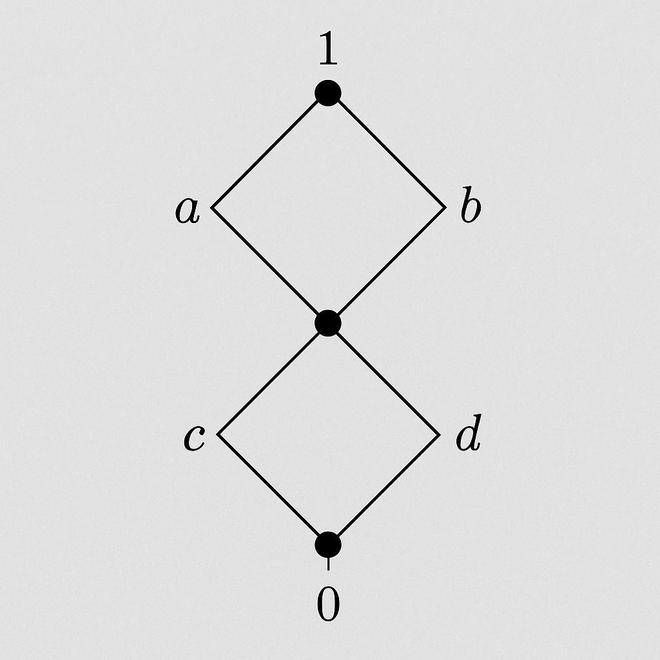
Elements
- The nodes labeled
0,c"middle point" and1represent elements in the poset. - The bottom element is the least element; everything else is above it.
- The top element is the greatest element; it is above all others.
Explanation
In a partially ordered set (poset), an upward path from one node to another means the lower node is less than or equal to the higher node according to the partial order relation.
For example:
- Since c and d are above 0, we have 0 ≤ c and 0 ≤ d.
- The middle node is above both c and d and below both a and b.
- Since 1 is above a and b, we have a ≤ 1 and b ≤ 1.
Meet and Join Examples
- Join (least upper bound) of
canddis the middle node. - Meet (greatest lower bound) of
aandbis the same middle node.
This structure shows how any two elements (e.g., c and d, or,a and b) have both a meet and a join, which is what makes the set a lattice.
Applications in Engineering
- Task Scheduling: Partial orders are used to represent dependencies among tasks. They help determine which tasks must be completed before others, enabling efficient scheduling and parallel execution.
- Data Structures: Lattices are useful in designing and optimizing data structures such as search trees and heaps. They help maintain order and support efficient data insertion, deletion, and retrieval.
- Database Theory: Partial orders and lattices are important in database systems for query optimization and schema design. They help organize hierarchies, manage constraints, and improve query execution efficiency.
- Formal Verification: These concepts are used in formal methods to verify system correctness, especially in concurrent systems where events do not always follow a fixed order. Partial orders help represent event dependencies and execution paths.
- Network Design: In communication networks, partial orders and lattices assist in routing optimization, dependency analysis, and efficient resource allocation.