

Given an integer N, the task is to find the number of ways to get the sum N by repeatedly throwing a dice.
Examples:
Input: N = 3
Output: 4
Explanation:
The four possible ways to obtain N are:
- 1 + 1 + 1
- 1 + 2
- 2 + 1
- 3
Input: N = 2
Output: 2
Explanation:
The two possible ways to obtain N are:
- 1 + 1
- 2
Recursive Approach: The idea is to iterate for every possible value of dice to get the required sum N. Below are the steps:
- Let findWays() be the required answer for sum N.
- The only numbers obtained from the throw of dice are [1, 6], each having equal probability in a single throw of dice.
- Therefore, for every state, recur for the previous (N - i) states (where 1 ? i ? 6). Therefore, the recursive relation is as follows:
findWays(N) = findWays(N - 1) + findWays(N - 2) + findWays(N - 3) + findWays(N - 4) + findWays(N - 5) + findWays(N - 6)
Below is the implementation of the above approach:
// C++ program for the above approach

#include <bits/stdc++.h>
using namespace std;

// Function to find the number of ways
// to get the sum N with throw of dice
int findWays(int N)
{
    // Base Case
    if (N == 0) {
        return 1;
    }

    // Stores the count of total
    // number of ways to get sum N
    int cnt = 0;

    // Recur for all 6 states
    for (int i = 1; i <= 6; i++) {

        if (N - i >= 0) {

            cnt = cnt
                  + findWays(N - i);
        }
    }

    // Return answer
    return cnt;
}

// Driver Code
int main()
{
    int N = 4;

    // Function call
    cout << findWays(N);

    return 0;
}
// Java program for the above approach
import java.util.*;

class GFG{

// Function to find the number of ways
// to get the sum N with throw of dice
static int findWays(int N)
{

    // Base Case
    if (N == 0)
    {
        return 1;
    }

    // Stores the count of total
    // number of ways to get sum N
    int cnt = 0;

    // Recur for all 6 states
    for(int i = 1; i <= 6; i++)
    {
        if (N - i >= 0)
        {
            cnt = cnt +
                  findWays(N - i);
        }
    }

    // Return answer
    return cnt;
}

// Driver Code
public static void main(String[] args)
{
    int N = 4;

    // Function call
    System.out.print(findWays(N));
}
}

// This code is contributed by 29AjayKumar
# Python3 program for the above approach

# Function to find the number of ways
# to get the sum N with throw of dice
def findWays(N):

    # Base case
    if (N == 0):
        return 1

    # Stores the count of total
    # number of ways to get sum N
    cnt = 0

    # Recur for all 6 states
    for i in range(1, 7):
        if (N - i >= 0):
            cnt = cnt + findWays(N - i)

    # Return answer
    return cnt

# Driver Code
if __name__ == '__main__':

    N = 4

    # Function call
    print(findWays(N))

# This code is contributed by mohit kumar 29
// C# program for
// the above approach
using System;
class GFG{

// Function to find the number of ways
// to get the sum N with throw of dice
static int findWays(int N)
{
  // Base Case
  if (N == 0)
  {
    return 1;
  }

  // Stores the count of total
  // number of ways to get sum N
  int cnt = 0;

  // Recur for all 6 states
  for(int i = 1; i <= 6; i++)
  {
    if (N - i >= 0)
    {
      cnt = cnt + findWays(N - i);
    }
  }

  // Return answer
  return cnt;
}

// Driver Code
public static void Main()
{
  int N = 4;

  // Function call
  Console.Write(findWays(N));
}
}

// This code is contributed by sanjoy_62
<script>

// JavaScript program for the above approach


// Function to find the number of ways
// to get the sum N with throw of dice
function findWays(N)
{
    // Base Case
    if (N == 0) {
        return 1;
    }

    // Stores the count of total
    // number of ways to get sum N
    var cnt = 0;

    // Recur for all 6 states
    for (var i = 1; i <= 6; i++) {

        if (N - i >= 0) {

            cnt = cnt
                  + findWays(N - i);
        }
    }

    // Return answer
    return cnt;
}

// Driver Code
var N = 4;

// Function call
document.write( findWays(N));


</script>
Output
8
Time Complexity: O(6N)
Auxiliary Space: O(1)
Dynamic Programming Approach: The above recursive approach needs to be optimized by dealing with the following overlapping subproblems:
Overlapping Subproblems:
Partial recursion tree for N = 8:
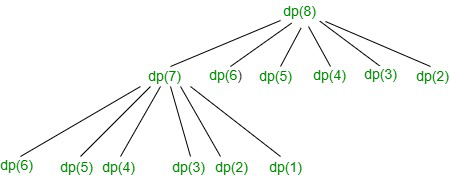
Optimal Substructure: As for every state, recurrence occurs for 6 states, so the recursive definition of dp(N) is the following:
dp[N] = dp[N-1] + dp[N-2] + dp[N-3] + dp[N-4] + dp[N-5] + dp[N-6]
Follow the steps below to solve the problem:
- Initialize an auxiliary array dp[] of size N + 1 with initial value -1, where dp[i] stores the count of ways of having sum i.
- The base case while solving this problem is if N is equal to 0 in any state, the result to such a state is 1.
- If for any state dp[i] is not equal to -1, then this value as this substructure is already beed calculated.
Top-Down Approach: Below is the implementation of the Top-Down approach:
// C++ Program for the above approach

#include <bits/stdc++.h>
using namespace std;

// Function to calculate the total
// number of ways to have sum N
int findWays(int N, int dp[])
{
    // Base Case
    if (N == 0) {
        return 1;
    }

    // Return already stored result
    if (dp[N] != -1) {

        return dp[N];
    }

    int cnt = 0;

    // Recur for all 6 states
    for (int i = 1; i <= 6; i++) {

        if (N - i >= 0) {
            cnt = cnt
                  + findWays(N - i, dp);
        }
    }

    // Return the result
    return dp[N] = cnt;
}

// Driver Code
int main()
{
    // Given sum N
    int N = 4;

    // Initialize the dp array
    int dp[N + 1];

    memset(dp, -1, sizeof(dp));

    // Function Call
    cout << findWays(N, dp);

    return 0;
}
// Java Program for
// the above approach
import java.util.*;
class GFG{

// Function to calculate the total
// number of ways to have sum N
static int findWays(int N, int dp[])
{
    // Base Case
    if (N == 0)
    {
        return 1;
    }

    // Return already
    // stored result
    if (dp[N] != -1)
    {
        return dp[N];
    }

    int cnt = 0;

    // Recur for all 6 states
    for (int i = 1; i <= 6; i++)
    {
        if (N - i >= 0)
        {
            cnt = cnt +
                  findWays(N - i, dp);
        }
    }

    // Return the result
    return dp[N] = cnt;
}

// Driver Code
public static void main(String[] args)
{
    // Given sum N
    int N = 4;

    // Initialize the dp array
    int []dp = new int[N + 1];

    for (int i = 0; i < dp.length; i++)
        dp[i] = -1;

    // Function Call
    System.out.print(findWays(N, dp));
}
}

// This code is contributed by 29AjayKumar
# Python3 Program for the
# above approach

# Function to calculate
# the total number of ways
# to have sum N
def findWays(N, dp):

    # Base Case
    if (N == 0):
        return 1

    # Return already
    # stored result
    if (dp[N] != -1):
        return dp[N]

    cnt = 0

    # Recur for all 6 states
    for i in range (1, 7):
        if (N - i >= 0):
            cnt = (cnt +
                   findWays(N - i, dp))

    # Return the result
    dp[N] = cnt
    return dp[N]

# Driver Code
if __name__ == "__main__":

    # Given sum N
    N = 4

    # Initialize the dp array
    dp = [-1] * (N + 1)

    # Function Call
    print(findWays(N, dp))

# This code is contributed by Chitranayal
// C# Program for
// the above approach
using System;
class GFG{

// Function to calculate the total
// number of ways to have sum N
static int findWays(int N, int []dp)
{
  // Base Case
  if (N == 0)
  {
    return 1;
  }

  // Return already stored result
  if (dp[N] != -1)
  {
    return dp[N];
  }

  int cnt = 0;

  // Recur for all 6 states
  for (int i = 1; i <= 6; i++)
  {
    if (N - i >= 0)
    {
      cnt = cnt + findWays(N - i, dp);
    }
  }

  // Return the result
  return dp[N] = cnt;
}

// Driver Code
public static void Main(String[] args)
{
  // Given sum N
  int N = 4;

  // Initialize the dp array
  int []dp = new int[N + 1];

  for (int i = 0; i < dp.Length; i++)
    dp[i] = -1;

  // Function Call
  Console.Write(findWays(N, dp));
}
}

// This code is contributed by Rajput-Ji
<script>
// Javascript Program for
// the above approach

// Function to calculate the total
// number of ways to have sum N
function findWays(N,dp)
{
    // Base Case
    if (N == 0)
    {
        return 1;
    }

    // Return already
    // stored result
    if (dp[N] != -1)
    {
        return dp[N];
    }

    let cnt = 0;

    // Recur for all 6 states
    for (let i = 1; i <= 6; i++)
    {
        if (N - i >= 0)
        {
            cnt = cnt +
                  findWays(N - i, dp);
        }
    }

    // Return the result
    return dp[N] = cnt;
}

// Driver Code
let N = 4;

// Initialize the dp array
let dp = new Array(N + 1);

for (let i = 0; i < dp.length; i++)
    dp[i] = -1;

// Function Call
document.write(findWays(N, dp));


// This code is contributed by unknown2108
</script>
Output
8
Time Complexity: O(N)
Auxiliary Space: O(N)
Bottom-Up Approach: Below is the implementation of the Bottom-up Dynamic Programming approach:
// C++ Program for the above approach

#include <bits/stdc++.h>
using namespace std;

// Function to calculate the total
// number of ways to have sum N
void findWays(int N)
{
    // Initialize dp array
    int dp[N + 1];

    dp[0] = 1;

    // Iterate over all the possible
    // intermediate values to reach N
    for (int i = 1; i <= N; i++) {

        dp[i] = 0;

        // Calculate the sum for
        // all 6 faces
        for (int j = 1; j <= 6; j++) {

            if (i - j >= 0) {
                dp[i] = dp[i] + dp[i - j];
            }
        }
    }

    // Print the total number of ways
    cout << dp[N];
}

// Driver Code
int main()
{
    // Given sum N
    int N = 4;

    // Function call
    findWays(N);

    return 0;
}
// Java program for the above approach
import java.util.*;

class GFG{

// Function to calculate the total
// number of ways to have sum N
static void findWays(int N)
{

    // Initialize dp array
    int []dp = new int[N + 1];

    dp[0] = 1;

    // Iterate over all the possible
    // intermediate values to reach N
    for(int i = 1; i <= N; i++)
    {
        dp[i] = 0;

        // Calculate the sum for
        // all 6 faces
        for(int j = 1; j <= 6; j++)
        {
            if (i - j >= 0)
            {
                dp[i] = dp[i] + dp[i - j];
            }
        }
    }

    // Print the total number of ways
    System.out.print(dp[N]);
}

// Driver Code
public static void main(String[] args)
{

    // Given sum N
    int N = 4;

    // Function call
    findWays(N);
}
}

// This code is contributed by Amit Katiyar
# Python3 program for
# the above approach

# Function to calculate the total
# number of ways to have sum N
def findWays(N):

    # Initialize dp array
    dp = [0] * (N + 1);
    dp[0] = 1;

    # Iterate over all the
    # possible intermediate
    # values to reach N
    for i in range(1, N + 1):
        dp[i] = 0;

        # Calculate the sum for
        # all 6 faces
        for j in range(1, 7):
            if (i - j >= 0):
                dp[i] = dp[i] + dp[i - j];

    # Print total number of ways
    print(dp[N]);

# Driver Code
if __name__ == '__main__':

    # Given sum N
    N = 4;

    # Function call
    findWays(N);

# This code is contributed by 29AjayKumar
// C# program for
// the above approach
using System;
class GFG{

// Function to calculate the total
// number of ways to have sum N
static void findWays(int N)
{
  // Initialize dp array
  int []dp = new int[N + 1];

  dp[0] = 1;

  // Iterate over all the possible
  // intermediate values to reach N
  for(int i = 1; i <= N; i++)
  {
    dp[i] = 0;

    // Calculate the sum for
    // all 6 faces
    for(int j = 1; j <= 6; j++)
    {
      if (i - j >= 0)
      {
        dp[i] = dp[i] + dp[i - j];
      }
    }
  }

  // Print the total number of ways
  Console.Write(dp[N]);
}

// Driver Code
public static void Main(String[] args)
{
  // Given sum N
  int N = 4;

  // Function call
  findWays(N);
}
}

// This code is contributed by 29AjayKumar
<script>

// JavaScript program for the above approach

// Function to calculate the total
// number of ways to have sum N
function findWays(N)
{
    // Initialize dp array
    let dp = new Array(N + 1);

    dp[0] = 1;

    // Iterate over all the possible
    // intermediate values to reach N
    for(let i = 1; i <= N; i++)
    {
        dp[i] = 0;

        // Calculate the sum for
        // all 6 faces
        for(let j = 1; j <= 6; j++)
        {
            if (i - j >= 0)
            {
                dp[i] = dp[i] + dp[i - j];
            }
        }
    }

    // Print the total number of ways
    document.write(dp[N]);
}

// Driver Code
 // Given sum N
let N = 4;

// Function call
findWays(N);


// This code is contributed by patel2127

</script>
Output
8
Time Complexity: O(N)
Auxiliary Space: O(N)
Efficient Approach: space optimization O(1)
To optimize the space complexity of the previous solution by using only an array of size 6 instead of an array of size N+1 to store the values of dp. We only need to store the values for the last 6 values of dp at any point in time.
Implementation Steps:
- Create an array DP if size 6 instead of size N because we need only the previous 6 computations to get the current value.
- Initialize DP with base case dp[0] = 1.
- Iterate over subproblems and get the current value from previous solutions of subproblems stored in DP.
- At the last return, the final answer is stored in dp[N%6]. ( n%6 ) to compute only the last 6 values.
Implementation:
// C++ program for above approach

#include <bits/stdc++.h>
using namespace std;

// Function to calculate the total
// number of ways to have sum N
void findWays(int N)
{
    // Initialize dp array
    int dp[6];

    dp[0] = 1;

    // Iterate over all the possible
    // intermediate values to reach N
    for (int i = 1; i <= N; i++) {
        int sum = 0;

        // Calculate the sum for
        // all 6 faces
        for (int j = 1; j <= 6; j++) {

            if (i - j >= 0) {
                sum += dp[(i-j)%6];
            }
        }

        // Store the sum for the current i
        dp[i%6] = sum;
    }

    // Print the total number of ways
    cout << dp[N%6];
}

// Driver Code
int main()
{
    // Given sum N
    int N = 4;

    // Function call
    findWays(N);

    return 0;
}

// this code is contributed by bhardwajji
import java.util.*;

public class DiceSum {

    // Function to calculate the total
    // number of ways to have sum N
    public static void findWays(int N) {

        // Initialize dp array
        int[] dp = new int[6];

        dp[0] = 1;

        // Iterate over all the possible
        // intermediate values to reach N
        for (int i = 1; i <= N; i++) {
            int sum = 0;

            // Calculate the sum for
            // all 6 faces
            for (int j = 1; j <= 6; j++) {

                if (i - j >= 0) {
                    sum += dp[(i-j)%6];
                }
            }

            // Store the sum for the current i
            dp[i%6] = sum;
        }

        // Print the total number of ways
        System.out.println(dp[N%6]);
    }

    // Driver Code
    public static void main(String[] args) {
        // Given sum N
        int N = 4;

        // Function call
        findWays(N);
    }
}
# Python program for above approach

# Function to calculate the total
# number of ways to have sum N
def findWays(N):
    # Initialize dp array
    dp = [0] * 6

    dp[0] = 1

    # Iterate over all the possible
    # intermediate values to reach N
    for i in range(1, N+1):
        sum = 0

        # Calculate the sum for
        # all 6 faces
        for j in range(1, 7):

            if i - j >= 0:
                sum += dp[(i-j)%6]

        # Store the sum for the current i
        dp[i%6] = sum

    # Print the total number of ways
    print(dp[N%6])

# Driver Code
if __name__ == '__main__':
    # Given sum N
    N = 4

    # Function call
    findWays(N)
using System;

public class MainClass
{
    public static void Main()
    {
        int N = 4;

        // Initialize dp array
        int[] dp = new int[6];

        dp[0] = 1;

        // Iterate over all the possible
        // intermediate values to reach N
        for (int i = 1; i <= N; i++)
        {
            int sum = 0;

            // Calculate the sum for
            // all 6 faces
            for (int j = 1; j <= 6; j++)
            {
                if (i - j >= 0)
                {
                    sum += dp[(i-j)%6];
                }
            }

            // Store the sum for the current i
            dp[i%6] = sum;
        }

        // Print the total number of ways
        Console.WriteLine(dp[N%6]);
    }
}
let N = 4;

// Initialize dp array
let dp = new Array(6).fill(0);

dp[0] = 1;

// Iterate over all the possible
// intermediate values to reach N
for (let i = 1; i <= N; i++) {
let sum = 0;

// Calculate the sum for
// all 6 faces
for (let j = 1; j <= 6; j++) {
if (i - j >= 0) {
sum += dp[(i - j) % 6];
}
}

// Store the sum for the current i
dp[i % 6] = sum;
}

// Print the total number of ways
console.log(dp[N % 6]);
Output
8
Time Complexity: O(N)
Auxiliary Space: O(1)