

Trees are one of the most important data structures in computer science and are frequently asked about in technical interviews. A strong understanding of tree concepts, traversals, and search trees is essential for solving many DSA problems.
- Covers the most commonly asked tree interview questions with concise explanations.
- Helps strengthen concepts related to tree properties, traversals, BSTs, balancing, and real-world applications.
Table of Content
Theoretical Questions for Interviews
1. What is a Tree Data Structure?
A tree is a non-linear hierarchical data structure that consists of nodes connected by edges. It starts with a root node, and every node can have zero or more child nodes, forming a parent-child relationship.
- Represents hierarchical relationships between data.
- Consists of nodes connected by edges.
- Has a single root node and no cycles.
- Widely used in file systems, databases, and XML/HTML documents.
2. Why are Trees Used?
Trees are used to organize and manage hierarchical data efficiently. They provide faster searching, insertion, and deletion than many linear data structures for suitable applications.
- Represents hierarchical data naturally.
- Supports efficient searching and traversal.
- Enables fast insertion and deletion in balanced trees.
- Used in file systems, databases, compilers, and decision trees.
3. What are the Applications of Trees?
Trees are widely used in computer science to represent hierarchical structures and perform efficient searching and processing.
Applications:
- File and directory systems.
- Database indexing (B-Trees, B+ Trees).
- Binary Search Trees (BSTs) for searching.
- Expression trees in compilers.
- XML/HTML DOM representation.
- Trie for autocomplete and spell checking.
- Decision trees in machine learning.
4. What are the basic operations performed on a tree?
Trees support several fundamental operations for storing, accessing, and managing hierarchical data efficiently.
- Insertion: Adds a new node while maintaining the tree's structure or properties.
- Deletion: Removes a node and updates the tree to preserve its validity.
- Traversal: Visits every node in a specific order for processing or retrieval.
- Searching: Locates a node based on a given key or value.
5. What are the components of a tree?
A tree consists of several components that define its hierarchical structure and relationships between nodes.
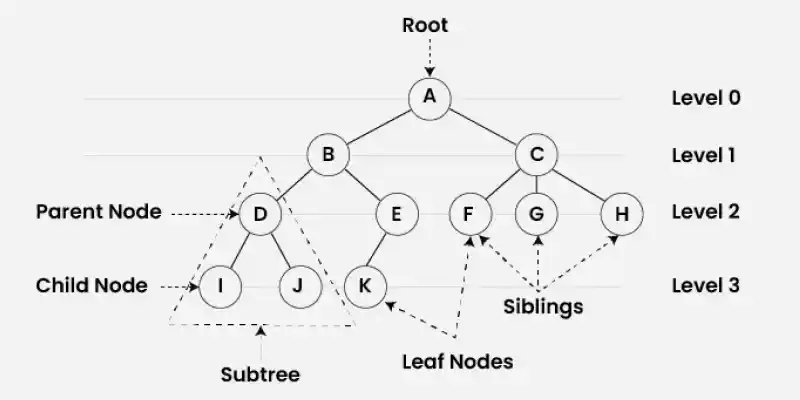
- Root: The topmost node with no parent.
- Node: The fundamental element that stores data and may have child nodes.
- Edge: A link that connects a parent node to its child.
- Leaf: A node that has no children.
- Internal Node: A node with one or more children.
- Subtree: A tree formed by a node and all of its descendants.
6. In a binary tree, what is the maximum number of nodes at level L (assuming the root is at level 0)?
The maximum number of nodes at level L in a binary tree is given by:
Maximum Nodes = 2ᴸ
- The root is at level 0 and contains at most 1 node.
- Each level can have at most twice as many nodes as the previous level.
- This represents the theoretical maximum, regardless of the actual tree structure.
| Level (L) | Maximum Nodes |
|---|---|
| 0 | 1 |
| 1 | 2 |
| 2 | 4 |
| 3 | 8 |
7. How would you delete a node in a binary search tree (BST)?
Deleting a node from a BST depends on the number of children the node has.
- If the node is a leaf, it can be deleted directly.
- If the node has one child, replace it with its child.
- If the node has two children, replace it with its inorder successor (or predecessor).
- Time Complexity: O(h), where h is the height of the BST.
8. Explain different types of trees
Different types of trees are designed to optimize searching, insertion, deletion, or hierarchical data representation.
| Tree Type | Description |
|---|---|
| Binary Tree | Each node has at most two children. |
| Binary Search Tree | A binary tree where the left subtree contains smaller keys and the right subtree contains larger keys. |
| Full Binary Tree | Every node has either zero or two children. |
| Complete Binary Tree | All levels are completely filled except possibly the last, which is filled from left to right. |
| Perfect Binary Tree | Every internal node has two children, and all leaf nodes are at the same level. |
| AVL Tree | A self-balancing BST where the height difference between subtrees is at most one. |
| Red-Black Tree | A self-balancing BST that maintains balance using coloring rules. |
| B-Tree | A multi-way search tree that stores multiple keys per node and is widely used in databases and file systems. |
9. What is the difference betweeen balanced binary tree and complete binary tree?
A balanced binary tree focuses on maintaining a small height difference between subtrees, whereas a complete binary tree focuses on the arrangement of nodes.
| Balanced Binary Tree | Complete Binary Tree |
|---|---|
| The height difference between the left and right subtrees of every node is at most one. | All levels are completely filled except possibly the last, which is filled from left to right. |
| Designed to keep tree operations efficient. | Designed to maximize space utilization. |
| Search, insertion, and deletion typically take O(log n) time. | Does not necessarily guarantee O(log n) search time. |
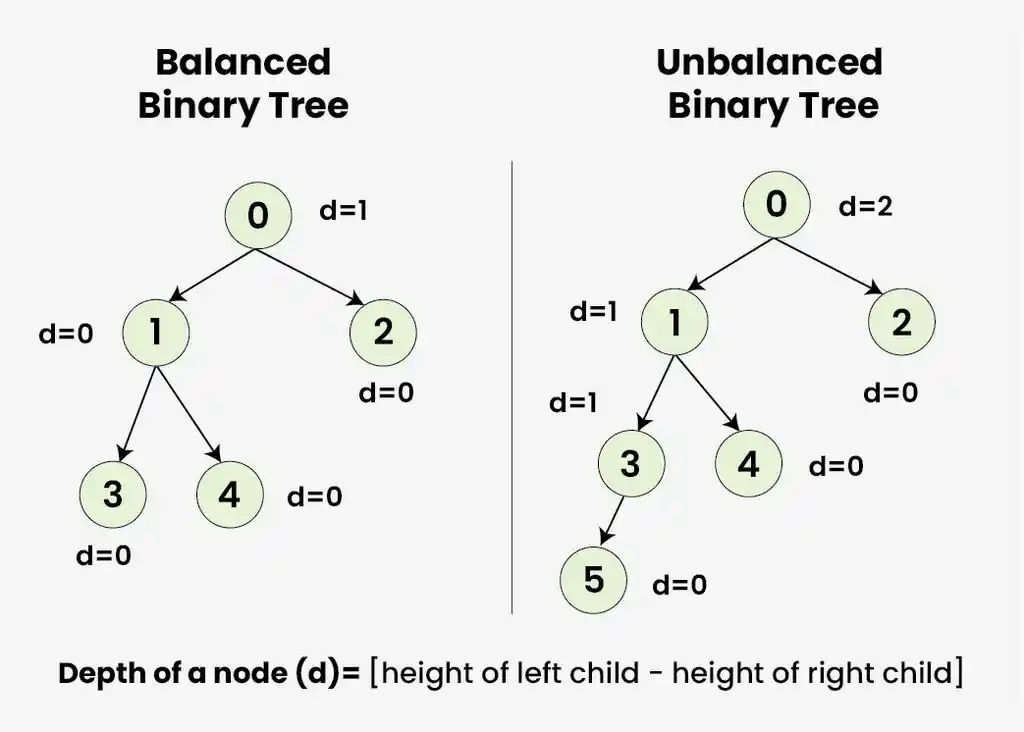
10. How would you check if a binary tree is balanced?
A binary tree is balanced if, for every node, the height difference between its left and right subtrees is at most 1.
Approach:
- Compute the height of the left and right subtrees for every node.
- Check if |leftHeight - rightHeight| ≤ 1.
- Recursively verify that both left and right subtrees are also balanced.
- If all nodes satisfy the condition, the tree is balanced.
- Time Complexity: O(n²)
Optimized Approach:
- Use a postorder traversal.
- Return the height of each subtree while checking the balance condition.
- Return -1 immediately if any subtree is unbalanced to avoid unnecessary computations.
- Time Complexity: O(n)
11. What are the different ways to represent a tree in memory?
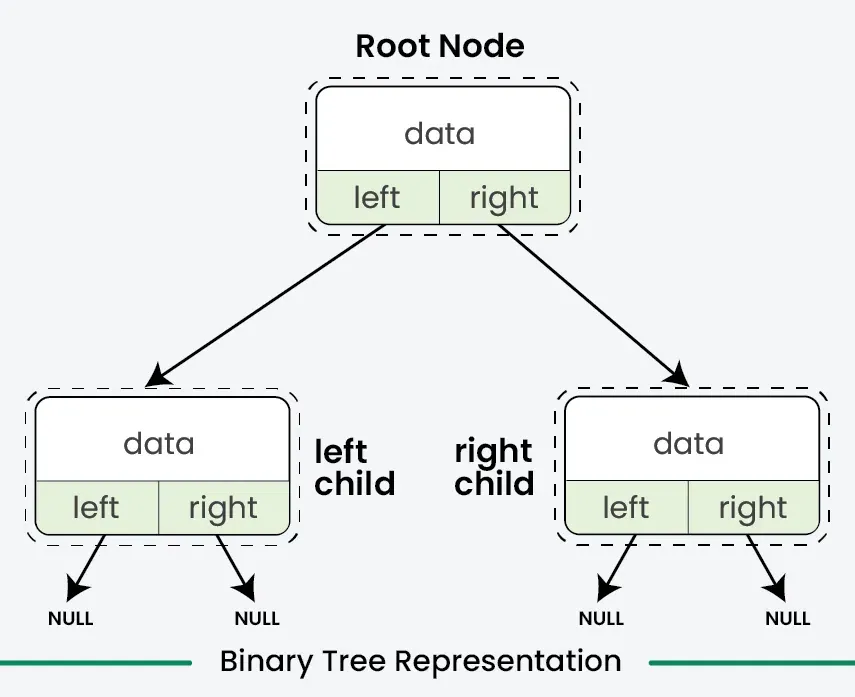
Trees can be represented in memory using different techniques based on their structure and application.
Node-based representation: Each node stores data along with references to its child nodes.
Array-based representation: Nodes are stored in an array using index relationships to locate parent and child nodes.

12. What are the advantages and disadvantages of using trees?
Trees provide an efficient way to organize and access hierarchical data but also introduce additional memory and implementation overhead.
Advantages
- Efficient for representing hierarchical relationships.
- Supports fast searching, insertion, and deletion in balanced trees.
- Enables efficient traversal and ordered data processing.
Disadvantages
- Requires additional memory to store links between nodes.
- Can become inefficient if the tree becomes unbalanced.
- More complex to implement than linear data structures.
13. When would you choose a tree over other data structures like arrays or linked lists?
A tree is preferred over arrays or linked lists when the data has a hierarchical structure or requires efficient searching, insertion, and deletion.
- Use a tree for hierarchical data such as file systems or organization charts.
- Use a tree for efficient searching, insertion, and deletion.
- Use a tree when maintaining sorted data with frequent updates.
- Use an array for fast index-based access.
- Use a linked list for frequent sequential insertions and deletions.
14. Explain the concept of a binary search tree.
A Binary Search Tree (BST) is a binary tree that follows a specific ordering rule, making searching and updates efficient.
- All nodes in the left subtree have values smaller than the root.
- All nodes in the right subtree have values greater than the root.
- Both the left and right subtrees must also satisfy the BST property.
- Enables efficient searching, insertion, and deletion operations.
15. How do self-balancing trees like AVL or Red-Black trees work?
Self-balancing trees automatically keep their height balanced to maintain efficient operations.
- They rebalance the tree after insertions and deletions.
- Rotations are used to restore balance when needed.
- AVL Trees keep the height difference between subtrees at most 1.
- Red-Black Trees use color rules to maintain balance.
- They provide O(log n) search, insertion, and deletion.
16. Describe the different tree traversal methods.
Tree traversal is the process of visiting every node of a tree in a specific order.
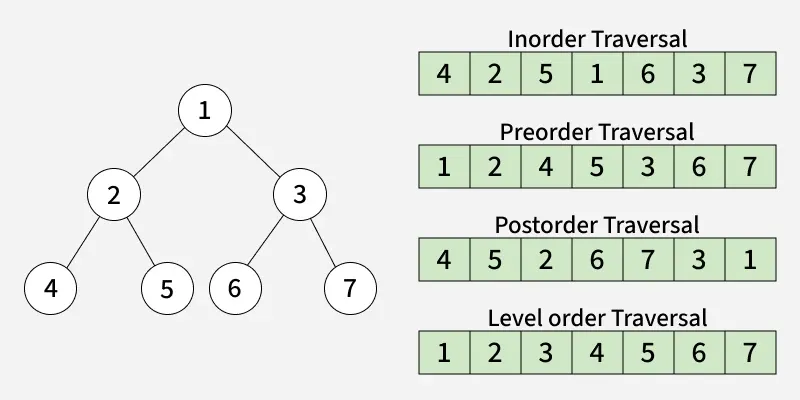
- Preorder (Root -> Left -> Right): Visit the root first, then the left subtree, followed by the right subtree.
- Inorder (Left -> Root -> Right): Visit the left subtree, then the root, and finally the right subtree. (Produces sorted order in a BST.)
- Postorder (Left -> Right -> Root): Visit the left subtree, then the right subtree, and finally the root.
- Level Order: Visits nodes level by level from top to bottom using a queue.
17. How would you find the minimum and maximum elements in a binary search tree (BST)?
In a Binary Search Tree (BST), the minimum and maximum elements can be found by following the tree's ordering property.
- Minimum Element: Traverse the left child repeatedly until the leftmost node is reached.
- Maximum Element: Traverse the right child repeatedly until the rightmost node is reached.
- Time Complexity: O(h), where h is the height of the BST.
- Auxiliary Space: O(1) for iterative traversal, O(h) for recursive traversal.
18. How can you convert a binary search tree into a sorted array?
A BST can be converted into a sorted array by performing an inorder traversal.
- Traverse the tree in Left -> Root -> Right order.
- Store each visited node in an array.
- The resulting array is sorted in ascending order.
- Time Complexity: O(n)
- Space Complexity: O(n) (excluding recursion stack)
19. What is a trie?
A trie (prefix tree) is a tree data structure used to store and retrieve strings efficiently based on their prefixes.
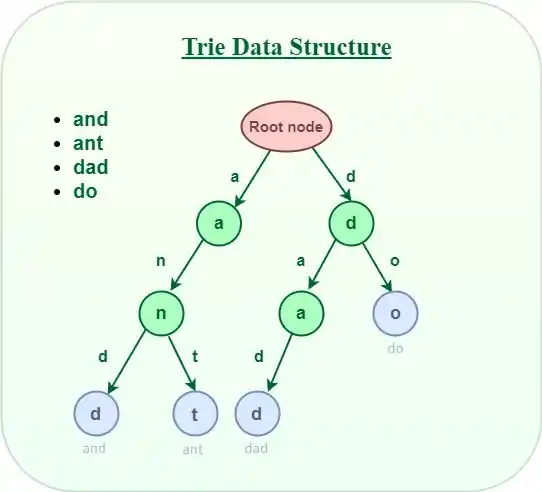
- Each node represents a character in a string.
- Commonly used for prefix searching and autocomplete.
- Supports efficient insertion, search, and deletion of strings.
20. What is the difference between a tree and a graph?
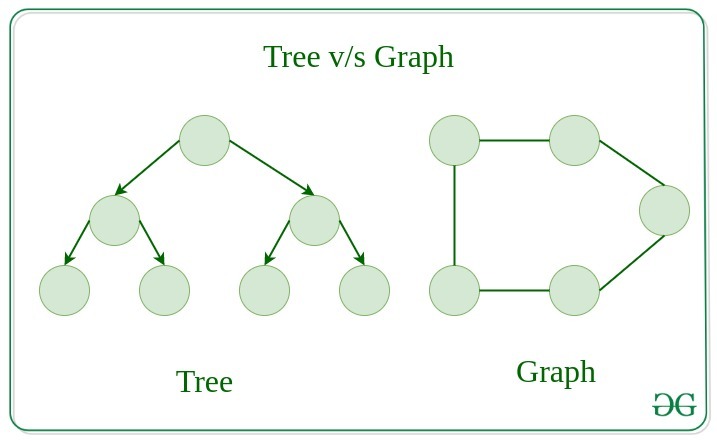
Although both trees and graphs consist of nodes and edges, they have different structural properties.
| Tree | Graph |
|---|---|
| A connected, acyclic data structure. | May contain cycles and can be disconnected. |
| Has exactly one path between any two nodes. | May have multiple paths between two nodes. |
| A tree with n nodes has n − 1 edges. | The number of edges can vary. |
21. What is the Lowest Common Ancestor (LCA) in a tree?
The Lowest Common Ancestor (LCA) of two nodes is the deepest node that is an ancestor of both.
- Represents the nearest common ancestor of two nodes.
- Commonly used in binary trees and binary search trees.
- Frequently asked in coding and system design interviews.
22. What is the difference between a binary tree and a binary search tree?
A binary tree and a binary search tree differ in the way their nodes are organized.
| Binary Tree | Binary Search Tree (BST) |
|---|---|
| Each node has at most two children. | Follows an ordering property for node values. |
| Nodes can have any arrangement. | Left subtree contains smaller keys, and the right subtree contains larger keys. |
| Searching may take O(n) time. | Searching takes O(log n) on average in a balanced BST. |
23. Describe the use cases of trees in real-world scenarios.
Trees are widely used to represent hierarchical data and support efficient searching and decision-making.
- File systems (directory structure)
- XML or JSON data representation
- Decision trees for machine learning
- Game AI (representing game states and possible actions)
- Social networks (representing user relationships)
Top Coding Interview Questions on Tree
The following list of 50 tree coding problems covers a range of difficulty levels, from easy to hard, to help candidates prepare for interviews.
Easy Problems
- Height of Binary Tree
- Identical Trees
- Mirror Trees
- Symmetric Trees
- Balanced tree
- Children Sum Parent
- Array to BST
- Nodes at given distance
- Inorder Successor in BST
- Kth Largest Element in a BST
- Balance a BST
Medium Problems
- Diameter of Tree
- Check if Subtree
- Check for BST
- Single Valued Subtree
- Unique BSTs
- Zigzag Tree Traversal
- Vertical Traversal
- Boundary Traversal
- Tree from Preorder and Inorder Traversal
- BST from preorder traversal
- Minimum distance between two nodes
- Maximum sum leaf to root path
- Odd Even Level Difference
- Lowest Common Ancestor of a Binary Tree
- Ancestors in Binary Tree
- Remove BST keys outside the given range
- Pair with given target in BST
- BST to greater sum tree
- Maximum sum of non adjacent
- Largest BST in a Binary Tree
- Extreme nodes in alternate order
- Connect nodes at same level