

Heap data structure interview questions are commonly asked to assess your understanding of heap operations, priority queues, heap sort, and related algorithms. This collection covers the most important heap concepts to help you prepare for coding and technical interviews.
- Covers the most frequently asked heap interview questions with concise explanations.
- Suitable for both freshers and experienced professionals preparing for technical interviews.
Table of Content
Theoretical Questions for Interviews
1. What is a Heap data structure?
A heap is a specialized complete binary tree that satisfies the heap property, where the parent node is ordered with respect to its children. It is commonly used to implement priority queues.
Heap comes in two primary forms, each suited for different use cases:
- A Max-heap stores the largest element at the root.
- A Min-heap stores the smallest element at the root.
2. What is the Heap Property?
The heap property defines the ordering relationship between a parent node and its children in a heap.
- In a max heap, every parent node is greater than or equal to its children.
- In a min heap, every parent node is less than or equal to its children.
- This property ensures that the root always contains the highest- or lowest-priority element.
3. What are the different types of heaps?
Heaps can be classified based on the ordering of their elements and their underlying structure.
Based on Heap Property
- Max Heap: The parent node is greater than or equal to its children.
- Min Heap: The parent node is less than or equal to its children.
Specialized Heap Variants
- Binary Heap: Complete binary tree commonly used to implement priority queues.
- Binomial Heap: Collection of binomial trees supporting efficient merge operations.
- Fibonacci Heap: Supports efficient amortized insertion and decrease-key operations.
- Skew Heap: Self-adjusting heap designed for efficient merging.
- Pairing Heap: Simplified self-adjusting heap with good practical performance.
4. How is a heap represented in memory?
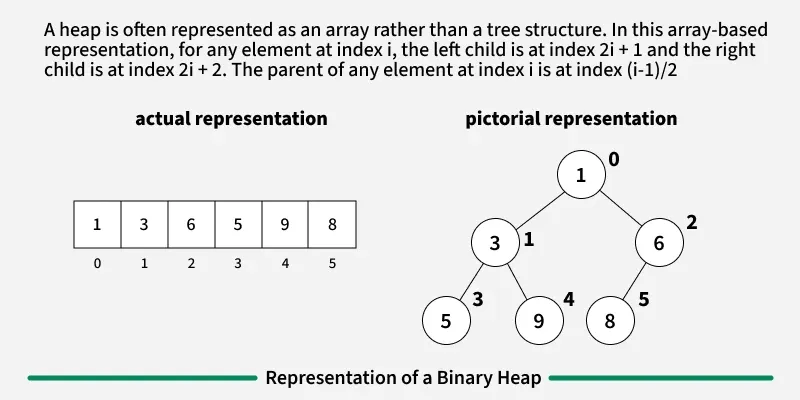
A heap is usually represented as a sequential array instead of using pointers. Since a heap is a complete binary tree, its nodes can be stored compactly without leaving gaps.
- The root is stored at index 0.
- The left child of index i is at 2 × i + 1, and the right child is at 2 × i + 2.
- The parent of index i is at ⌊(i − 1) / 2⌋.
5. Why is a heap called a complete binary tree?
A heap is called a complete binary tree because all its levels are completely filled except possibly the last, and the last level is filled from left to right without any gaps.
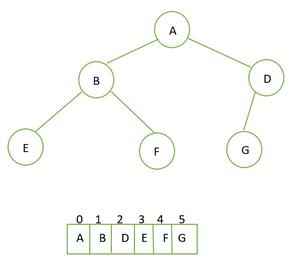
- Every level, except the last, contains the maximum possible number of nodes.
- Nodes in the last level are placed from left to right in contiguous positions.
- This structure allows the heap to be stored efficiently in an array.
6. What are the basic operations on a heap?
A heap supports several operations for maintaining and accessing elements while preserving the heap property.
- Insert(): Adds a new element to the heap.
- GetMin()/GetMax(): Returns the root element without removing it.
- ExtractMin()/ExtractMax(): Removes and returns the root element.
- DecreaseKey()/IncreaseKey(): Updates a key and restores the heap property.
- Delete(): Removes a specified element from the heap.
- Heapify(): Rearranges nodes to restore the heap property after an update.
Note: In a min heap, the operations are GetMin() and ExtractMin(), whereas in a max heap, they are GetMax() and ExtractMax().
7. What is the time complexity of heap operations?
The time complexity of heap operations depends on the height of the heap, which is O(log n) for a heap containing n elements.
| Operation | Time Complexity |
|---|---|
| Insert() | O(log n) |
| GetMin()/GetMax() | O(1) |
| ExtractMin()/ExtractMax() | O(log n) |
| DecreaseKey()/IncreaseKey() | O(log n) |
| Delete() | O(log n) |
| Heapify() | O(log n) |
| Build Heap | O(n) |
- Most heap operations take O(log n) time because they may traverse the height of the heap.
- Accessing the root element takes O(1) time.
- Building a heap from an unordered array takes O(n) time.
8. How efficient is it to find the minimum or maximum element in different heaps?
The efficiency depends on the type of heap because a heap keeps only one extreme element at the root.
- In a min heap, the minimum element is at the root, so it can be found in O(1) time, while finding the maximum requires scanning the heap, taking O(n) time.
- In a max heap, the maximum element is at the root, so it can be found in O(1) time, while finding the minimum takes O(n) time.
- A heap is optimized for accessing one extreme element efficiently, not both simultaneously.
9. What is Heapify?
Heapify is the process of rearranging the elements of a heap to restore the heap property after an insertion, deletion, or key update.
- Restores the heap property when it is violated.
- Rearranges nodes by moving elements up or down the heap.
- Runs in O(log n) time for a single heapify operation.
10. What is Build Heap?
Build Heap is the process of converting an unordered collection of elements into a valid heap.
- Constructs a heap from an unsorted array.
- Applies heapify starting from the last non-leaf node to the root.
- Runs in O(n) time.
11. What is the difference between a heap and a binary search tree (BST)?
A heap and a binary search tree (BST) are both tree-based data structures, but they differ in how elements are organized and accessed.
| Feature | Heap | Binary Search Tree (BST) |
|---|---|---|
| Ordering | Follows the heap property | Left subtree < Root < Right subtree |
| Structure | Complete binary tree | Not necessarily complete |
| Root Element | Contains the minimum or maximum element | Depends on inserted values |
| Searching | O(n) | O(log n) on average |
| Primary Use | Priority queues | Fast searching, insertion, and deletion |
- A heap is optimized for retrieving the minimum or maximum element.
- A BST is optimized for searching elements in sorted order.
- Both support insertion and deletion, but serve different purposes.
12. What is the difference between a heap and a priority queue?
A heap is a data structure, whereas a priority queue is an abstract data type (ADT) that processes elements based on their priority.
| Feature | Heap | Priority Queue |
|---|---|---|
| Type | Data structure | Abstract data type (ADT) |
| Purpose | Organizes elements using the heap property | Retrieves elements based on priority |
| Implementation | Usually implemented as a binary heap | Can be implemented using a heap, BST, or other structures |
| Operations | Heap-specific operations such as heapify | Priority queue operations such as insert and extract |
- A heap is the most common implementation of a priority queue.
- A priority queue defines what operations are supported, while a heap defines how they are performed.
13. What are the applications of heaps?
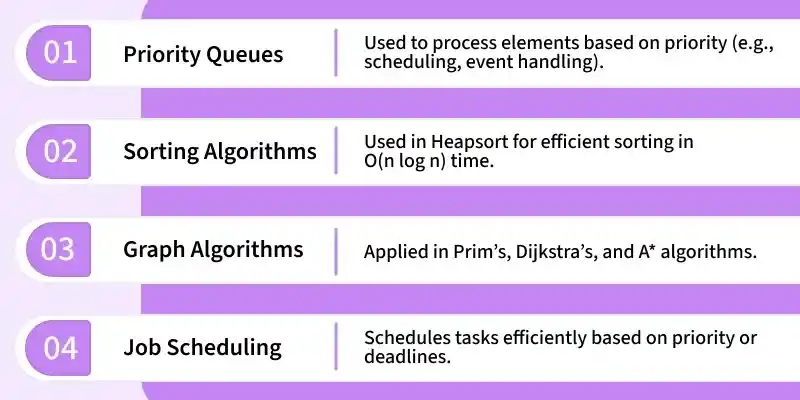
Heaps are widely used in algorithms that require efficient access to the highest- or lowest-priority element.
14. What is Heap Sort?
Heap Sort is a comparison-based sorting algorithm that uses a heap to sort elements in ascending or descending order.
- First builds a heap from the input elements.
- Repeatedly removes the root element and restores the heap property.
- Runs in O(n log n) time with O(1) auxiliary space.
15. What is the time complexity of Heap Sort?
Heap Sort has the same time complexity in the best, average, and worst cases because it always performs heap construction followed by repeated heapify operations.
| Case | Time Complexity |
|---|---|
| Best Case | O(n log n) |
| Average Case | O(n log n) |
| Worst Case | O(n log n) |
- Building the initial heap takes O(n) time.
- Each extraction and heapify operation takes O(log n) time.
- Sorting all n elements results in an overall complexity of O(n log n).
16. How do you merge two heaps?
Two heaps can be merged by combining their elements and rebuilding the heap, or by using specialized heap variants that support efficient merge operations.
.webp)
Steps:
- Combine the elements of both heaps into a single collection.
- Rebuild the heap using the combined elements.
- The resulting heap satisfies the heap property.
Time Complexity: O(n + m) for a binary heap, where n and m are the sizes of the two heaps.
17. How do you convert a BST into a heap?
A Binary Search Tree (BST) can be converted into a heap by preserving its structure and rearranging the node values to satisfy the heap property.
Steps:
- Store the BST elements using an inorder traversal.
- Perform a level-order traversal of the BST.
- Assign the stored values to the visited nodes to satisfy the desired heap property.
Assign values in ascending order to create a min heap and in descending order to create a max heap.
- Time Complexity: O(n)
- Auxiliary Space: O(n)
18. How do you find the Kth largest or Kth smallest element using a heap?
A heap can efficiently find the Kth largest or Kth smallest element without sorting the entire collection.
Steps to Find the Kth Largest Element:
- Build a min heap of the first K elements.
- Process the remaining elements one by one.
- Replace the root if a larger element is found.
- The root of the heap is the Kth largest element.
Steps to Find the Kth Smallest Element:
- Build a max heap of the first K elements.
- Process the remaining elements one by one.
- Replace the root if a smaller element is found.
- The root of the heap is the Kth smallest element.
Time Complexity: O(n log k)
Auxiliary Space: O(k)
19. What are Binomial and Fibonacci Heaps?
Binomial Heap and Fibonacci Heap are advanced heap data structures designed to support efficient priority queue operations, especially heap merging.
Binomial Heap
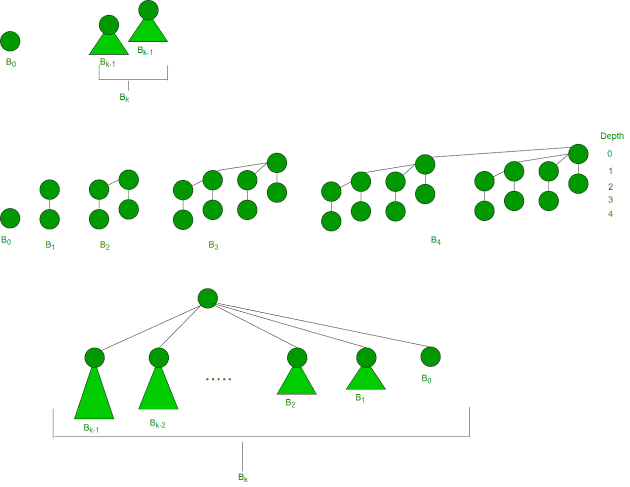
- Consists of a collection of binomial trees.
- Supports efficient merge (union) operations.
- Commonly used in algorithms requiring frequent heap merges.
Fibonacci Heap
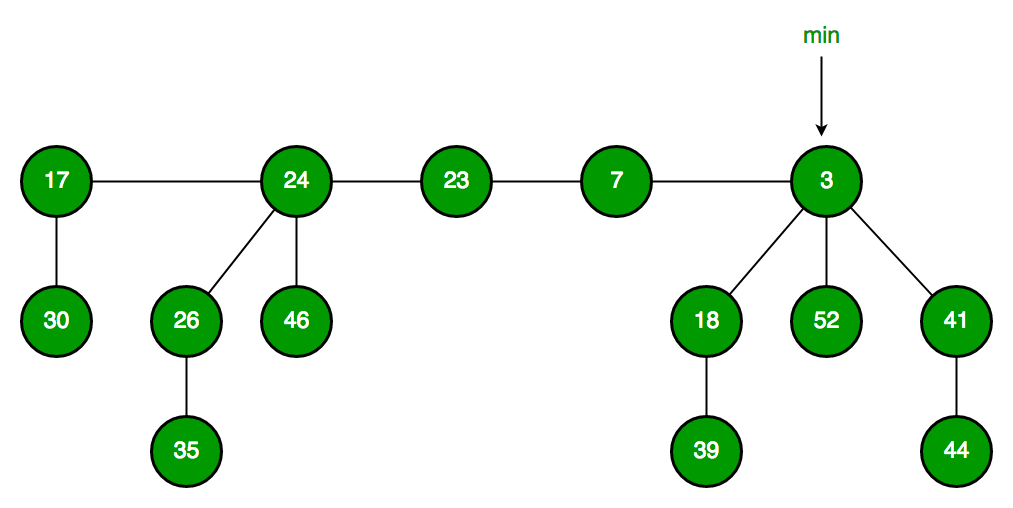
- Consists of a collection of heap-ordered trees connected using linked lists.
- Supports very efficient amortized insertion, merge, and decrease-key operations.
- Commonly used in graph algorithms such as Dijkstra's and Prim's algorithms.
20. When should you use a heap instead of other data structures?
A heap is preferred when the application requires efficient access to the minimum or maximum element without maintaining the entire collection in sorted order.
- When implementing priority queues.
- When repeatedly retrieving the minimum or maximum element.
- When solving problems such as Heap Sort, Kth largest/smallest, and scheduling tasks.
- When using graph algorithms such as Dijkstra's and Prim's.
Coding Interview Questions
The following list of 50 heap coding problems covers a range of difficulty levels, from easy to hard, to help candidates prepare for interviews.
Easy Problems
- Heap Sort
- Kth Smallest Element
- Minimum product of k in an array
- Sort an Almost Sorted Array
- Min sum of two numbers from Digits
- Sum between k1’th and k2’th smallest
- K Closest Points to the Origin
Medium Problems
- Top K Frequent
- Rearrange characters
- Convert min Heap to max Heap
- Check if a Binary Tree is a Min Heap
- kth smallest element in a row-column sorted matrix
- Connect n ropes with min cost
- Merge two binary max heaps
- Find k closest numbers
- K’th largest in a stream
- k numbers with most occurrences in array
- Game with String
- Maximize The Array
- Min sum of squares of counts after removing k
- Maximum sum of Two Non-Overlapping Intervals
- K-th Largest Sum Subarray
- Room with Maximum Meetings
- BST to Max Heap