

Graph interview questions are commonly asked to evaluate your understanding of graph representations, traversals, shortest path algorithms, and graph-based problem solving. This collection covers the most important graph concepts to help you prepare for coding and technical interviews.
- Covers the most frequently asked graph interview questions with concise explanations.
- Suitable for both freshers and experienced professionals preparing for technical interviews.
Table of Content
Theoretical Questions for Interviews
1. What is a Graph Data Structure?
A graph is a non-linear data structure that consists of a set of vertices (nodes) connected by edges. It is used to represent relationships or connections between different entities.
- Consists of vertices (nodes) and edges (connections).
- Can represent directed or undirected relationships.
- Widely used in networks, maps, social media, and routing problems.
2. What are the Different Types of Graphs?
Graphs can be classified based on their edge direction, edge weights, connectivity, and structural properties.
1. Based on Edge Direction
- Directed Graph (Digraph): Edges have a specific direction.
- Undirected Graph: Edges have no direction.
2. Based on Edge Weights
- Weighted Graph: Each edge has an associated weight or cost.
- Unweighted Graph: Edges do not have weights.
3. Based on Connectivity
- Connected Graph: A path exists between every pair of vertices.
- Disconnected Graph: One or more vertices are not reachable from others.
4. Based on Cycles
- Cyclic Graph: Contains at least one cycle.
- Acyclic Graph: Contains no cycles.
5. Based on Structure
- Complete Graph: Every pair of distinct vertices is connected by an edge.
- Bipartite Graph: Vertices can be divided into two disjoint sets such that no two vertices in the same set are adjacent.
- Tree: A connected graph with no cycles.
- Directed Acyclic Graph (DAG): A directed graph without cycles.
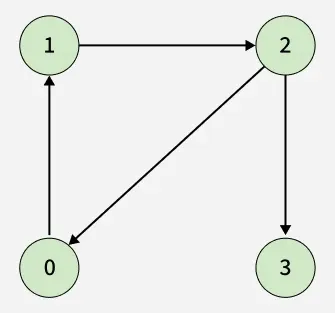
3. What is a Cycle in a Graph?
A cycle is a path in a graph that starts and ends at the same vertex, with no repeated vertices or edges except the starting and ending vertex.
- Begins and ends at the same vertex.
- Visits each intermediate vertex only once.
- Can exist in both directed and undirected graphs.
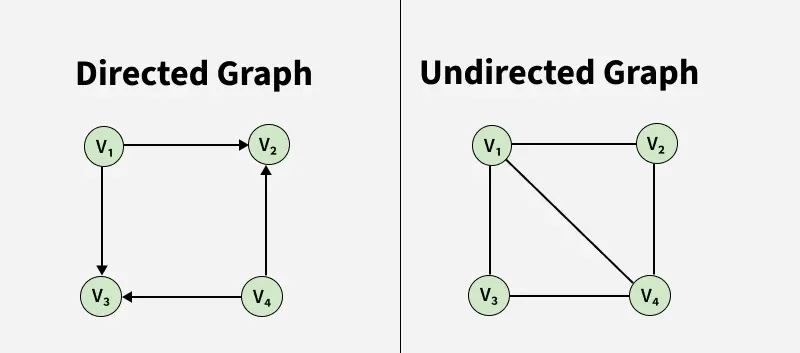
4. What is the Difference Between a Directed and an Undirected Graph?
A directed graph stores edges with a specific direction, whereas an undirected graph stores edges without any direction, allowing traversal in both ways. The following are the major differences between directed and undirected graphs:
| Feature | Directed Graph | Undirected Graph |
|---|---|---|
| Edge Direction | Edges have a direction | Edges have no direction |
| Representation | Ordered pair (u, v) | Unordered pair {u, v} |
| Traversal | Allowed only in the edge direction | Allowed in both directions |
| Relationship | One-way | Two-way |
| Example | One-way roads, task dependencies | Friendships, two-way roads |
5. What are the Different Ways to Represent a Graph?
A graph can be represented in different ways depending on the operations to be performed and the memory requirements. The choice of representation affects the efficiency of graph algorithms.
1. Adjacency Matrix
- Represents the graph using a 2D matrix.
- Stores 1 (or the edge weight) if an edge exists; otherwise stores 0.
- Suitable for dense graphs.
2. Adjacency List
- Represents each vertex with a list of its adjacent vertices.
- Uses less memory for sparse graphs.
- Most commonly used graph representation.
3. Edge List
- Stores the graph as a list of edges.
- Each edge is represented as a pair (or tuple) of vertices.
- Useful when processing or sorting edges, such as in Kruskal's algorithm.
4. Incidence Matrix
- Uses a matrix where rows represent vertices and columns represent edges.
- Each cell indicates whether a vertex is incident to an edge.
- Commonly used in graph theory and network analysis.
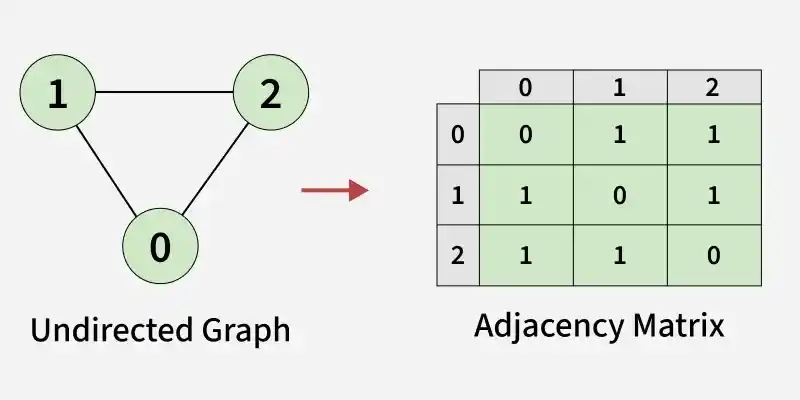
6. What is an Adjacency Matrix?
An adjacency matrix represents a graph using a 2D array, where each cell indicates whether an edge exists between two vertices.
- Uses a V × V matrix to represent the graph.
- Stores 1 (or the edge weight) if an edge exists; otherwise stores 0.
- Supports constant-time O(1) edge lookup.
- Best suited for dense graphs with many edges.
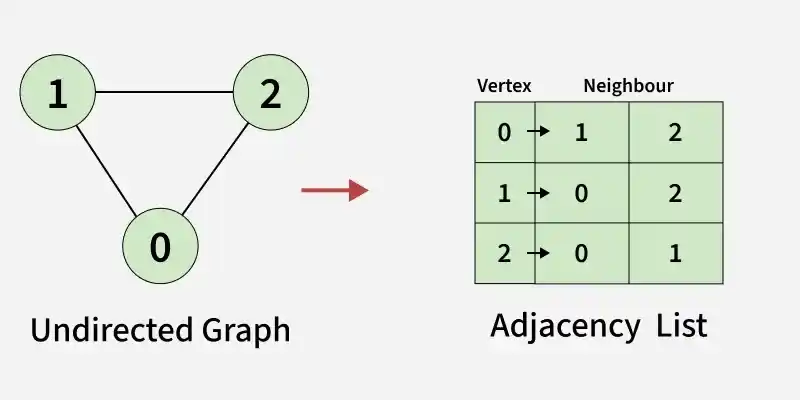
7. What is an Adjacency List?
An adjacency list is a graph representation in which each vertex maintains a list of all the vertices directly connected to it. Instead of storing every possible edge, it stores only the existing connections, making it memory-efficient.
- Stores the neighbors of each vertex in separate lists.
- Requires O(V + E) memory, where V is the number of vertices and E is the number of edges.
- Efficient for traversing the neighbors of a vertex.
- Best suited for sparse graphs with fewer edges.
8. What is the Difference Between an Adjacency Matrix and an Adjacency List?
An adjacency matrix stores graph connections in a 2D array, whereas an adjacency list stores a list of neighboring vertices for each vertex. The following table summarizes the key differences between the two representations:
| Feature | Adjacency Matrix | Adjacency List |
|---|---|---|
| Representation | 2D array | Array (or map) of lists |
| Space Complexity | O(V²) | O(V + E) |
| Edge Lookup | O(1) | O(degree of vertex) |
| Traversing Neighbors | O(V) | O(degree of vertex) |
| Adding an Edge | O(1) | O(1) (average) |
| Removing an Edge | O(1) | O(degree of vertex) |
| Best Suited For | Dense graphs | Sparse graphs |
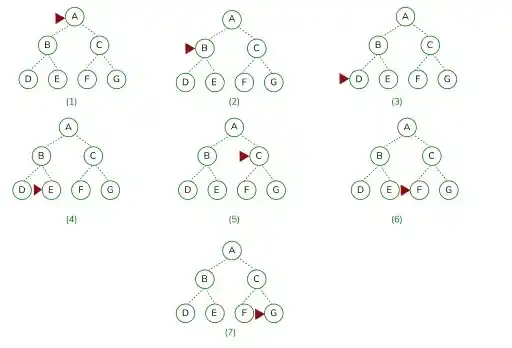
9. What is Depth First Search (DFS)?
Depth First Search (DFS) is a graph traversal algorithm that explores a path as deeply as possible before backtracking to visit other vertices. It is commonly implemented using recursion or a stack.
- Traverses vertices by moving to the deepest unvisited vertex first.
- Uses a stack (explicitly or through recursion) for traversal.
- Commonly used for cycle detection, topological sorting, and connected component analysis.
10. What is Breadth First Search (BFS)?
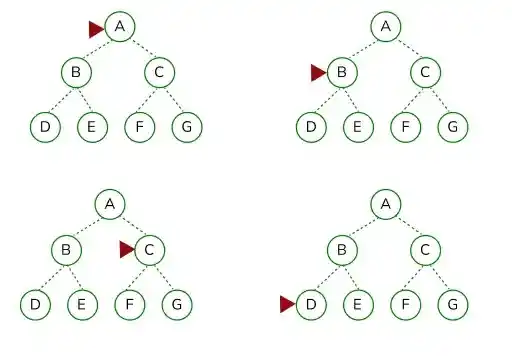
Breadth First Search (BFS) is a graph traversal algorithm that visits vertices level by level, exploring all neighboring vertices before moving to the next level. It is commonly implemented using a queue.
- Visits vertices level by level from the starting vertex.
- Uses a queue to maintain the traversal order.
- Useful for shortest paths and level-order traversal.
11. What is the Difference Between DFS and BFS?
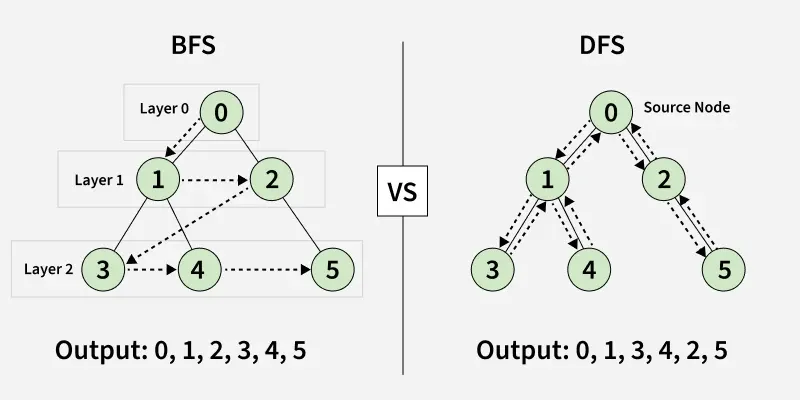
DFS explores a graph by going as deep as possible before backtracking, whereas BFS explores the graph level by level by visiting all neighboring vertices first. The following table summarizes the
key differences between DFS and BFS:
| Feature | DFS | BFS |
|---|---|---|
| Traversal Order | Goes deep before backtracking | Visits vertices level by level |
| Data Structure Used | Stack (or recursion) | Queue |
| Shortest Path | Does not guarantee shortest path | Finds the shortest path in unweighted graphs |
| Memory Usage | Usually lower | Usually higher |
| Common Applications | Cycle detection, topological sorting | Shortest path, level-order traversal |
12. What is the Time Complexity of DFS and BFS?
The time complexity of both Depth First Search (DFS) and Breadth First Search (BFS) depends on the graph representation. For an adjacency list, both algorithms visit each vertex and edge at most once.
| Graph Representation | DFS | BFS |
|---|---|---|
| Adjacency List | O(V + E) | O(V + E) |
| Adjacency Matrix | O(V²) | O(V²) |
Where:
- V = Number of vertices
- E = Number of edges
Note: Both DFS and BFS have the same time complexity. The difference between them lies in the traversal strategy and the data structure used (stack for DFS and queue for BFS).
13. How do you Find the Shortest Path in an Unweighted Graph?
The shortest path in an unweighted graph is typically found using Breadth First Search (BFS). Since BFS visits vertices level by level, the first time a vertex is reached is guaranteed to be through the shortest path.
Steps:
- Start BFS from the source vertex.
- Mark each visited vertex and store its parent.
- Continue until the destination vertex is reached.
- Reconstruct the path by following the parent pointers.

Input: V = 8, E = 10, S = 0, D = 7, edges[][] = {{0, 1}, {1, 2}, {0, 3}, {3, 4}, {4, 7}, {3, 7}, {6, 7}, {4, 5}, {4, 6}, {5, 6}}
Output: 0 3 7
Explanation: BFS explores the graph level by level. Starting from 0, it first visits its adjacent vertices and continues exploring the next level. Since 7 is first reached through 0 -> 3-> 7, this is the shortest path containing only 2 edges.
14. How do you Find the Shortest Path in a Weighted Graph?
The shortest path in a weighted graph is found using algorithms that consider the weights assigned to edges. The choice of algorithm depends on whether the graph contains negative edge weights.
- Dijkstra's Algorithm: Used when all edge weights are non-negative.
- Bellman-Ford Algorithm: Handles graphs with negative edge weights.
- Floyd-Warshall Algorithm: Finds shortest paths between all pairs of vertices.
15. What is Dijkstra's Algorithm and How Does it Work?
Dijkstra's algorithm is a shortest path algorithm used to find the minimum distance from a source vertex to all other vertices in a weighted graph with non-negative edge weights.
- Finds the shortest path from a source to all reachable vertices.
- Works only with non-negative edge weights.
- Uses a priority queue (min-heap) for efficient processing.
Working of Dijkstra's Algorithm
- Initialize the source vertex with distance 0 and all other vertices with ∞.
- Select the unvisited vertex with the smallest tentative distance.
- Update the distances of all its adjacent vertices if a shorter path is found.
- Mark the current vertex as visited.
- Repeat until all vertices are processed.
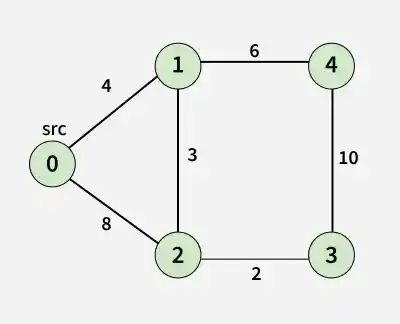
If the source vertex is 0, the shortest path to vertex 4 is:
0 -> 1 -> 4
Total Cost: 4 + 6 = 10
Explanation: Dijkstra's algorithm selects the minimum-cost path by updating the shortest distance to each vertex until all reachable vertices are processed.
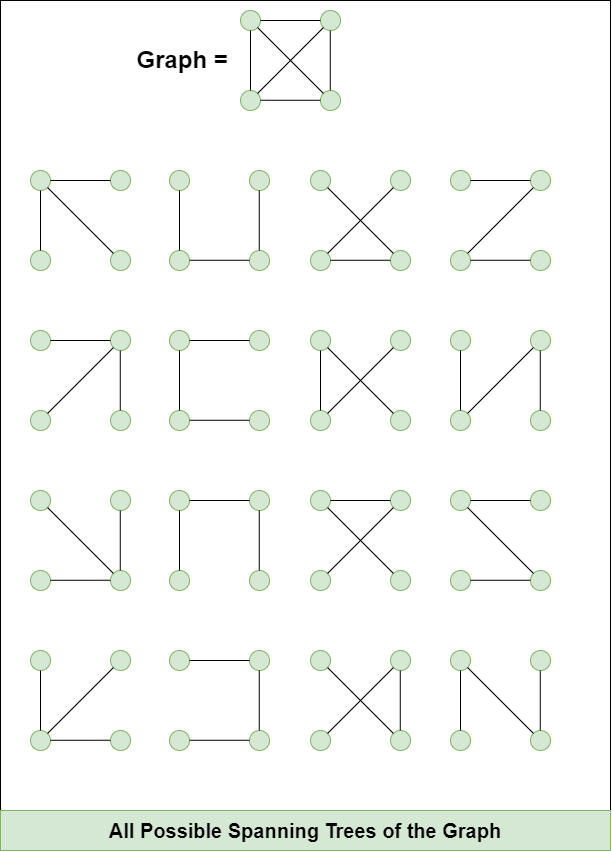
16. What is a Spanning Tree?
A spanning tree is a subgraph of a connected graph that includes all the vertices and connects them using the minimum number of edges without forming any cycles.
- Contains all the vertices of the original graph.
- Has exactly V − 1 edges, where V is the number of vertices.
- Does not contain any cycles.
17. What is a Minimum Spanning Tree (MST)?
A Minimum Spanning Tree (MST) is a spanning tree of a weighted, connected graph that connects all vertices with the minimum possible total edge weight without forming any cycles.
- Connects all vertices with the minimum total edge weight.
- Contains exactly V − 1 edges and no cycles.
- Can be found using Prim's or Kruskal's algorithm.
18. What is Kruskal's Algorithm?
Kruskal's algorithm is a greedy algorithm used to find the Minimum Spanning Tree (MST) of a weighted, connected graph. It repeatedly selects the edge with the smallest weight while ensuring that no cycles are formed.
Working of Kruskal's Algorithm
- Sort all edges in ascending order of their weights.
- Select the smallest edge that does not form a cycle.
- Repeat until V - 1 edges are included in the MST.
19. What is Prim's Algorithm?
Prim's algorithm is a greedy algorithm used to find the Minimum Spanning Tree (MST) of a weighted, connected graph. It starts from any vertex and repeatedly adds the minimum-weight edge that connects a visited vertex to an unvisited vertex.
Working of Prim's Algorithm
- Choose any vertex as the starting point.
- Select the minimum-weight edge connected to the visited vertices.
- Add the new vertex to the MST.
- Repeat until all vertices are included.
20. How do you Detect a Cycle in a Directed Graph?
A cycle in a directed graph can be detected using Depth First Search (DFS) by maintaining an additional recursion stack (or recursion state) along with the visited array. If DFS encounters a vertex that is already present in the recursion stack, a cycle exists.
- Uses DFS along with a recursion stack.
- A back edge indicates the presence of a cycle.
- Runs in O(V + E) time.
Working
- Start DFS from an unvisited vertex.
- Mark the current vertex as visited and add it to the recursion stack.
- Visit all adjacent vertices recursively.
- If an adjacent vertex is already in the recursion stack, a cycle is detected.
- Remove the current vertex from the recursion stack after all its neighbors are processed.
Coding Interview Questions
The following list of 50 coding problems on Graphs covers a range of difficulty levels, from easy to hard, to help candidates prepare for interviews.
Easy Problems
- BFS of Graph
- DFS of Graph
- Number of islands
- Detect cycle in an undirected graph
- Bipartite Graph
- Snake and Ladder problem
- Flood Fill Algorithm
- Replace O’s with X’s
Medium Problems
- Cycle in a Directed Graph
- Union-Find
- Kruskal's Minimum Spanning Tree
- Prim's Minimum Spanning Tree
- Dijkstra's Shortest Path
- Bellman Ford Algorithm
- Floyd's Algorithm
- Toplogical Sort
- Prerequisite Tasks
- Course Schedule
- Circle of Strings
- Maximum Bipartite Matching
- Detect cycle in a directed graph
- Find whether path exists
- Possible paths between 2 vertices
- Find the number of ‘X’ total shapes
- Distance of nearest cell having 1
- Mother Vertex
- Unit Area of largest region of 1’s
- Rotten Oranges
- Minimum Swaps to Sort
- Steps by Knight
- Dijkstra Algorithm
- Word Search
- Word Boggle
Hard Problems
- Minimum Weight Cycle
- Bridge Edge in Graph
- Strongly Connected Components (Kosaraju’s Algo)
- Minimum Cost Path
- Strongly Connected Components (Tarjan’s Algo)
- Articulation Point
- Alien Dictionary
- Word Ladder I
- Word Ladder II
- Number of closed islands
- Shortest Path by removing K walls
- Min Length String with All Substrings of Size N
- Hamiltonian Path