

Given a string of characters of length less than 10. We need to print all the alpha-numeric abbreviation of the string. The alpha-numeric abbreviation is in the form of characters mixed with the digits which is equal to the number of skipped characters of a selected substring.
So, whenever a substring of characters is skipped, you have to replace it with the digit denoting the number of characters in the substring. There may be any number of skipped substrings of a string. No two substrings should be adjacent to each other. Hence, no two digits are adjacent in the result. For a clearer idea, see the example.
Examples:
Input: ANKS
Output:
ANKS (nothing is replaced)
ANK1 (S is replaced)
AN1S (K is replaced)
AN2 (KS is replaced)
A1KS (N is replaced)
A1K1 (N and S are replaced)
A2S (NK is replaced)
A3 (NKS is replaced)
1NKS (A is replaced)
1NK1 (A and S are replaced)
1N1S (A and N is replaced)
1N2 (A and KS are replaced)
2KS (AN is replaced)
2K1 (AN and S is replaced)
3S (ANK is replaced)
4 (ANKS is replaced)Input: ABC
Output:
ABC
AB1
A1C
A2
1BC
1B1
2C
3
Note: 11C is not valid because no two digits should be adjacent,
2C is the correct one because AB is a substring, not A and B individually
The idea is to start with an empty string. At every step, we have two choices.
- Consider character as it is.
- Add character to count. If there is no count, then use 1.
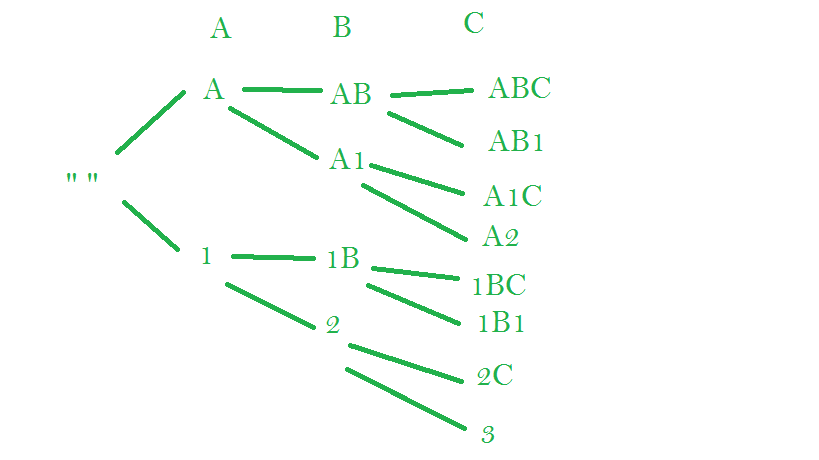
You can see how each character can either add up to the result as a character or as a digit. This further gives rise to 2^n abbreviations at the end where n is the length of string.
Implementation:
// C++ program to print all Alpha-Numeric Abbreviations
// of a String
#include <bits/stdc++.h>
using namespace std;

// Recursive function to print the valid combinations
// s is string, st is resultant string
void printCompRec(const string& s, int index,
                int max_index, string st)
{
    // if the end of the string is reached
    if (index == max_index) {
        cout << st << "\n";
        return;
    }

    // push the current character to result
    st.push_back(s[index]);

    // recur for the next [Using Char]
    printCompRec(s, index + 1, max_index, st);

    // remove the character from result
    st.pop_back();

    // set count of digits to 1
    int count = 1;

    // addition the adjacent digits
    if (!st.empty()) {

        if (isdigit(st.back())) {

            // get the digit and increase the count
            count += (int)(st.back() - '0');

            // remove the adjacent digit
            st.pop_back();
        }
    }

    // change count to a character
    char to_print = (char)(count + '0');

    // add the character to result
    st.push_back(to_print);

    // recur for this again [Using Count]
    printCompRec(s, index + 1, max_index, st);
}

// Wrapper function
void printComb(std::string s)
{
    // if the string is empty
    if (!s.length())
        return;

    // Stores result strings one by one
    string st;

    printCompRec(s, 0, s.length(), st);
}

// driver function
int main()
{
    string str = "GFG";
    printComb(str);
    return 0;
}
import java.io.*;


public class GFG {


    // Recursive function to print the valid combinations
    // s is string, st is resultant string
    static void printCompRec(String s, int index, int max_index, String st)
    {
        // if the end of the string is reached
        if (index == max_index) {
            System.out.println(st);
            return;
        }

        // push the current character to result
        st = st + s.charAt(index);

        // recur for the next [Using Char]
        printCompRec(s, index + 1, max_index, st);

        // remove the character from result
        st = st.substring(0, st.length() - 1);

        // set count of digits to 1
        int count = 1;

        // addition the adjacent digits
        if (st.length() > 0) {

            if (st.charAt(st.length()-1) >= '0' && st.charAt(st.length() -1) <= '9') {

                // get the digit and increase the count
                count = count + (st.charAt(st.length()-1) - '0');

                // remove the adjacent digit
                st = st.substring(0, st.length() - 1);
            }
        }

        // change count to a character
        char to_print = (char)(count + '0');

        // add the character to result
        st = st + to_print;

        // recur for this again [Using Count]
        printCompRec(s, index + 1, max_index, st);
    }

    // Wrapper function
    static void printComb(String s)
    {
        // if the string is empty
        if (s.length() == 0)
            return;

        // Stores result strings one by one
        String st = "";

        printCompRec(s, 0, s.length(), st);
    }

    public static void main(String[] args) {

        String str = "GFG";
        printComb(str);
    }
}

// The code is contributed by Nidhi goel.
# Python program to print all Alpha-Numeric Abbreviations
# of a String

# Recursive function to print the valid combinations
# s is string, st is resultant string
def printCompRec(s, index, max_index, st):

    # if the end of the string is reached
    if (index == max_index):
        print(st)
        return

    # push the current character to result
    st += s[index]

    # recur for the next [Using Char]
    printCompRec(s, index + 1, max_index, st)

    # remove the character from result
    st = st[0:len(st)-1]

    # set count of digits to 1
    count = 1

    # addition the adjacent digits
    if (len(st) > 0):

        if (ord(st[-1])>=ord('0') and ord(st[-1])<=ord('9')):

            # get the digit and increase the count
            count += (ord(st[-1]) - ord('0'))

            # remove the adjacent digit
            st = st[0:len(st)-1]

    # change count to a character
    to_print = chr(count + ord('0'))

    # add the character to result
    st += to_print

    # recur for this again [Using Count]
    printCompRec(s, index + 1, max_index, st)


# Wrapper function
def printComb(s):

    # if the string is empty
    if (len(s) == 0):
        return

    # Stores result strings one by one
    st = ""

    printCompRec(s, 0, len(s), st)

# driver function
Str = "GFG"
printComb(Str)

# This code is contributed by shinjanpatra
using System;

// C# program to print all Alpha-Numeric Abbreviations
// of a String
class GFG {

  // Recursive function to print the valid combinations
  // s is string, st is resultant string
  public static void printCompRec(string s, int index, int max_index, string st)
  {
    // if the end of the string is reached
    if (index == max_index) {
      Console.WriteLine(st);
      return;
    }

    // push the current character to result
    st = st + s[index];

    // recur for the next [Using Char]
    printCompRec(s, index + 1, max_index, st);

    // remove the character from result
    st = st.Substring(0,st.Length-1);

    // set count of digits to 1
    int count = 1;

    // addition the adjacent digits
    if (st.Length > 0) {

      if ((int)st[st.Length-1] >=(int)'0' && (int)st[st.Length - 1]<= (int)'9') {

        // get the digit and increase the count
        count += ((int)st[st.Length-1] - (int)'0');

        // remove the adjacent digit
        st = st.Substring(0,st.Length-1);
      }
    }

    // change count to a character
    char to_print = (char)(count + '0');

    // add the character to result
    st = st + to_print;

    // recur for this again [Using Count]
    printCompRec(s, index + 1, max_index, st);
  }


  // Wrapper function
  public static void printComb(string s)
  {
    // if the string is empty
    if (s.Length == 0)
      return;

    // Stores result strings one by one
    string st = "";

    printCompRec(s, 0, s.Length, st);
  }


  static void Main() {
    string str = "GFG";
    printComb(str);
  }
}

// The code is contributed by Nidhi goel.
<script>

// JavaScript program to print all Alpha-Numeric Abbreviations
// of a String

// Recursive function to print the valid combinations
// s is string, st is resultant string
function printCompRec(s, index, max_index, st){

    // if the end of the string is reached
    if (index == max_index){
        document.write(st,"</br>")
        return
    }

    // push the current character to result
    st += s[index]

    // recur for the next [Using Char]
    printCompRec(s, index + 1, max_index, st)

    // remove the character from result
    st = st.substring(0,st.length-1)

    // set count of digits to 1
    let count = 1

    // addition the adjacent digits
    if (st.length > 0){

        if (st.charCodeAt(st.length-1)>='0'.charCodeAt(0) && st.charCodeAt(st.length-1)<='9'.charCodeAt(0)){

            // get the digit and increase the count
            count += (st.charCodeAt(st.length-1) - '0'.charCodeAt(0))

            // remove the adjacent digit
            st = st.substring(0,st.length-1)
        }
    }

    // change count to a character
    let to_print = String.fromCharCode(count + '0'.charCodeAt(0))

    // add the character to result
    st += to_print

    // recur for this again [Using Count]
    printCompRec(s, index + 1, max_index, st)
}

// Wrapper function
function printComb(s){

    // if the string is empty
    if (s.length == 0)
        return

    // Stores result strings one by one
    let st = ""

    printCompRec(s, 0, s.length, st)
}

// driver function
let Str = "GFG"
printComb(Str)

// This code is contributed by shinjanpatra

</script>
Output
GFG
GF1
G1G
G2
1FG
1F1
2G
3
Time Complexity: O(2^N), Where N is the length of the input string.
Auxiliary Space: O(2^N)
We can generate all these Abbreviations Iteratively too
Algorithm : 1. Let string of length n = 3 , str = "ABC" binary value between 0 to 7 will helps in deciding which character to be used or which character will be replaced If for let say n = 6 , binary = 110 consider each binary bit position as index bit = 1 means it will be replaced and 0 means we are not changing that index character and 0 means it remain as it is
Implementation:
#include<bits/stdc++.h>
using namespace std;


void printans(string str)
{
    string ans = "";
    int counter = 0;
    for (auto ch: str) {
        if (ch == '-') {
            counter++;
        }
        else {
            if (counter > 0)
                ans = ans + to_string(counter);
            counter = 0;
            ans = ans + ch;
        }
    }
    if (counter > 0)
        ans = ans + to_string(counter);
    cout << ans << endl;
}

int main()
{

    string str = "ANKS";

    int n = str.size();
    int limit = 1 << n;
    for (int i = 0; i < limit; i++) {
        int counter = i, idx = 0;
        string abb = "";
        for (int b = 0; b < n; b++) {
            int bit = counter % 2;
            counter /= 2;
            if (bit == 1) {
                abb = abb + "-";
            }
            else {
                abb = abb + str[idx];
            }
            idx++;
        }
        printans(abb);
    }

    return 0;
}

// The code is contributed by Gautam goel.
import java.io.*;
import java.util.*;

public class Main {

    private static void printans(String str)
    {
        String ans = "";
        int counter = 0;
        for (char ch : str.toCharArray()) {
            if (ch == '-') {
                counter++;
            }
            else {
                if (counter > 0)
                    ans = ans + counter;
                counter = 0;
                ans = ans + ch;
            }
        }
        if (counter > 0)
            ans = ans + counter;
        System.out.println(ans);
    }

    public static void main(String[] args)
    {

        String str = "ANKS";

        int n = str.length();
        int limit = 1 << n;
        for (int i = 0; i < limit; i++) {
            int counter = i, idx = 0;
            String abb = "";
            for (int b = 0; b < n; b++) {
                int bit = counter % 2;
                counter /= 2;
                if (bit == 1) {
                    abb = abb + "-";
                }
                else {
                    abb = abb + str.charAt(idx);
                }
                idx++;
            }
            printans(abb);
        }
    }
}
# Python code for above approach
def printans(Str):
    ans=""
    counter=0
    for ch in Str:
        if(ch=='-'):
            counter+=1
        else:
            if(counter>0):
                ans+=str(counter)
            counter=0
            ans+=ch

    if(counter>0):
        ans+=str(counter)

    print(ans)

#
Str = "ANKS"

n=len(Str)
limit=1<<n
for i in range(limit):
    counter,idx=i,0
    abb=""
    for b in range(n):
        bit=counter%2
        counter=counter//2
        if(bit==1):
            abb+="-"
        else:
            abb+=Str[idx]
        idx+=1
    printans(abb)


# This code is contributed by Pushpesh Raj.
// C# code for above approach
using System;

public class GFG{

    private static void printans(String str)
    {
        string ans = "";
        int counter = 0;
        foreach (char ch in str) {
            if (ch == '-') {
                counter++;
            }
            else {
                if (counter > 0)
                    ans = ans + counter;
                counter = 0;
                ans = ans + ch;
            }
        }
        if (counter > 0)
            ans = ans + counter;
        Console.WriteLine(ans);
    }

    public static void Main()
    {

        string str = "ANKS";

        int n = str.Length;
        int limit = 1 << n;
        for (int i = 0; i < limit; i++) {
            int counter = i, idx = 0;
            string abb = "";
            for (int b = 0; b < n; b++) {
                int bit = counter % 2;
                counter /= 2;
                if (bit == 1) {
                    abb = abb + "-";
                }
                else {
                    abb = abb + str[idx];
                }
                idx++;
            }
            printans(abb);
        }
    }
}

// This code is contributed by Aman Kumar
// JavaScript program for the above approach
function printans(str){
    let ans = "";
    let counter = 0;
    for(let i = 0; i<str.length; i++){
        let ch = str[i];
        if(ch == '-') counter++;
        else{
            if(counter > 0) ans = ans + counter.toString();
            counter = 0;
            ans = ans + ch;
        }
    }
    if(counter > 0) ans = ans + counter.toString();
    console.log(ans);
}

// driver program for the above function
let str = "ANKS";
let n = str.length;
let limit = 1<<n;
for(let i = 0; i<limit; i++){
    let counter = i;
    let idx = 0;
    let abb = "";
    for(let b = 0; b<n; b++){
        let bit = counter % 2;
        counter = parseInt(counter / 2);
        if(bit == 1) abb += "-";
        else abb += str[idx];
        idx++;
    }
    printans(abb);
}

// THIS CODE IS CONTRIBUTED BY YASH AGARWAL(YASHAGARWAL2852002)
Output
ANKS
1NKS
A1KS
2KS
AN1S
1N1S
A2S
3S
ANK1
1NK1
A1K1
2K1
AN2
1N2
A3
4
Time Complexity: O(2^N), Where N is the length of the input string.
Auxiliary Space: O(N), for storing strings in a temporary string.