

A Sum of Products (SOP) is a Boolean expression in which multiple product terms (formed using the AND operation) are combined using the OR (+) operation.
- Preferred when the truth table contains more 1s than 0s.
- Can be simplified using Boolean algebra or Karnaugh Maps (K-Maps) before implementation.
- Commonly used to design combinational logic circuits.
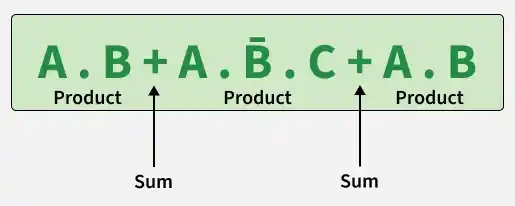
Types of SOP Forms
Non-Canonical SOP Form
In a Non-Canonical SOP form, one or more product terms may not contain all the variables of the Boolean function.
Example
F(A, B, C) = A + B·C + A·C
In this expression:
- The term A does not contain B and C.
- The product term B.C does not contain the variable A.
- The term A·C does not contain B.
Therefore, this is a Non-Canonical SOP expression.
Canonical SOP Form
In a Canonical SOP form, every product term contains all the variables of the Boolean function, either in true or complemented form.
Example
F(A, B) = A'B + AB'
In this expression:
- The term A'·B contains both variables A and B.
- The term A·B' also contains both variables A and B.
Therefore, this is a Canonical SOP expression.
Advantages
- Easy to Derive: SOP expressions can be directly obtained from a truth table by considering the rows where the output is 1.
- Simple Implementation: SOP circuits can be implemented easily using AND and OR gates.
- Uniform Representation: SOP provides a consistent and standardized way to represent Boolean functions.
- Suitable for Digital Design: SOP expressions are widely used in designing and analyzing combinational logic circuits.
Disadvantages
- Larger Circuits: Without simplification, SOP expressions may require more logic gates, increasing circuit size.
- Not Suitable for Large Functions: As the number of variables increases, the number of product terms also grows, making the expression more complex.
- May Not Be Fully Optimized: An SOP expression is not always the simplest representation and may require Boolean simplification.
- Higher Hardware Cost: More gates can increase hardware requirements, power consumption, and overall implementation cost.
Applications
- Digital Circuit Design: Used to implement combinational circuits such as multiplexers, encoders, and decoders.
- Logic Minimization: Boolean functions represented in SOP form can be simplified using Karnaugh Maps (K-Maps) or the Quine–McCluskey method.
- Programmable Logic Arrays (PLAs): SOP expressions are commonly used to define logic functions in PLAs.
- Finite State Machines (FSMs): Used to represent transition and output logic in digital state machine design.