

Security mechanisms are techniques and controls used to protect data and systems from unauthorized access, attacks, and misuse by ensuring confidentiality, integrity, and availability.
- Designed to safeguard information and system resources
- Ensure confidentiality, integrity, and availability (CIA triad)
- Classified into Specific and Pervasive security mechanisms
- Used across OSI layers to prevent, detect, and recover from attacks
Types of Security Mechanisms
Security mechanisms are broadly classified into two:
- Specific Security Mechanisms
- Pervasive Security Mechanisms
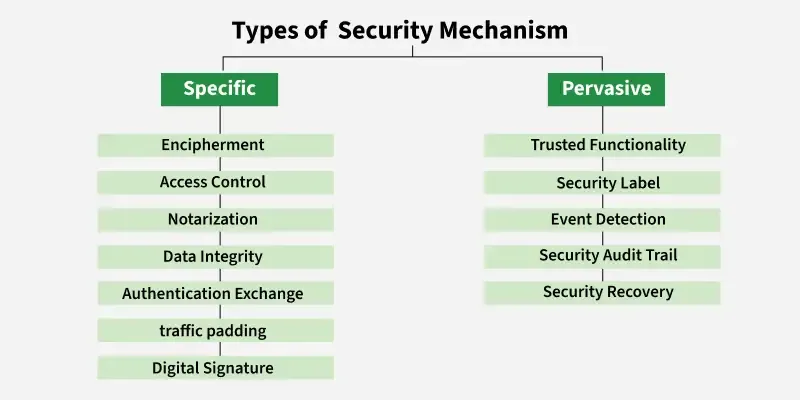
1. Specific Security Mechanisms
These mechanisms operate at specific OSI layers and provide targeted security services.
Key Types
1. Encipherment
- Protects data confidentiality by converting readable data into unreadable form
- Uses cryptographic algorithms
- Strength depends on the encryption technique used
2. Access Control
- Prevents unauthorized access to data or systems
- Implemented using passwords, PINs, firewalls, or access policies
3. Notarization
- Uses a trusted third party to validate communication
- Helps resolve disputes by maintaining transaction records
4. Data Integrity
- Ensures data is not altered during transmission
- Achieved using checksums, hashes, or message authentication codes
5. Authentication Exchange
- Verifies the identity of communicating entities
- Often uses handshaking mechanisms to confirm sender and receiver identities
6. Bit Stuffing
- Adds extra bits to data for error detection
- Commonly uses even or odd parity checks
7. Digital Signature
- Confirms sender identity and message authenticity
- Uses cryptographic techniques
- Ensures non-repudiation and data integrity
2. Pervasive Security Mechanisms
These mechanisms apply across all OSI layers and support overall system security.
Key Types:
1. Trusted Functionality
- Built-in security features of a system
- Ensures reliable enforcement of security rules
2. Security Labels
- Tags data with classifications like Public, Confidential, or Top Secret
- Helps control access and handling of information
3. Event Detection
- Monitors systems for abnormal or suspicious activities
- Helps identify potential security threats early
4. Security Audit Trail
- Maintains logs of system activities such as logins and file access
- Useful for monitoring, investigation, and accountability
5. Security Recovery
- Restores systems after a security breach
- Ensures continuity and protection of data
Difference Between Specific and Pervasive Security Mechanisms
The following table shows the key differences between specific and pervasive security mechanisms, showing how each type plays an important role in protecting an information.
| Specific Security Mechanisms | Pervasive Security Mechanisms |
|---|---|
| Applied to specific OSI layers | Applied across all OSI layers |
| Provide targeted security services like encryption and authentication | Support overall security and policy enforcement |
| Focus on protecting particular data | Ensure security management and system-wide controls |
| Examples: Encipherment, Access Control, Digital Signature | Examples: Trusted Functionality, Security Labels, Event Detection |
| Technical controls at specific layers | Management and infrastructural controls |
| Protects individual communications or data | Maintains security of entire system |