

Alfred Werner proposed Werner’s coordination theory in 1893 to explain the bonding and structure of coordination compounds. The theory introduced the concepts of primary and secondary valences and successfully explained the properties and geometrical arrangement of coordination compounds. It laid the foundation of modern coordination chemistry.
Postulate of Werner’s Theory
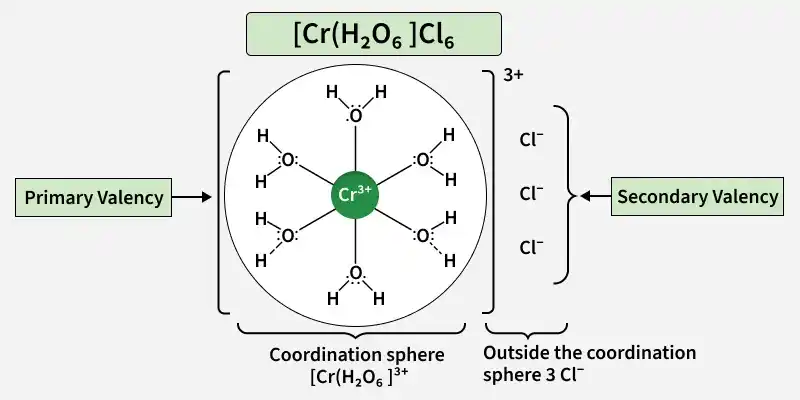
Werner proposed a number of postulates to explain the bonding, ionization, and geometrical arrangement of coordination compounds. According to Werner, metal ions possess two types of valences known as primary valency and secondary valency.
1. Primary Valency
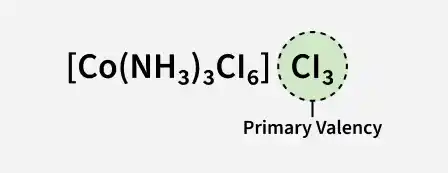
Primary valency corresponds to the oxidation state of the central metal ion.
- It is usually satisfied by negative ions and is ionizable in nature.
- The ions satisfying primary valency remain outside the coordination sphere and dissociate in aqueous solution.
Example: In [Co(NH3)6]Cl3 , the primary valency of cobalt is 3. It is satisfied by three chloride ions present outside the coordination sphere. These chloride ions ionize in aqueous solution.
2. Secondary Valency
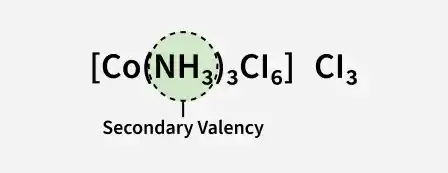
Secondary valency corresponds to the coordination number of the central metal ion.
- It is satisfied by negative ions or neutral molecules called ligands.
- Secondary valency is non-ionizable in nature, and the groups satisfying it remain inside the coordination sphere.
Example: In [Co(NH3)6]Cl3 , the secondary valency of cobalt is 6. It is satisfied by six ammonia molecules directly attached to the cobalt ion inside the coordination sphere. These ammonia molecules do not ionize in solution.
Structures of Coordination Compound based on Werner's Theory
Werner explained the structures of coordination compounds on the basis of primary and secondary valencies. According to his theory, the groups satisfying secondary valencies remain inside the coordination sphere, while those satisfying primary valencies remain outside the coordination sphere and ionise in solution.
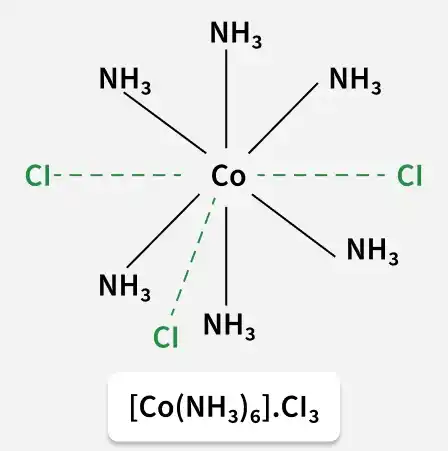
1. [Co(NH3)6]Cl3
In this complex, cobalt exhibits a primary valency of 3 and a secondary valency of 6.
- Six ammonia molecules satisfy the secondary valency of cobalt and are directly linked to the metal ion inside the coordination sphere.
- Three chloride ions satisfy the primary valency and remain outside the coordination sphere.
- The complex has octahedral geometry due to six ligands around cobalt.
Structure: [Co(NH3)6] 3+ + 3Cl −
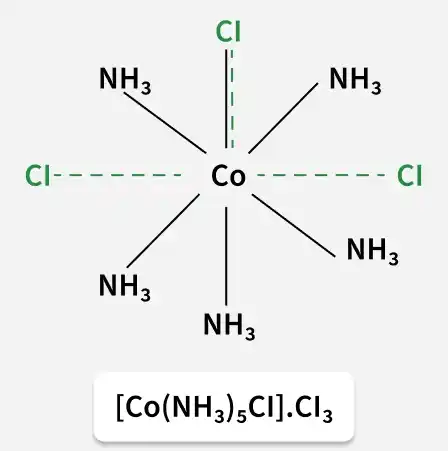
2. [Co(NH3)5Cl]Cl2
In this complex, cobalt again has a primary valency of 3 and a secondary valency of 6.
- Five ammonia molecules and one chloride ion satisfy the secondary valency and remain inside the coordination sphere.
- Two chloride ions remain outside the coordination sphere and satisfy the primary valency.
- Shows octahedral geometry around cobalt.
Structure: [Co(NH3)5Cl] 2+ + 2Cl -
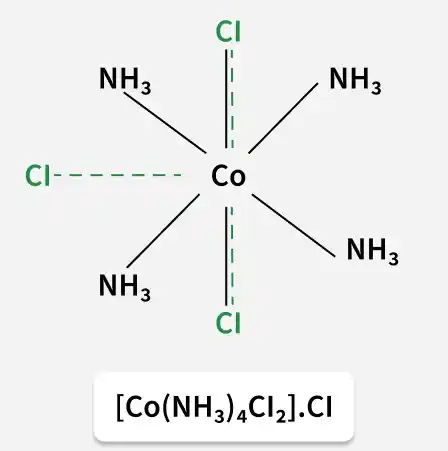
3. [Co(NH3)4Cl2]Cl
In this complex:
- Four ammonia molecules and two chloride ions satisfy the secondary valency and remain inside the coordination sphere.
- One chloride ion remains outside the coordination sphere.
- The complex has octahedral geometry.
Structure: [Co(NH3)4Cl2] + + Cl −
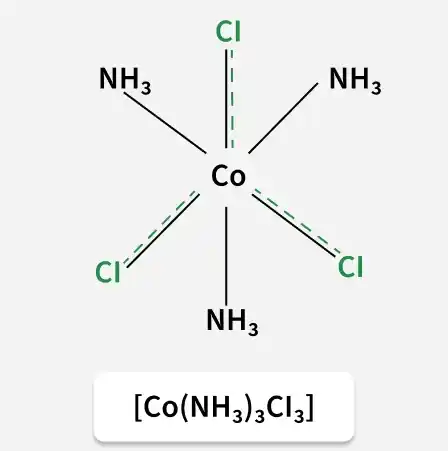
4. [Co(NH3)3Cl3]
In this complex:
- Three ammonia molecules and three chloride ions satisfy the secondary valency of cobalt.
- No chloride ion remains outside the coordination sphere.
- Exists in geometrical isomeric forms.
Structure: [Co(NH3)3Cl3]
Evidence in Favour of Werner’s Theory
Werner’s coordination theory was supported by experimental observations related to ionisation and conductance of coordination compounds in solution.
1. Precipitation Reactions with Silver Nitrate
Werner treated cobalt(III) chloride-ammonia complexes with silver nitrate solution. The number of chloride ions precipitated as silver chloride showed whether the chloride ions were present inside or outside the coordination sphere. These observations supported Werner’s idea of ionisable primary valencies and non-ionisable secondary valencies.
- [Co(NH3)6]Cl3 gives three moles of AgCl because all three chloride ions are outside the coordination sphere.
- [Co(NH3)5Cl]Cl2 gives two moles of AgCl because two chloride ions are outside the coordination sphere.
- [Co(NH3)4Cl2]Cl gives one mole of AgCl because only one chloride ion is outside the coordination sphere.
- [Co(NH3)3Cl3] does not give AgCl precipitate because all chloride ions are inside the coordination sphere.
2. Electrical Conductance Measurements
Werner also explained coordination compounds on the basis of their electrical conductance in solution. The conductance of a solution depends on the number of ions produced in aqueous solution.
- [Co(NH3)6]Cl3 produces four ions in solution and therefore shows the highest conductance.
- [Co(NH3)5Cl]Cl2 produces three ions and shows lower conductance.
- [Co(NH3)4Cl2]Cl produces two ions and shows still lower conductance.
- [Co(NH3)3Cl3] does not ionise and therefore shows very low conductance.
Limitations of Werner's Theory
Although Werner’s theory successfully explained the structures and ionisation behaviour of coordination compounds, it had certain limitations.
- Werner’s theory could not explain the exact nature of bonding between the central metal ion and ligands.
- The theory failed to explain the cause of formation and stability of coordination compounds.
- It could not explain the magnetic properties of coordination compounds.
- Werner’s theory was unable to explain the colour and spectral properties shown by many coordination compounds.
- The theory did not provide detailed information about the electronic arrangement in coordination compounds.