

Electrode potential is the potential difference that develops between an electrode and the electrolyte solution in which it is immersed. It arises due to the tendency of the electrode to lose or gain electrons, resulting in the establishment of an equilibrium at the electrode-electrolyte interface.
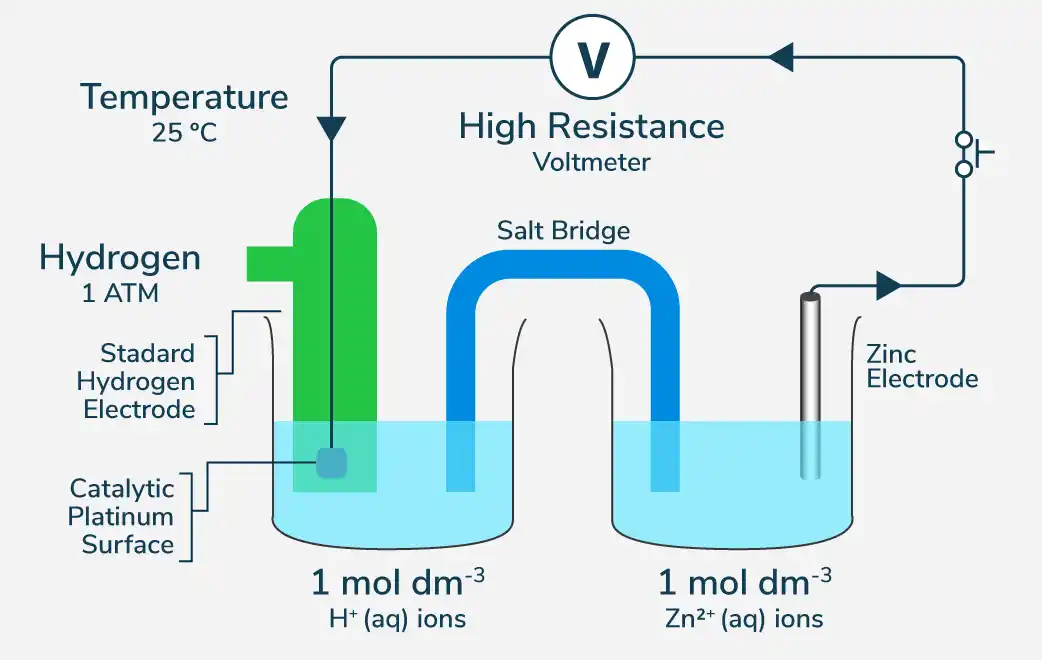
The standard electrode potential (E°) of an electrode is defined as the potential difference of the electrode when it is in contact with a solution of its ions having unit concentration (1 mol L⁻¹), the gas involved (if any) at 1 bar pressure, and the system is maintained at 298 K temperature.
- The value of standard electrode potential indicates the tendency of a species to get reduced.
- A higher positive value of E° shows a greater tendency to gain electrons (reduction), while a more negative value indicates a greater tendency to lose electrons (oxidation).
Half-Cell Reactions
A half-cell reaction represents the oxidation or reduction process that occurs at a single electrode in an electrochemical cell. In a half-cell, an electrode is immersed in a solution containing its ions, and an equilibrium is established between the metal and its ions.
Oxidation Half-Reaction (Anode) : Oxidation occurs when a metal atom loses electrons and forms positive ions in solution.
Example:
Zn(s) \rightarrow Zn^{2+}(aq) + 2e^-
Reduction Half-Reaction (Cathode) : Reduction occurs when metal ions in solution gain electrons and are deposited as neutral metal atoms on the electrode.
Example:
Cu^{2+} (aq) + 2e^- \rightarrow Cu (s)
Standard Hydrogen Electrode (SHE)
The Standard Hydrogen Electrode (SHE) is the reference electrode used to measure the standard electrode potential of other electrodes. Its electrode potential is fixed as 0.00 V under standard conditions.
1. Construction of Standard Hydrogen Electrode
The Standard Hydrogen Electrode consists of the following parts:
a) Platinum Electrode
- A platinum wire coated with finely divided platinum black is used.
- Platinum is inert and does not take part in the reaction.
- It only provides a surface for adsorption of hydrogen gas.
b) Hydrogen Gas
- Pure hydrogen gas is bubbled around the platinum electrode.
- Pressure of hydrogen gas is maintained at 1 bar.
c) Acidic Solution
- The electrode is dipped in an aqueous solution containing H⁺ ions of concentration 1 M (usually HCl solution).
Representation:
Pt(s) | H_2(g, 1,bar) | H^+(aq, 1,M)
2. Electrode Reaction
This reversibility makes SHE suitable as a reference electrode.
The overall reversible half-cell reaction is:
H^+(aq) + e^- \rightleftharpoons \frac{1}{2}H_2(g)
3. Standard Electrode Potential of SHE
The standard electrode potential of SHE is defined as zero. This is not measured experimentally but assigned as a reference value.
E^\circ = 0.00 V
Measurement of Standard Electrode Potential
The standard electrode potential of an electrode cannot be determined directly because a single electrode cannot exist independently. Therefore, it is always measured by coupling the given electrode with a reference electrode to form a complete electrochemical cell.
Principle of Measurement of Standard Electrode Potential
The standard electrode potential is determined by constructing a galvanic cell in which:
- One half-cell is the Standard Hydrogen Electrode (SHE).
- The other half-cell is the copper electrode immersed in 1 M Cu²⁺ solution.
- The two half-cells are connected by a salt bridge.
The EMF of the cell is measured, and using the known value of SHE (0.00 V), the standard electrode potential of the copper electrode is calculated.
Cell representation
The cell is set up as:
SHE ∣ ∣Metal ion / Metal electrode
Example: Pt | H2 ( g, 1 bar) ∣ H+ ( 1 M) ∣∣ Cu 2+ ( aq, 1M) ∣ Cu (s)
Procedure for Measurement of Standard Electrode Potential
The standard electrode potential of an electrode cannot be determined directly because a single electrode cannot exist independently without another electrode to complete the circuit.
Step 1: Formation of Cell
- SHE is connected with the copper electrode whose potential is to be determined.
Step 2: Establishment of Redox Reaction
- A spontaneous redox reaction takes place between the two half-cells.
- Copper has a higher reduction potential than hydrogen; therefore, the copper electrode acts as the cathode and SHE acts as the anode.
Step 3: Flow of Electrons
- Electrons flow from the Standard Hydrogen Electrode to the copper electrode through the external circuit.
Step 4: Measurement of EMF
- The EMF of the cell is measured using a voltmeter.
E^\circ_{cell}=E^\circ_{cathode}-E^\circ_{anode}
E^\circ_{SHE}=0.00 V and the copper electrode acts as the cathode,
E^\circ_{Cu^{2+}/Cu}=+0.34 V
Thus, the measured cell EMF is equal to the standard electrode potential of the copper electrode.