Phenols are aromatic hydroxy compounds in which the hydroxyl group (-OH) is directly attached to an aromatic ring.
- The simplest member of this class is phenol (C₆H₅OH).
- Phenols are important industrial chemicals used in the manufacture of plastics, dyes, medicines, explosives, and antiseptics.
- Since phenol is not readily available in nature in large quantities, it is prepared by several laboratory and industrial methods.
1. From Haloarenes
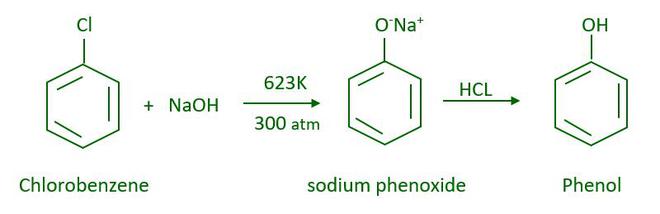
In this method, chlorobenzene is heated with aqueous sodium hydroxide at about 623 K and a pressure of nearly 300 atmospheres.
- Under these drastic conditions, the chlorine atom present in chlorobenzene is replaced by a hydroxyl group, resulting in the formation of sodium phenoxide.
- The sodium phenoxide obtained is then treated with dilute hydrochloric acid to produce phenol.
- This method is commonly known as the Dow Process and is an important method for the preparation of phenol from haloarenes.
2. From Benzene Sulphonic Acid
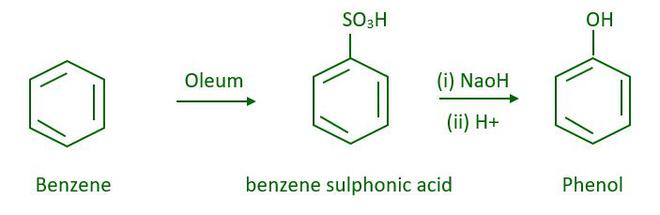
Benzene sulphonic acid is fused with sodium hydroxide at a high temperature.
- During this reaction, the sulphonic acid group (-SO3H) is replaced by a hydroxyl group, leading to the formation of sodium phenoxide.
- The sodium phenoxide is then acidified using dilute hydrochloric acid to obtain phenol.
- This method demonstrates the conversion of aromatic sulphonic acids into phenols and is frequently used in laboratory preparations.
3. From Diazonium Salts
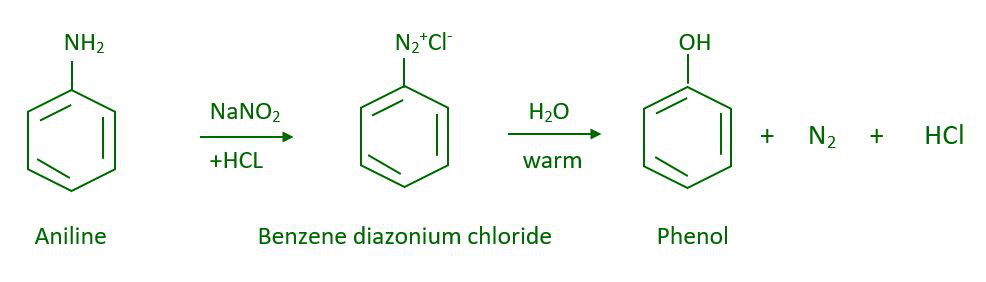
Benzene diazonium chloride undergoes hydrolysis when warmed with water or dilute acid.
- During the reaction, the diazonium group (-N2⁺Cl⁻) is replaced by a hydroxyl group, resulting in the formation of phenol.
- Nitrogen gas is liberated as a by-product.
- Since nitrogen gas escapes from the reaction mixture, the reaction proceeds smoothly and gives a good yield of phenol.
- This method is particularly useful in laboratory synthesis.
4. From Cumene
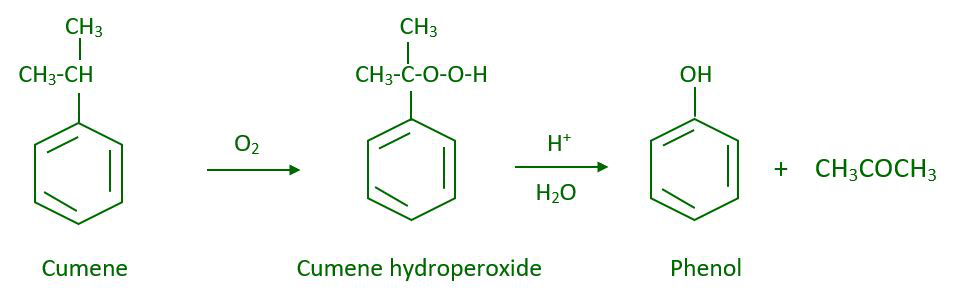
The industrial manufacture of phenol is carried out by the Cumene Process.
- In this method, cumene (isopropylbenzene) is first oxidised by air to form cumene hydroperoxide.
- The hydroperoxide is then treated with dilute acid, causing it to decompose into phenol and acetone.
- This process is economically important because both phenol and acetone are valuable industrial chemicals.
- Therefore, the cumene process is widely used for large-scale commercial production of phenol.