

Amines are organic compounds derived from ammonia in which one or more hydrogen atoms are replaced by alkyl or aryl groups. They serve as important intermediates in the manufacture of pharmaceuticals, dyes, polymers, and biological molecules.
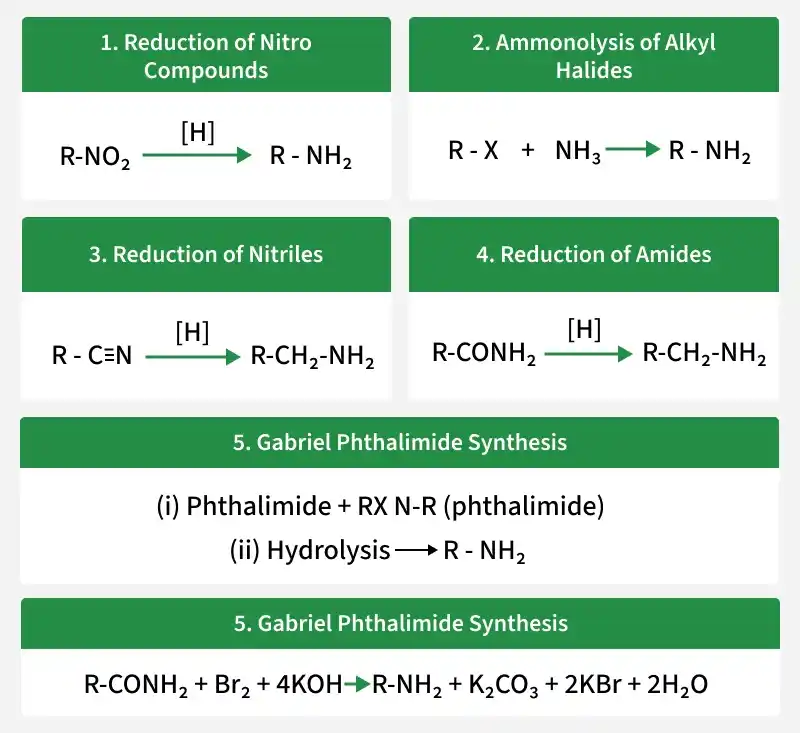
1. Reduction of Nitro Compound
Nitro compounds are one of the most important starting materials for the preparation of primary amines.
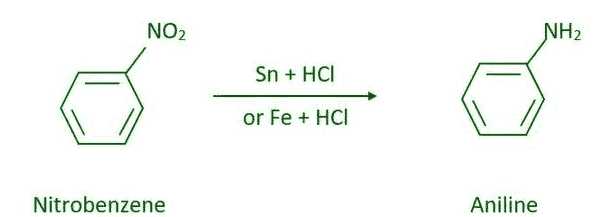
- In this method, the nitro group (-NO₂) is reduced to an amino group (-NH₂) using reducing agents such as hydrogen in the presence of nickel, tin and hydrochloric acid, or iron and hydrochloric acid.
- This method is particularly useful for preparing aromatic amines.
Reaction: R − NO2 + 6[H] → R − NH2 + 2H2O
Example:
C_6H_5NO_2 + 6[H] \xrightarrow{\text{Sn/HCl}} C_6H_5NH_2 + 2H_2O
2. Ammonolysis of Alkyl Halides
Alkyl halides react with ammonia in the presence of alcohol to form amines.
- During the reaction, the halogen atom of the alkyl halide is replaced by an amino group.
- Since the amine produced is more nucleophilic than ammonia, it may further react with alkyl halide to form secondary and tertiary amines.
Reaction: R − X + NH3 → R − NH2 + HX
Example:
C_2H_5Br + 2NH_3 \rightarrow C_2H_5NH_2 + NH_4Br
3. Reduction of Nitriles
Nitriles can be converted into primary amines by reduction using hydrogen in the presence of nickel catalyst or lithium aluminium hydride (LiAlH₄). In this process, the carbon-nitrogen triple bond is reduced to form a carbon-nitrogen single bond.
Reaction: R − CN + 2H2 → R −CH2NH2
Example:
CH_3CN + 2H_2 \xrightarrow{\text{Ni}} CH_3CH_2NH_2
4. Reduction of Amide
Amides can be reduced to amines by using lithium aluminium hydride (LiAlH₄). During the reaction, the carbonyl group of the amide is reduced to a methylene group (-CH₂-), producing an amine.
Reaction: RCONH2 → RCH2NH2
Example:
CH_3CONH_2 \xrightarrow{\text{LiAlH}_4} CH_3CH_2NH_2
5. Gabriel Phthalimide Synthesis
Gabriel phthalimide synthesis is an important laboratory method used for the preparation of pure primary alkyl amines. Potassium phthalimide reacts with an alkyl halide to form N-alkyl phthalimide, which on hydrolysis yields a primary amine.
Reaction: Potassium phthalimide + Alkyl halide → N-alkyl phthalimide
N-alkyl phthalimide + Hydrolysis → Primary amine

6. Hoffmann Bromamide Degradation Reaction
In this reaction, a primary amide is treated with bromine and aqueous potassium hydroxide. The amide loses its carbonyl carbon and is converted into a primary amine containing one carbon atom less than the original amide.
Reaction: RCONH2 + Br2 + 4KOH → RNH2 + K2CO3 + 2KBr + 2H2O
Example:
CH_3CONH_2 + Br_2 + 4KOH\rightarrowCH_3NH_2 + K_2CO_3 + 2KBr + 2H_2O