

Alcohols, phenols, and ethers are oxygen-containing organic compounds that differ in the arrangement of their functional groups. The presence of oxygen significantly influences their physical properties such as boiling point, solubility, and physical state. These properties are largely determined by intermolecular forces, especially hydrogen bonding.
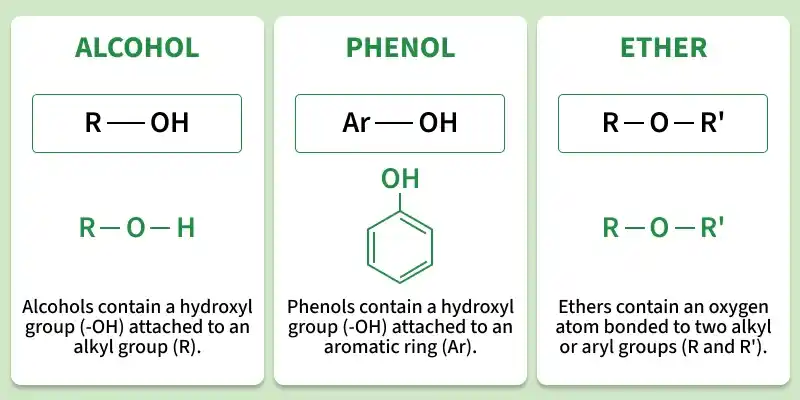
Alcohols
Alcohols contain a hydroxyl (-OH) group attached to an alkyl group. The presence of the hydroxyl group enables alcohol molecules to form intermolecular hydrogen bonds, which greatly affect their physical properties.
1. Physical State: Lower alcohols are colorless liquids with characteristic odors. Higher alcohols containing many carbon atoms may be waxy solids.
2. Boiling Point: Alcohols have higher boiling points than corresponding hydrocarbons and haloalkanes of comparable molecular masses. This is due to the presence of strong intermolecular hydrogen bonding between alcohol molecules.
3. Solubility in Water: Lower alcohols such as methanol and ethanol are completely miscible with water because they form hydrogen bonds with water molecules. As the carbon chain length increases, solubility decreases.
4. Density: Most alcohols have densities lower than that of water and are therefore lighter than water. Most alcohols have densities lower than that of water and are therefore lighter than water.
Phenols
Phenols contain a hydroxyl (-OH) group directly attached to an aromatic benzene ring. Their physical properties are influenced by both the hydroxyl group and the aromatic ring.
1. Physical State: Pure phenol is a colorless crystalline solid with a characteristic appearance. Phenol has a melting point of about 314 K, so it may appear as a liquid in warm weather.
2. Boiling Point: Phenols have relatively high boiling points because of intermolecular hydrogen bonding between phenol molecules. The strong attractive forces between molecules require more energy to overcome, resulting in higher boiling points.
3. Solubility in Water: Phenol is only sparingly soluble in water. However, it is fairly soluble in organic solvents such as alcohol and ether. Phenol is much more soluble in organic solvents such as alcohol, ether, and benzene.
4. Characteristic Odour: Phenol possesses a distinct medicinal or antiseptic smell. This characteristic odor is one of the reasons phenol was historically used as a disinfectant in hospitals and laboratories.
Ethers
Ethers contain an oxygen atom bonded to two alkyl or aryl groups. Unlike alcohols and phenols, ethers do not contain an O–H bond and therefore cannot form intermolecular hydrogen bonds among themselves.
1. Physical State: Most ethers are colorless liquids with a characteristic pleasant odor. They are generally lighter than water and are highly volatile.
2. Boiling Point: Ethers have lower boiling points than alcohols of comparable molecular masses because they do not exhibit intermolecular hydrogen bonding. As a result, ether molecules separate more easily on heating.
3. Solubility in Water: Lower ethers are slightly soluble in water because the oxygen atom can form hydrogen bonds with water molecules. Their solubility decreases with increasing molecular mass.
4. Volatility: Ethers are highly volatile liquids and evaporate rapidly at room temperature. Because of their low boiling points and high flammability, they must be stored carefully away from open flames and sources of heat.