

Methyl Orange is a chemical indicator that identifies whether a substance is basic or acidic. It is abbreviated as MeO. Methyl orange, a popular indicator, is used for titration. During titration, it gives different colors at different pH values. Methyl orange is a weak acidic azo dye used as an acid–base indicator.
The structure of Methyl Orange is shown below:
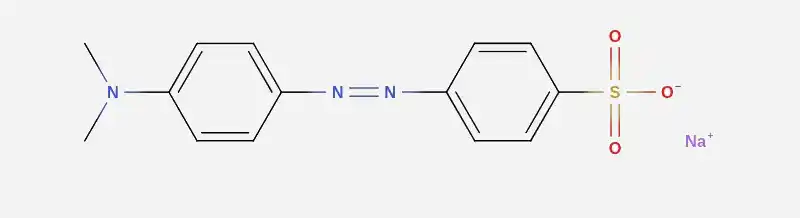
The structure of methyl orange consists of a central azo group (―N=N―), which is the characteristic feature of azo dyes.
- This azo group connects two aromatic rings: a benzene ring and a naphthalene ring.
- One of the nitrogen atoms in the azo group is protonated and carries a positive charge when the indicator is in its acidic form.
- The other nitrogen atom is connected to a sodium atom and a sulfonate group, which contribute to the water solubility of methyl orange.
Chemical Formula of Methyl Orange
Chemical Formula of Methyl Orange is C14H14N3NaO3S
IUPAC Name of Methyl Orange
IUPAC Name of Methyl Orange is Sodium 4-{(4-(dimethylamino)phenyl) diazenyl)}benzene-1-sulphonate
Methyl Orange pH Range
Methyl orange is used as an indicator because of its various pH ranges. The pH range of methyl orange is 3.1 to 4.4
General Properties of Methyl Orange
Methyl Orange has some important properties. These properties are given below in the box.
Colour | Orange or yellow |
|---|---|
Appearance | Orange crystalline powder |
Odor | Odorless |
Molar Mass | 327.33 g·mol⁻¹ |
Density | 1.28 g/cm³ |
Melting Point | 300°C |
Storage condition | Store +5°C to +30°C |
Flash point | 37°C |
Solubility | Soluble in water |
Preparation of Methyl Orange
Methyl Orange is generally found in powdered form. To make a solution of methyl orange, we have to dissolve 0.1 g of methyl orange powder in 100 cc of distilled water. However, the methyl orange solution, which is for the indicator, is more sensitive and hence prepared by dissolving only 0.02 gram of methyl orange in 100cc of water
Preparation of Methyl Orange with Sulphanilic Acid
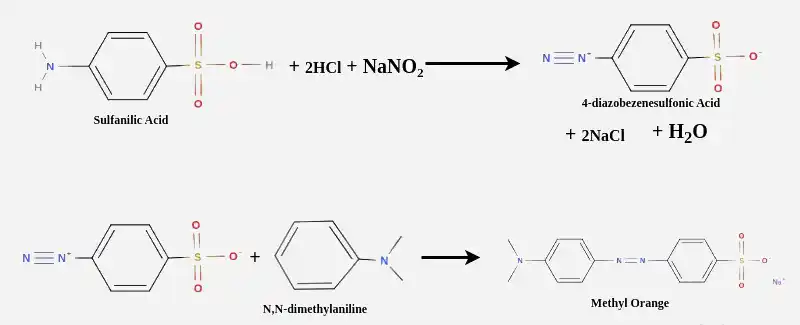
To produce methyl orange from sulfanilic acid and N,N-dimethylaniline, a reaction named the diazonium coupling reaction was used. Diazonium coupling reaction is a typical reaction for treating an aliphatic amine to yield a carbanion.
At first, in the presence of HCl, sulfanilic acid and sodium nitrate react, and then the prepared diazotized sulfanilic acid is treated with N,N-dimethylaniline to get the desired product, which is methyl orange.
Preparation of methyl orange from sulfanilic acid can be understood from the chemical reactions below:\
Methyl Orange Indicator
Water-soluble azo dye, methyl orange, is popularly known as a pH indicator that is generally used in the titration. It is used in titration because of its color variations at different pH levels. Methyl orange is not as strong an indicator as litmus. Methyl orange makes only a narrow spectrum in the color band. In an acid solution, methyl orange turns red, and in a base solution, methyl orange turns yellow.
Colour Change of Methyl Orange
Generally methyl orange is found in orange color. But when methyl orange is used as an indicator of an acid solution, it becomes red from its yellow/orange color. Similarly, when it is used in a base solution, methyl orange becomes yellow. This is the property of color change of methyl orange.
Methyl Orange in Acid
In an acidic medium, methyl orange turns red from orange.
It is popularly used in acid titration because it changes color at the pKa of a mid-strength acid. Methyl orange is not similar to a universal indicator like litmus because it does not have a complete spectrum of color transition; however, it does have a sharp endpoint. When methyl orange comes into contact with water, then it breaks down into orange neutral molecules. Methyl Orange is a weak acid.
Methyl Orange in Base
Because of the various pH levels of methyl orange, we use it as an indicator. In base solution, methyl orange turns into a yellow color from an orange color.
Phenolphthalein vs Methyl Orange
Methyl orange and phenolphthalein are two indicators apart from litmus paper, which is used in the identification of acid and base. The differences between the methyl orange and phenolphthalein are described below:
Parameters | Methyl Orange | Phenolphthalein |
|---|---|---|
In Acidic medium | Methyl orange turns red from orange. | Phenolphthalein remains colorless in Acidic conditions. |
In Alkaline condition | Methyl orange turns into yellow colour. | Phenolphthalein turns into pink colour. |
pH value | The pH value of methyl orange ranges from 3.1 to 4.4 | The pH value of phenolphthalein ranges from 8.2 to 10.0 |
pKa | The pKa of methyl orange is 3.5 | The pKa of phenolphthalein is 9.4 |
Applications of Methyl Orange
The uses and applications of methyl orange are given below:
- Methyl orange is used as an important indicator for titration. It acts similar to Litmus.
- We will get color variations at different levels of pH value by using methyl orange.
- It is used as a dye.