

Metal carbonyls are important organometallic compounds in which carbon monoxide (CO) acts as a ligand and bonds with transition metals. These compounds contain direct metal–carbon bonds and show unique bonding involving σ donation and π back bonding. Metal carbonyls play an important role in coordination chemistry due to their interesting structures, stability and industrial applications.

The general formula of metal carbonyls is:
Mx (CO)y
where:
- M = metal atom
- CO = carbonyl ligand
Organometallic Compounds
Organometallic compounds are compounds that contain at least one direct bond between a metal atom and the carbon atom of an organic group or ligand. These compounds form an important class of coordination compounds and combine the properties of both metals and organic compounds. These compounds are generally,
- Mostly covalent in nature
- Many are sensitive to air and moisture
- Important in catalytic and industrial reactions
Examples : Ni(CO)4 (Nickel tetracarbonyl), Fe(CO)5 (Iron pentacarbonyl), Zeise’s salt, Grignard reagent (CH3MgBr)
Bonding in Metal Carbonyls
The bonding in metal carbonyls involves both σ (sigma) bonding and π (pi) back bonding between the metal atom and carbon monoxide ligand (CO).
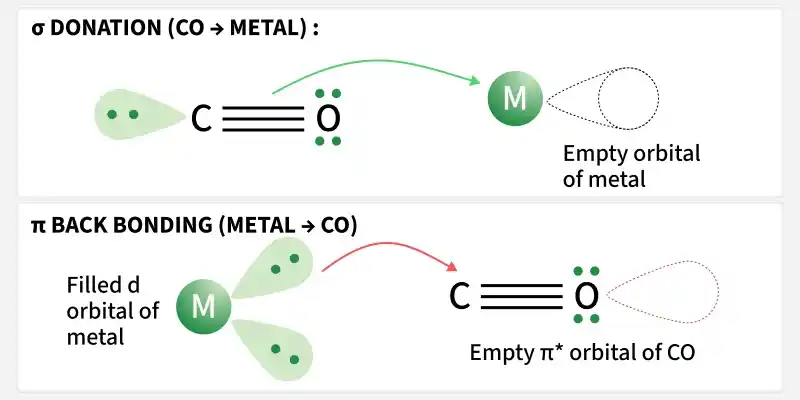
- In CO, the carbon atom donates a lone pair of electrons to the vacant orbital of the metal atom forming a coordinate σ bond.
- At the same time, the filled d-orbitals of the metal donate electrons back to the empty antibonding π* orbitals of CO. This is called π back bonding or back donation.
- This mutual sharing of electrons strengthens the metal–carbon bond and weakens the carbon–oxygen bond. Due to strong π back bonding, metal carbonyls become stable complexes.
Structure of Metal Carbonyls
The structure of metal carbonyls depends on the number of carbon monoxide ligands attached to the metal atom and the hybridization of the central metal atom. In these compounds, carbon monoxide acts as a strong field ligand and forms stable complexes with transition metals. Most metal carbonyls are diamagnetic because electrons pair up in the presence of the strong field CO ligand.
1. Structure of Nickel Tetracarbonyl (Ni(CO)4 )
Nickel tetracarbonyl contains one nickel atom bonded to four carbon monoxide ligands. In Ni(CO)4 , nickel is in zero oxidation state. Due to the strong field nature of CO ligands, electrons pair up and the nickel atom undergoes sp3 hybridization.
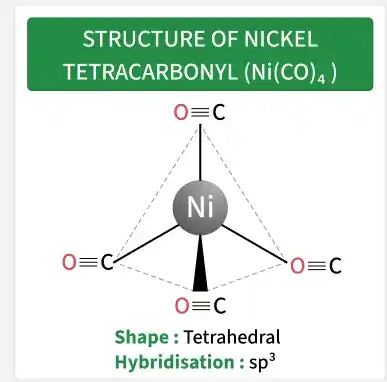
Thus, Ni(CO)4 has:
- Atomic number of Ni = 28
- Electronic configuration of Ni = [Ar] 3d84s2
- Tetrahedral geometry
- sp3 hybridization
The structure can be represented as: Ni(CO)4
2. Structure of Iron Pentacarbonyl (Fe(CO)5 )
Iron pentacarbonyl contains one iron atom bonded to five carbon monoxide ligands. In Fe(CO)5 , iron is in zero oxidation state and forms bonds with five CO ligands. The complex undergoes dsp3 hybridization.
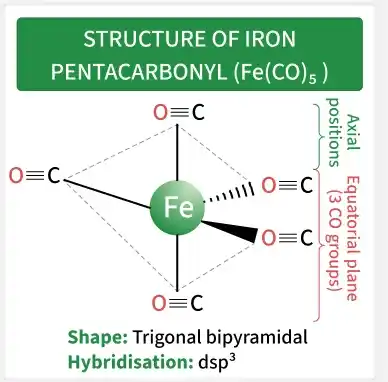
Thus, Fe(CO)5 has:
- Atomic number of Fe = 26
- Electronic configuration of Fe = [Ar] 3d64s2
- Trigonal bipyramidal geometry
- dsp3 hybridization
- Diamagnetic nature
The structure can be represented as: Fe(CO)5
Types of Metal Carbonyls
Metal carbonyls are classified on the basis of the number of metal atoms present in the molecule. They are mainly of two types: mononuclear carbonyls and polynuclear carbonyls.
1. Mononuclear Metal Carbonyls
Mononuclear metal carbonyls contain only one metal atom bonded to carbon monoxide ligands. In these compounds, all the CO ligands are attached to a single metal atom.
- They contain a single metal centre
- These are mostly volatile and covalent
- Usually diamagnetic due to electron pairing
- Show definite geometrical shapes
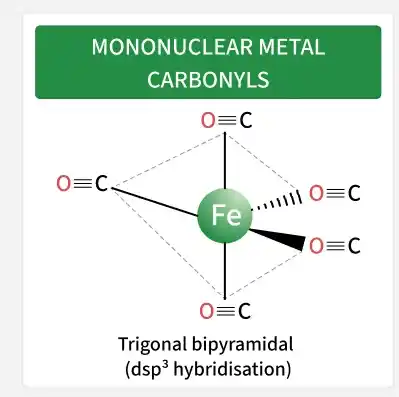
General form: M(CO)n
Examples: Ni(CO)4, Fe(CO)5 , Cr(CO)6
2. Polynuclear Metal Carbonyls
Polynuclear metal carbonyls contain two or more metal atoms in the same molecule. The metal atoms may be directly bonded to each other and share carbon monoxide ligands.
- They contain metal–metal bonds
- May contain bridging carbon monoxide ligands
- More complex structures than mononuclear carbonyls
- Usually formed by transition metals
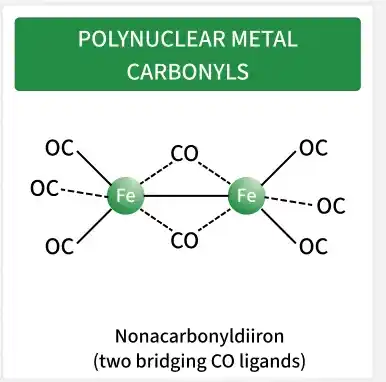
Examples: Mn2(CO)10 , Fe2(CO)9 , Co2(CO)8
Stability of Metal Carbonyls
The stability of metal carbonyls mainly arises due to the strong bonding between the metal atom and the carbon monoxide ligand. The combined effect of these interactions strengthens the metal–carbon bond and increases the stability of the complex.
The stability of metal carbonyls depends upon:
- Strength of π back bonding
- Nature of the metal atom
- Oxidation state of the metal
- Number of CO ligands attached
Example: Ni(CO)4 attains the electronic configuration of krypton.
Applications of Metal Carbonyls
Metal carbonyls are important organometallic compounds widely used in industrial and chemical processes because of their stability and catalytic properties.
1. Purification of Nickel: Nickel tetracarbonyl, Ni(CO)₄, is used in the Mond process for purification of nickel. Impure nickel reacts with carbon monoxide to form volatile nickel tetracarbonyl. On heating, it decomposes to give pure nickel metal.
2. Used as Catalysts: Many metal carbonyls act as catalysts in industrial reactions such as hydrogenation and hydroformylation reactions. They increase the speed and efficiency of chemical reactions.
3. Preparation of Metal Powders: Metal carbonyls decompose on heating to form pure finely divided metal powders. The pure metal powders obtained are used in metallurgy and electronic industries.
4. Organic Synthesis: Metal carbonyls are used in the synthesis of organic compounds and organometallic compounds. They help in the formation of carbon–carbon bonds and preparation of useful chemicals.
5. Importance in Coordination Chemistry: Metal carbonyls are important in studying metal–ligand bonding, π back bonding and stability of coordination compounds in organometallic chemistry.