

Lanthanides are a series of 15 elements ranging from lanthanum (La, Z = 57) to lutetium (Lu, Z = 71) in the periodic table, belonging to the f-block and also known as inner transition elements. They are called rare earth elements not because they are extremely scarce, but because they occur in low concentrations and are difficult to separate from one another.
Electronic Configuration
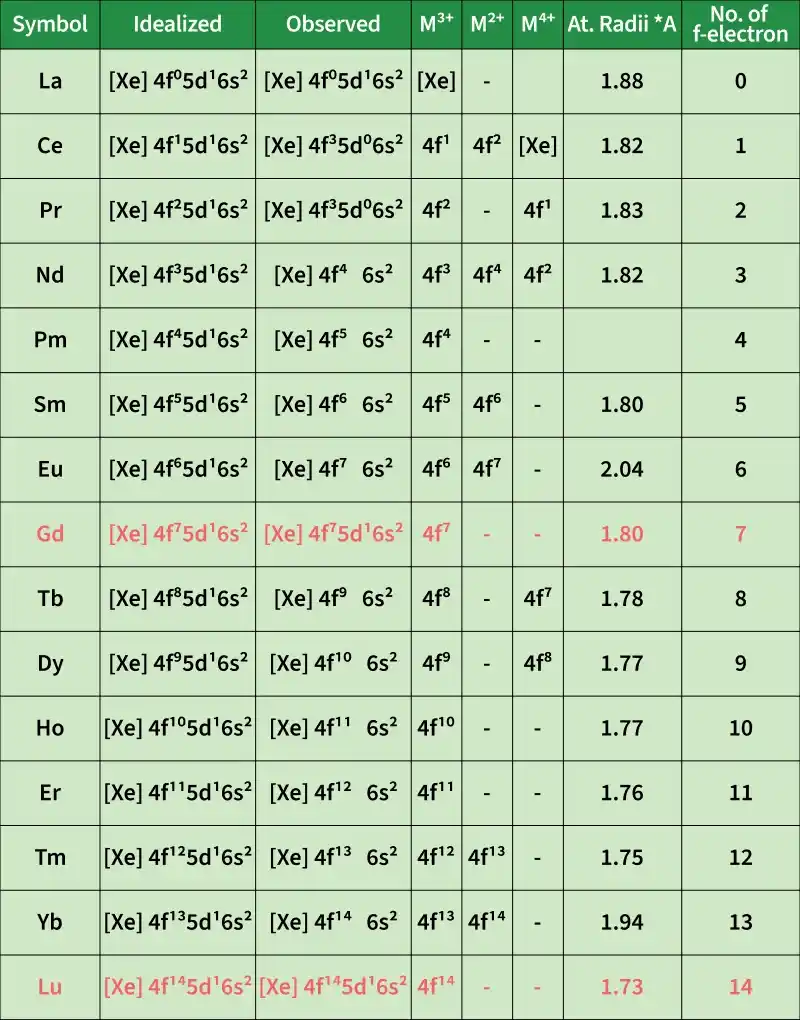
Lanthanides of the first f-block have a terminal electronic configuration of [Xe] 4f1-14 5d0-1 6s2. Promethium (Pm), with atomic number 61, is the sole synthetic radioactive element among the fourteen lanthanides. Because the energies of 4f and 5d electrons are so similar, the 5d orbital remains unoccupied and the electrons enter the 4f orbital.
Exceptions: Gadolinium, Gd (Z = 64), where the electron enters the 5d orbital due to the existence of a half-filled d-orbital, and lutetium (Z = 71), where the electron enters the 5d orbital due to the presence of a half-filled d-orbital.
Physical Properties
- Because density is the ratio of a substance's mass to its volume, the density of d-block elements will be greater than that of s-block elements.
- Among the inner transition series, the density trend will be the inverse of atomic radii, i.e. density will grow as the atomic number increases over the period. They have a high density that ranges from 6.77 to 9.74 g cm-3. It rises as the atomic number rises.
- Lanthanides have a relatively high melting point, but there is no discernible pattern in their melting and boiling points.
- Magnetic Properties: Materials are classed as diamagnetic if they are repelled by a magnetic field and paramagnetic if they are attracted by one. Because of unpaired electrons in orbitals, lanthanide atoms/ions other than f0 and f14 are paramagnetic in nature. As a result, Lu3+, Yb2+, and Ce4+ are diamagnetic.
Properties of Lanthanide Series
- If we include the lanthanides and actinides series in the periodic table, the table will be excessively large. These two series are located at the bottom of the periodic table and are known as the 4f series (Lanthanods series) and the 5f series (Actinide series). The 4f and 5f series are referred to as inner transition elements.
- In terms of chemical and physical properties, all of the elements in the series are quite similar to lanthanum and each other.
- They have a lustrous sheen and a silvery look.
- Because they are delicate metals, they can even be sliced with a knife.
- Depending on their basicity, the elements have varying response tendencies. Some people react quickly, while others take their time.
- If lanthanides are contaminated with other metals or nonmetals, they might corrode or become brittle.
- They all mostly combine to generate a trivalent compound. They can also combine to generate divalent or tetravalent compounds.
- They have a magnetic pull.
Lanthanide Contraction
Because of the increasing nuclear charge and electrons entering the inner (n-2) f orbitals, the atomic size or ionic radius of tri positive lanthanide ions decreases steadily from La to Lu. Lanthanide contraction refers to the steady decrease in size with increasing atomic number.
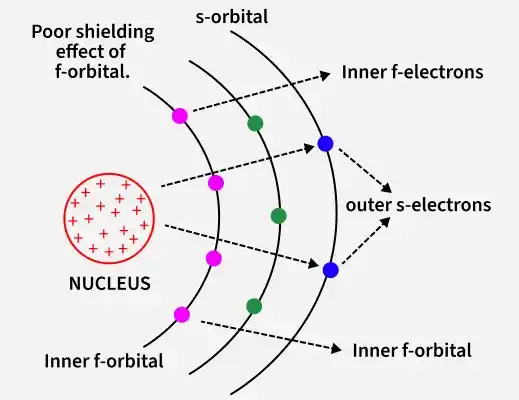
Its ramifications are as follows:
- Atomic size: The size of an atom in the third transition series is approximately identical to that of an atom in the second transition series. For example, the radius of Zr equals the radius of Hf, and the radius of Nb equals the radius of Ta, and so on.
- Difficulty in separating lanthanides: Because the ionic radii of Lanthanides differ only slightly, their chemical characteristics are comparable. This makes element separation in the pure state challenging.
- The effect of lanthanide size on hydroxide basic strength: As lanthanide size declines from La to Lu, the covalent character of the hydroxides rises, and hence their basic strength diminishes. As a result, La(OH)3 is more basic, while Lu(OH)3 is the least basic.
- Complex formation: The tendency to develop coordinates due to the smaller size but increased nuclear charge. Complexity rises from La3+ to Lu3+.
- From La to Lu, electronegativity increases.
- Ionization energy: Because the nuclear charge attracts electrons much more strongly, the ionisation energy of 5d elements is much higher than that of 4d and 3d elements. Except for Pt and Au, all elements in the 5d series have a filled s-shell.
- Complex formation: Lanthanides with 3+ oxidation states have a greater charge to radius ratio. Lanthanides' ability to form complexes is thus reduced when compared to d-block elements.
Oxidation State
- The most common and stable oxidation state of lanthanide elements is +3.
- However, some lanthanides also exhibit +2 and +4 oxidation states, though less frequently
Reason for Variable Oxidation States
The variation in oxidation states arises due to the extra stability of certain f-electron configurations, namely:
- Empty (f⁰)
- Half-filled (f⁷)
- Fully filled (f¹⁴) subshells
+2 Oxidation State
Elements like Sm, Eu, and Yb commonly show the +2 state. In aqueous solution:
- Sm²⁺, Eu²⁺, and Yb²⁺ tend to lose electrons easily.
- Hence, they act as strong reducing agents.
+4 Oxidation State
A few lanthanides such as Ce, Pr, and Tb exhibit the +4 state. In aqueous solution:
- Ce⁴⁺, Pr⁴⁺, Tb⁴⁺ tend to gain electrons.
- Hence, they act as strong oxidising agents.
Chemical Reactivity
Lanthanides show similar reactivity due to their comparable electronic configuration. It is more reactive than transition elements because their 4f electrons are poorly shielded and do not participate in bonding, making the outer electrons (5s, 5p, 6s) easier to lose and thus increasing their electropositive character.
Reaction with Halogen
Lanthanides readily react with oxygen to form oxides of type M₂O₃:4M+3O2→2M2O3
Reaction with Halogen
- Lanthanides react directly with halogens to form trihalides (MX₃):
2M+3X2→2MX3
- Halides can also be prepared by heating oxides with ammonium halides (NH₄X).
Reaction with Hydrogen
- Most lanthanides react with hydrogen at 300–400°C to form solid hydrides (MH₂ or MH₃):
2M+3H2→2MH3
Formation of Coloured Ions
Lanthanides ions, like d-block elements, can have electrons in f-orbitals as well as empty orbitals. When a frequency of light is absorbed, the light is transmitted as a complementary colour to the absorbed frequency. Ions in the inner transition zone can absorb visible frequency and utilise it for f-f electron transitions and visible colour. The colour of several lanthanide metals is silver-white. Lanthanide ions with an oxidation state of +3 appear coloured in both solid and aqueous solutions.