

Isomerism in coordination compounds refers to the existence of two or more compounds having the same molecular formula but different arrangement of ligands or different spatial orientation around the central metal atom. Coordination compounds show various types of isomerism due to the presence of ligands inside and outside the coordination sphere and different geometrical arrangements of ligands.
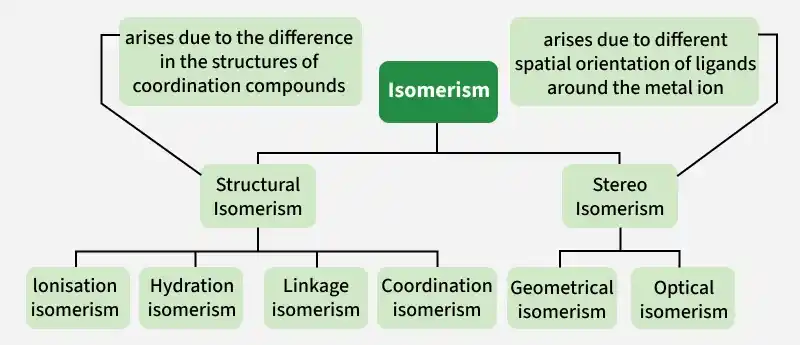
1.Structural Isomerism
Structural isomerism arises when coordination compounds have the same molecular formula but differ in the arrangement of ions or ligands inside and outside the coordination sphere.
Structural isomerism is of the following types:
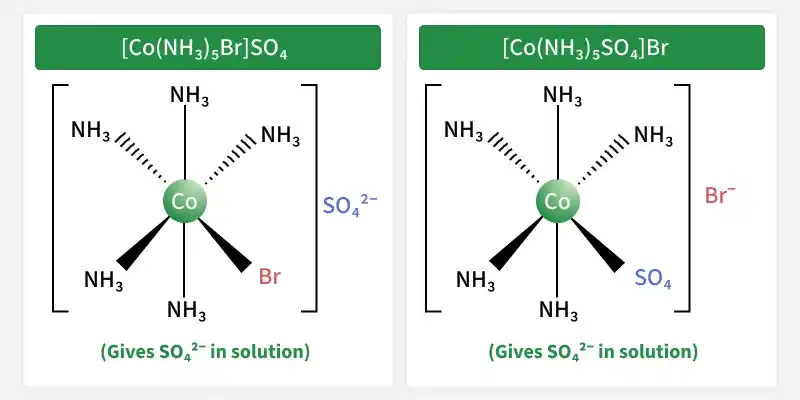
a) Ionization Isomerism
Ionization isomerism occurs when the counter ion inside the coordination sphere exchanges its position with the ion outside the coordination sphere. These isomers give different ions in solution.
- The first compound gives sulphate ions in solution.
- The second compound gives bromide ions in solution.
Example: [Co(NH3)5Br]SO4 and [Co(NH3)5SO4]Br
b) Hydrate Isomerism
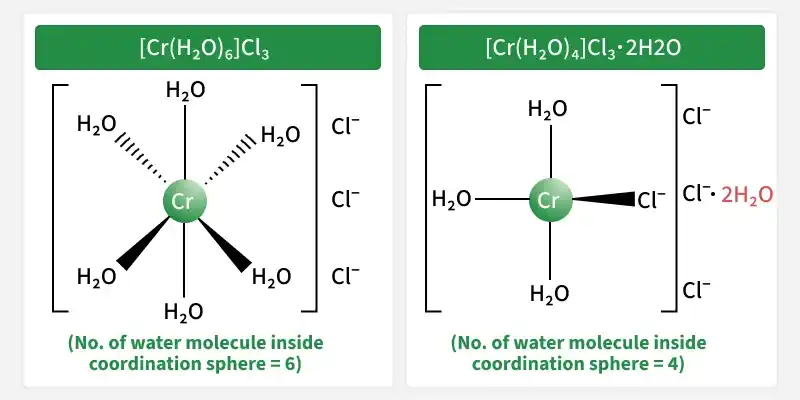
Hydrate isomerism arises due to the presence of different number of water molecules inside and outside the coordination sphere. Different hydrate isomers contain water molecules either as ligands or as water of crystallisation.
Example: [Cr(H2O)6]Cl3
c) Linkage Isomerism
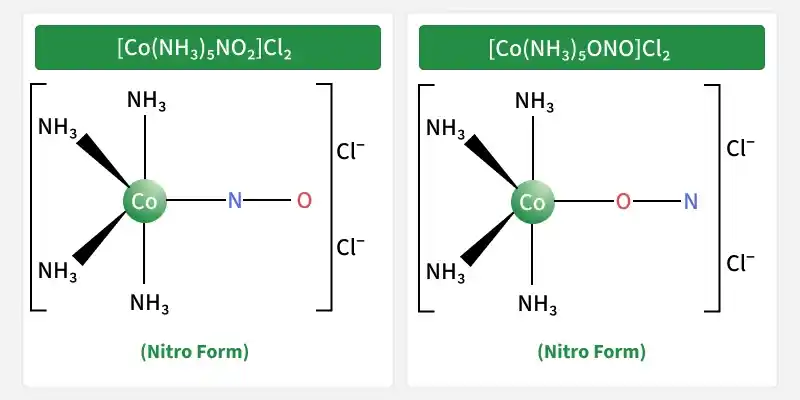
Linkage isomerism is shown by compounds containing ambidentate ligands. These ligands can coordinate through different donor atoms.
- Examples of ambidentate ligands NO2- and SCN-
- In one compound, bonding occurs through nitrogen atom, while in the other it occurs through oxygen atom.
Example: [Co(NH3)5NO2]Cl2 and [Co(NH3)5ONO]Cl2
d) Coordination Isomerism
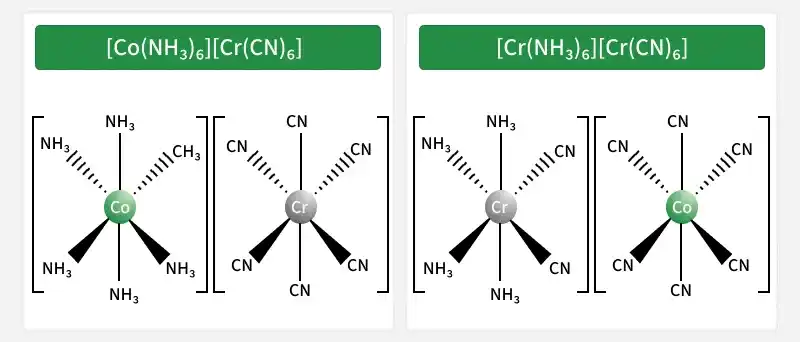
Coordination isomerism occurs when both the cation and anion are complex ions and ligands are exchanged between them. The distribution of ligands between the two metal ions is different.
Example: [Co(NH3)6][Cr(CN)6] and [Cr(NH3)6][Co(CN)6]
2. Stereoisomerism
Stereoisomerism arises when coordination compounds have the same composition and sequence of bonding but differ in the spatial arrangement of ligands around the central metal atom.
Stereoisomerism is of two types:
a) Geometrical Isomerism
Geometrical isomerism arises due to different possible arrangements of ligands around the central metal atom. It is commonly observed in square planar complexes and octahedral complexes.
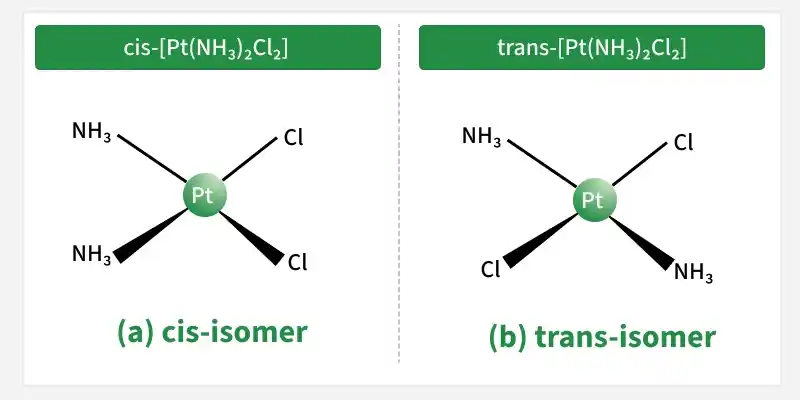
The two forms are:
- cis form: similar ligands adjacent to each other
- trans form: similar ligands opposite to each other
Example: [Pt(NH3)2Cl2]
- cis-[Pt(NH3)2Cl2]
- trans-[Pt(NH3)2Cl2]
In the cis form, both chloride ligands are adjacent, while in the trans form they are opposite to each other.
b) Optical Isomerism
Optical isomerism occurs when coordination compounds exist as non-superimposable mirror images of each other. These mirror image isomers are called optical isomers.
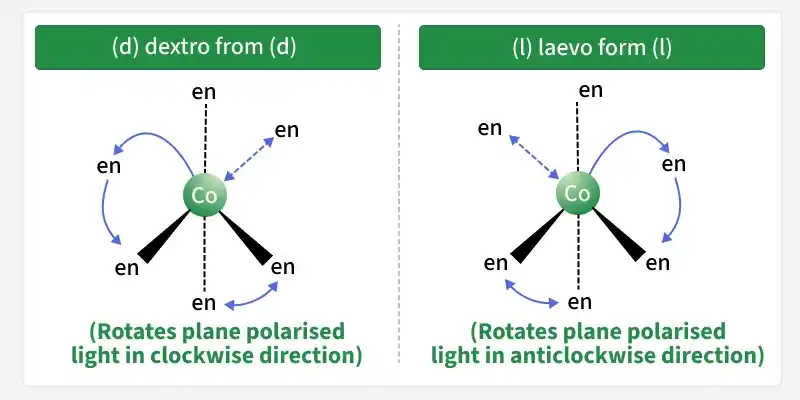
Optical isomers rotate plane polarized light in opposite directions:
- dextro form (d): rotates light to the right
- laevo form (l): rotates light to the left
Example: [Co(en)3] 3+
The two mirror image forms cannot be superimposed on each other.