

Transition elements show unique physical and chemical properties due to their partially filled d-orbitals.
- These elements combine to generate colored compounds and ions. This color is explained by the electron d-d transition.
- The energy gap between these elements' potential oxidation states is relatively small. As a result, the oxidation states of transition elements are diverse.
- Because of the unpaired electrons in the d orbital, these elements create a large number of paramagnetic compounds.
- These elements can be bound by a wide range of ligands. As a result, transition elements generate a wide range of stable complexes.
- These elements have a high charge-to-radius ratio.
- Transition metals are hard and have relatively high densities when compared to other elements.
- Because delocalized d electrons participate in metallic bonding, the boiling and melting temperatures of these elements are high.
Several transition metals possess catalytic capabilities that are extremely useful in the commercial manufacture of certain compounds. Iron, for example, is employed as a catalyst in the Haber process for producing ammonia. Vanadium pentoxide, on the other hand, is utilized as a catalyst in the commercial synthesis of sulfuric acid.
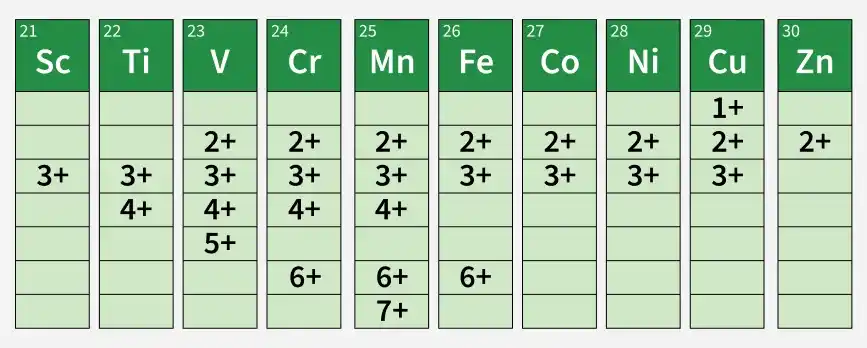
- Oxidation State: Because transition elements exist in various oxidation states, their atoms might lose a varied number of electrons. Because the energies of the ns and (n - 1)d-subshells are nearly comparable .
- Atomic Ionic Radii: Because of the inadequate shielding provided by the tiny amount of d-electrons, the atomic and ionic radii of the transition elements decrease from group 3 to group 6. Those placed between groups 7 and 10 have atomic radii that are roughly similar, but those placed between groups 11 and 12 have bigger radii. This is because electron-electron repulsions balance out the nuclear charge. As you move down the group, you'll see an increase in the atomic and ionic radii of the elements. The presence of a greater number of subshells can explain the rise in radius.
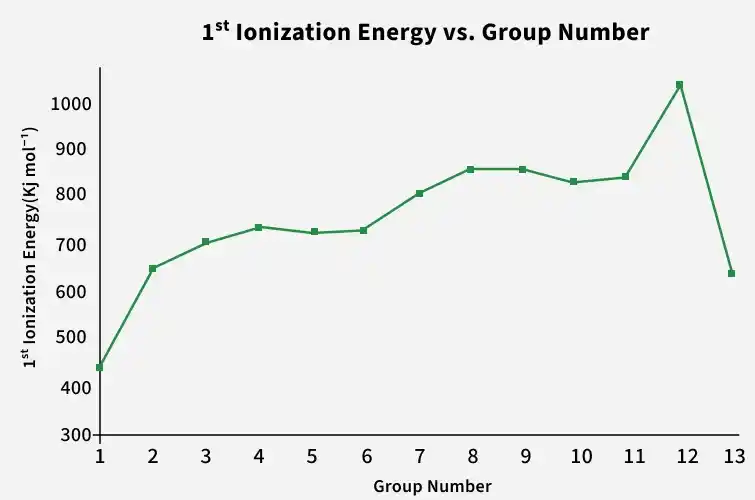
- Ionization Enthalpy: The amount of energy required to remove a valence electron from an element is referred to as its ionization enthalpy. The larger the effective nuclear charge acting on electrons, the greater the element's ionization potential. As a result, the ionization enthalpies of transition elements are often higher than those of s-block elements.
- Metallic Radii and Densities: The transition metals are denser than the s-block metals, and the density increases from scandium to copper. This density factor varies because of the uneven decrease of metallic radii and the increase of atomic mass. As a result, the ionic radius reduces while the atomic number increases.//image
- Boiling and Melting Points: Because of the overlapping of (n - 1)d orbital and d orbital unpaired electrons in covalent bonding, these elements have high boiling and melting temperatures. Metals with entirely full (n-1)d orbitals include Hg, Cd, and Zn. Because they cannot form covalent bonds, their boiling points are lower than those of the other d-block elements.// image
- Metallic Nature: Because the transition elements have fewer electrons in their outermost shells, they are all metals. As a result, they have all of the properties of a metal, such as a malleability and ductility. They are also excellent heat and electricity conductors. Except for mercury, which is liquid and more akin to alkali metals, all of these elements are hard and fragile.