

Distillation is a widely used separation and purification technique in chemistry. It is employed to separate liquids from mixtures or to obtain pure liquids from solutions containing impurities. The method works on the basis of differences in the boiling points of substances. During distillation, a liquid is heated to form vapours, which are then cooled and condensed back into the liquid state.
Principle of Distillation
The principle of distillation is based on the difference in the boiling points of substances present in a mixture.
- When a liquid mixture is heated, the component with the lower boiling point vaporizes first.
- These vapours are separated and condensed to obtain a purified liquid.
- Thus, distillation enables the separation and purification of liquids by utilizing differences in their volatility.
Distillation Apparatus
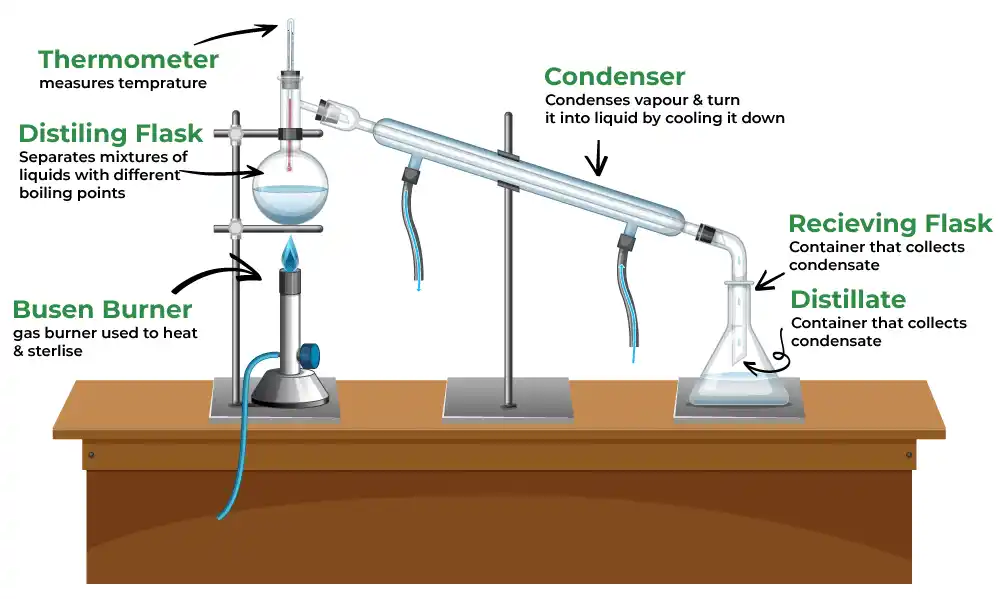
A simple distillation setup consists of a distillation flask, thermometer, condenser, receiver flask, and a heat source.
- The liquid mixture is heated in the distillation flask.
- The vapours formed pass through the condenser, where they are cooled and converted back into liquid form.
- The purified liquid is then collected in the receiving flask.
Process of Distillation
The process of distillation involves a series of steps through which a liquid is purified by vaporization and condensation.
Step 1: Heating the Liquid Mixture
The liquid mixture to be purified is placed in a distillation flask and heated using a suitable heat source. As the temperature rises, the liquid begins to absorb heat energy.
Step 2: Formation of Vapours
When the temperature reaches the boiling point of the more volatile component (the component with the lower boiling point), it starts converting into vapours. The less volatile components remain in the flask.
Step 3: Passage of Vapours into the Condenser
The vapours formed move through the side arm of the distillation apparatus and enter the condenser. A thermometer placed near the outlet records the temperature of the vapours.
Step 4: Cooling and Condensation
The condenser is continuously supplied with cold water. As the hot vapours pass through it, they lose heat and change back into liquid form. This process is known as condensation.
Step 5: Collection of Distillate
The condensed liquid is collected in a receiving flask. This purified liquid is called the distillate.
Step 6: Separation of Impurities
Non-volatile impurities or substances with much higher boiling points do not vaporize and remain behind in the distillation flask. Thus, the liquid collected in the receiver is much purer than the original mixture.
Types of Distillation
Different types of distillation are used depending on the nature of the substances being separated and the difference in their boiling points.
1. Simple Distillation
Simple distillation is the most basic form of distillation. It is used when the difference in boiling points of two liquids is large (usually more than 25–30 K) or when a liquid has to be separated from non-volatile impurities.
- In this method, the liquid mixture is heated in a distillation flask.
- The component with the lower boiling point vaporizes first and passes through the condenser, where it is cooled and converted back into liquid form.
- The condensed liquid is collected separately, while the non-volatile impurities remain in the distillation flask.
- This method provides an effective way of obtaining pure liquids from impure samples.
Applications: Preparation of distilled water , Separation of water from salt solution , Purification of organic liquids.
2. Fractional Distillation
Fractional distillation is used when the boiling points of liquids are close to each other. Since simple distillation cannot effectively separate such liquids, a fractionating column is employed to improve separation.
- The fractionating column contains glass beads or plates that provide a large surface area for repeated vaporization and condensation.
- As vapours rise through the column, the more volatile component becomes enriched in the vapour phase while the less volatile component condenses and returns to the flask.
- This repeated process results in efficient separation of liquids with similar boiling points.
Applications: Separation of benzene and toluene , Refining of crude petroleum , Separation of liquid air into oxygen and nitrogen.
3. Steam Distillation
Steam distillation is used for substances that are volatile in steam and immiscible with water. It is particularly useful for compounds that decompose at high temperatures.
- In this method, steam is passed through the substance to be purified.
- The mixture of steam and organic compound boils at a temperature lower than the normal boiling point of either component.
- As a result, the compound can be distilled without undergoing decomposition.
- The vapours are then condensed and collected, and the organic layer is separated from water.
Applications: Extraction of essential oils , solation of natural aromatic compounds , Purification of certain organic substances.
4. Vacuum Distillation
Vacuum distillation is employed for liquids that have very high boiling points or decompose before reaching their boiling point under ordinary pressure.
- In this method, the pressure above the liquid is reduced using a vacuum pump.
- Since boiling point decreases with a decrease in pressure, the liquid can be distilled at a much lower temperature.
- This prevents thermal decomposition and allows purification of sensitive compounds that cannot be distilled under normal atmospheric conditions.
Applications: Purification of high-boiling organic compounds , Petroleum industry , Separation of thermally unstable substances.