

Chemical reactions occur when the reactant molecules collide with one another. However, every collision does not result in the formation of products. For a reaction to take place, the colliding molecules must possess sufficient energy and proper orientation.
Collision theory explains how chemical reactions occur and why the rates of reactions differ.
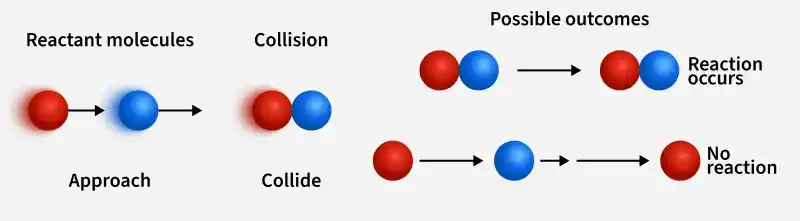
According to collision theory, chemical reactions occur only when the reacting molecules collide with each other. However, every collision does not lead to the formation of products. Only those collisions that are capable of producing products are called effective collisions.
For a collision to be effective, the reacting molecules must satisfy two important conditions:
1. Sufficient Energy
The colliding molecules must possess energy equal to or greater than the activation energy (Ea ) Molecules having energy less than activation energy undergo ineffective collisions and return unchanged.
The condition can be represented as: E ≥ Ea
Where:
- E = kinetic energy of reacting molecules
- Ea = activation energy
2. Proper Orientation
The reacting molecules must collide in a proper orientation so that bond breaking and bond formation can occur easily.
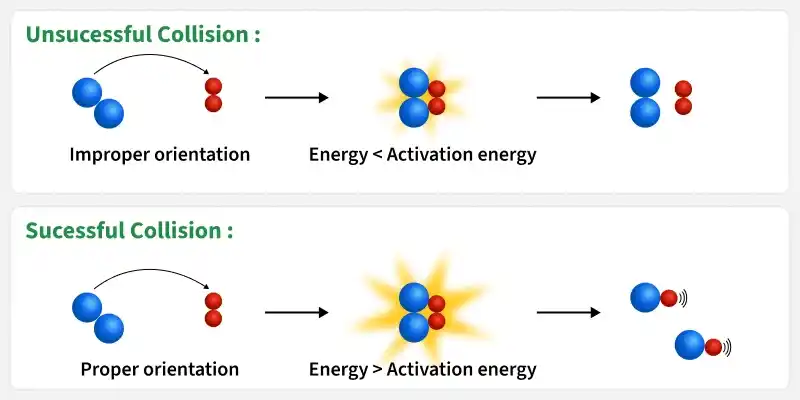
- Collisions occurring in incorrect orientation do not result in product formation even if the molecules possess sufficient energy.
- The rate of a chemical reaction depends on the number of effective collisions occurring per unit time.
- Therefore greater collision frequency, higher temperature, and larger number of molecules possessing activation energy increase the rate of reaction.
Activation Energy
Activation energy is the minimum amount of energy required by reacting molecules to undergo a chemical reaction and form products. It is represented by Ea. Only molecules having energy equal to or greater than activation energy can form products.
Arrhenius Equation
The relationship between the rate constant of a reaction and temperature was given by Arrhenius in the form of the Arrhenius equation. According to this equation, the rate constant increases exponentially with increase in temperature.
k = A e^{-\frac{E_a}{RT}}
Where:
- k = rate constant
- A = Arrhenius factor or frequency factor
- Ea = activation energy
- R = gas constant
- T = temperature in kelvin
Importance of Collision Theory
Collision theory is important in chemical kinetics because it explains how chemical reactions occur and why the rates of reactions differ.
1. Explains the Mechanism of Chemical Reactions: Collision theory explains that chemical reactions occur due to collisions between reacting molecules. It shows that only effective collisions lead to the formation of products.
2. Explains the Effect of Temperature on Reaction Rate: According to collision theory, increase in temperature increases the kinetic energy of molecules. As a result:
- collision frequency increases,
- collisions become more energetic,
- and the number of effective collisions increases.
3. Explains the Concept of Activation Energy: Collision theory explains that reacting molecules must possess a minimum amount of energy called activation energy (Ea) for a reaction to occur.
4. Explains Effective and Ineffective Collisions: The theory distinguishes between effective collisions that form products, and ineffective collisions that do not lead to reaction. This helps in understanding why all collisions are not successful in producing products.
5. Helps in Understanding Reaction Rates: Collision theory relates the rate of reaction to the number of effective collisions occurring per unit time. Greater the number of effective collisions, faster is the reaction.
6. Basis of Arrhenius Equation: Collision theory supports the Arrhenius equation, which explains the relationship between temperature and rate constant.
7. Industrial Importance: Understanding collision theory helps in controlling industrial reactions by adjusting temperature, pressure, and concentration to increase reaction rates and product yield.