

Carboxylic acids are organic compounds containing the carboxyl functional group (-COOH). The carboxyl group consists of a carbonyl group (>C=O) and a hydroxyl group (-OH) attached to the same carbon atom.
- These compounds occur widely in nature and are important constituents of many biological and industrial products.
- Examples include formic acid found in ant stings and acetic acid present in vinegar.
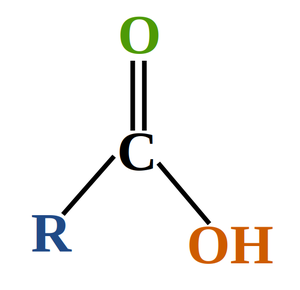
Carboxyl Functional Group
The characteristic functional group of carboxylic acids is the carboxyl group (-COOH).
- It combines the features of both the carbonyl group and hydroxyl group.
- The presence of this group is responsible for the characteristic acidic nature and chemical behavior of carboxylic acids.
Structure: R–C(=O)–OH
Structure of the Carboxyl Group
The carbon atom of the carboxyl group is sp² hybridised and the group is planar in structure. Due to resonance, the two C–O bonds possess partial double-bond character, which contributes to the stability of the carboxylate ion formed after loss of a proton.
The carboxyl group contains:
- One carbon atom
- One oxygen atom joined by a double bond
- One hydroxyl group attached to the same carbon atom
Classification of Carboxylic Acids
Carboxylic acids can be classified on the basis of the number of carboxyl groups present.
1. Monocarboxylic Acids: Contain one carboxyl group.
Examples: Methanoic acid , Ethanoic acid
2. Dicarboxylic Acids: Contain two carboxyl groups.
Examples: Oxalic acid , Succinic acid
3. Tricarboxylic Acids: Contain three carboxyl groups.
Example: Citric acid
Acidic Nature of Carboxylic Acids
One of the most important properties of carboxylic acids is their acidic character.
- The acidic behaviour arises because the carboxylate ion formed is stabilised by resonance.
- This makes the release of a proton easier than in alcohols and phenols.
- The negative charge in the carboxylate ion is delocalised over two oxygen atoms through resonance, making the ion more stable.
Carboxylic acids ionise in aqueous solution to produce hydrogen ions:
RCOOH ⇌ RCOO ⁻ + H ⁺
Factors Affecting Acidity
The strength of a carboxylic acid depends upon the stability of the carboxylate ion.
- Electron-Withdrawing Groups: Electron-withdrawing groups such as –Cl, –Br and –NO₂ increase the acidity of carboxylic acids by stabilising the negative charge on the carboxylate ion.
Example: ClCH2COOH is more acidic than CH3COOH.
- Electron-Donating Groups: Alkyl groups release electron density towards the carboxyl group and destabilise the carboxylate ion, thereby decreasing acidity.
Example: CH3COOH is less acidic than HCOOH.