

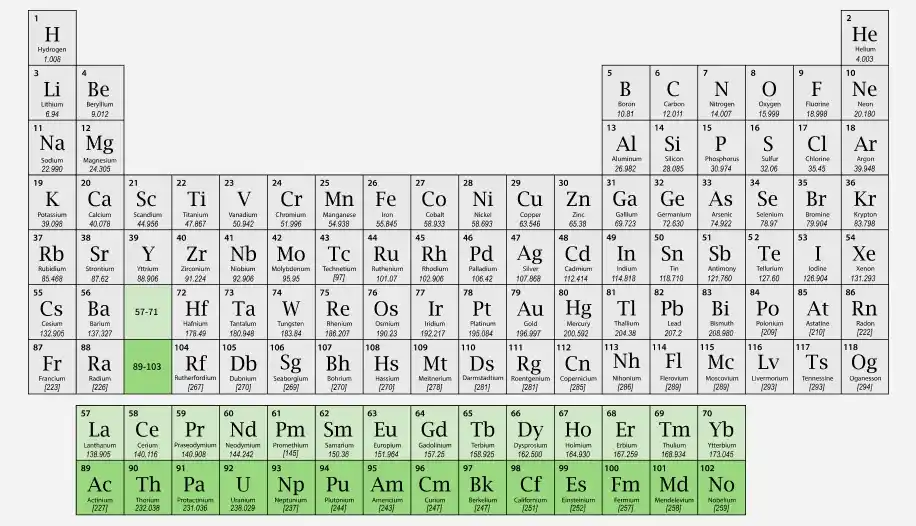
Actinides are elements with atomic numbers ranging from 90 to 103 that follow actinium. They include naturally occurring thorium, protactinium, and uranium elements, as well as eleven transuranic elements created artificially through nuclear processes.
These elements are found in nuclear reactors as well as nuclear weapons. Actinides have the following general electrical configuration: [Rn] 5f1 - 14 6d0 - 1 7s2. Radium is the nearest noble gas, and its electronic configuration is [Rn].
Actinide Contraction
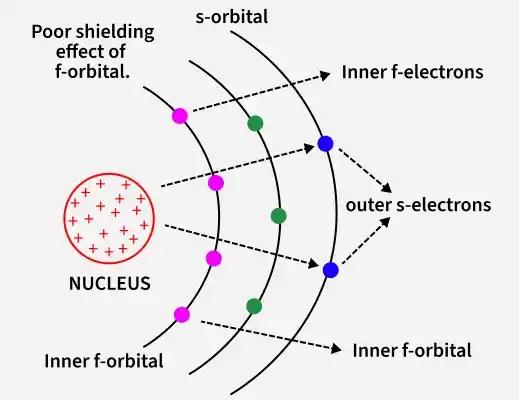
Because of the growing nuclear charge and electrons entering the inner (n - 2) f orbital, the ionic radii, or atomic size, of tripositive actinide ions tend to decrease continuously from Th to Lw. As a result, this steady decrease in size with increasing atomic number is known as actinide contraction, and it occurs similarly to lanthanide contraction. Because of the inadequate shielding by 5f electrons, contraction may be greater along the period.
Electronic Configuration
Actinides are the second series of f-block elements, with a terminal electronic configuration of [Rn] 5f1-14 6d0-1 7s2. Because the energies of 5f and 6d electrons are near, electrons enter the 5f orbital.
Formation of Coloured Ions
Actinides, like lanthanides, have electrons in f-orbitals as well as empty orbitals, as do d-block elements. The f-f electron transition creates visible color when a frequency of light is absorbed.
Oxidation State
Because of the narrower energy difference between the 5f, 6d, and 7s orbitals, actinides have varying oxidation states. Although 3+ is the most stable oxidation state, more oxidation states are possible due to the significant shielding of f-electrons. The maximal oxidation state increases up to the middle of the series and then declines; for example, it increases from +4 for Th to +5, +6, and +7 for Pa, V, and Np but falls in the next elements.
Formation of Complexes
Because of their smaller size but higher nuclear charge, actinides are superior complexing agents than lanthanides. In the sequence of appearance, the degree of complexion lowers.
M4+ > MO22+ > M3+ > MO22+
Chemical Reactivity
Actinides are more electropositive and reactive than lanthanides due to their lower ionization energy. They react when exposed to hot water. Form a passive coating by reacting with oxidizing substances. Halides and hydrides are formed. Actinides are extremely effective lowering agents.
Physical Properties of Actinides
- They are all radioactive. There are no stable isotopes of these elements.
- Actinides have a strong electropositivity.
- Actinide metals are often soft. Some of them can be sliced with a knife.
- These elements have a malleable and ductile nature.
- The actinides are all paramagnetic.
- They produce hydrogen gas when they react with hot water or dilute acid.
Chemical Properties of Actinides
- All actinides, like lanthanides, are extremely reactive with halogens and chalcogens; however, actinides react more readily. Actinides, particularly those with a low number of 5f-electrons, are susceptible to hybridization.
- Actinium and lanthanum are chemically related, as evidenced by their comparable ionic radii and electronic structures.
- Actinium, like lanthanum, usually invariably has an oxidation state of +3 in compounds, but it is less reactive and has stronger basic characteristics.
- Thorium is a chemically active element. Tetravalent thorium compounds are colorless due to a lack of electrons on the 6d and 5f orbitals.
Similarities Between Lanthanides and Actinides
The (n-2) f subshell is employed for filling and characterization of all lanthanides and actinides. Lanthanides and Actinides have very similar electrical configurations. The following are some of the significant commonalities between these two:
- Lanthanides and actinides have a high oxidation state of +3.
- The filling of these elements involves (n - 2) f orbitals.
- Lanthanides and actinides are both reactive and electropositive.
- As the atomic number of these elements increases, so do their ionic and atomic sizes.
- Lanthanides and actinides both have strong magnetic characteristics.
Differences Between Lanthanides and Actinides
- The filling of lanthanides involves 4f-orbitals, whereas the filling of actinides involves 5f-orbitals.
- The energy that binds this 4F atom is smaller than that of actinides, which is 5F electrons.
- The shielding of 5F electrons is also less than that of 4F electrons.
- The paramagnetic characteristics of lanthanides are fairly simple to explain. In the case of Actinides, however, it is difficult to explain all of the paramagnetic features.
- Except for Promethium, the majority of Lanthanides are non-radioactive. The elements in the Actinide series are all radioactive.
- There are multiple oxidation states of the elements in the Actinides class, but none in the Lanthanides.
Uses and Applications of Actinides
- Thorium is mostly employed in gas mantles.
- Actinium is used by scientists and researchers to conduct scientific research or studies.
- Actinium is also employed as a gamma source, an indicator, and a neutron source.
- A significant number of actinides are used in defense activities, nuclear weapons, and energy generation.
- Plutonium is used in nuclear reactors as well as nuclear bombs.
- Many actinide elements are employed in nuclear power plants as well as in the creation of electronic power.
- The actinides lack stable isotopes.