

In accounting, understanding how much it costs to produce a product is essential for determining its price, profitability, and efficiency. The total cost involved in manufacturing a product from raw materials to its finished stage is known as product cost. It includes all expenses directly related to production, such as raw material, labor, and factory overhead.
Product cost helps managers, accountants, and decision-makers evaluate production efficiency, control expenses, and ensure accurate pricing strategies. Without knowing the true product cost, it becomes difficult for a business to plan budgets, set selling prices, or analyze profits correctly.
In accounting, product cost refers to all the expenses incurred to create goods that are intended for sale. These costs are recorded as part of inventory until the goods are sold, after which they become part of the cost of goods sold (COGS). It differs from period costs like rent and administrative expenses, which are not related to production and are charged as expenses in the same period.
Formula: Product Cost = Direct Materials + Direct Labor + Manufacturing Overheads
Components of Product Cost
Product cost primarily consists of three main components. Each component plays a distinct role in ensuring that a product reaches its finished stage efficiently and economically.
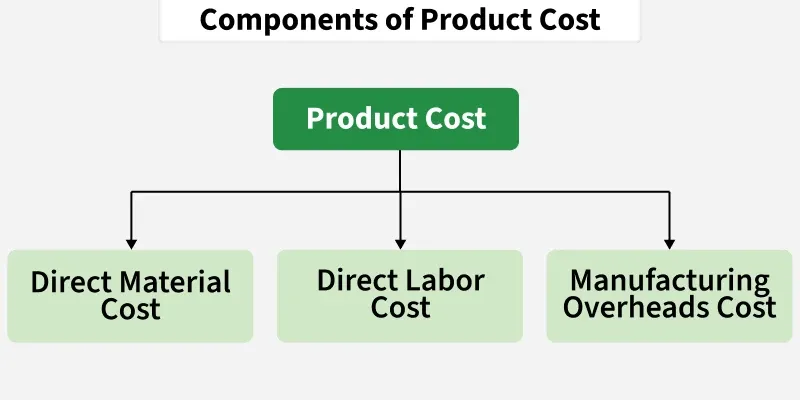
Direct Material Cost
Direct materials are the raw materials that can be directly traced to the final product. These are the physical components that become part of the finished good. For instance, leather in shoes, wood in furniture, or flour in bread are direct materials. Direct material cost includes not only the purchase price of materials but also expenses related to freight, insurance, and handling before the material is used in production. Efficient control of material cost helps in minimizing wastage and improving cost efficiency.
Direct Labor Cost
Direct labor cost refers to the wages paid to workers who are directly involved in manufacturing the product. These include employees who assemble, process, or operate machinery to produce goods. This cost includes not just the basic wages but also related expenses such as bonuses, overtime payments, and benefits. Maintaining an efficient labor force ensures steady productivity and cost stability. Any delay or inefficiency in direct labor affects the overall production cost and delivery schedule.
Manufacturing Overheads
Manufacturing overheads are the indirect costs incurred during production that cannot be directly linked to a single product. These include costs like factory rent, depreciation on machinery, indirect materials such as lubricants, electricity used in production, and salaries of supervisory staff. Since these costs are shared across various products or departments, they are allocated using appropriate cost drivers such as machine hours or labor hours. Effective management of overheads ensures accurate cost determination and helps maintain profitability.
Illustration
Suppose a company manufactures 500 units of a product. The following costs are incurred during production:
- Direct Material Cost: ₹1,00,000
- Direct Labor Cost: ₹60,000
- Factory Overheads: ₹40,000
Total Product Cost = Direct Material + Direct Labor + Factory Overheads
= ₹1,00,000 + ₹60,000 + ₹40,000 = ₹2,00,000
Cost per Unit = Total Product Cost ÷ Number of Units Produced
= ₹2,00,000 ÷ 500 = ₹400 per unit
Hence, the product cost per unit is ₹400. This figure helps the company decide its selling price and evaluate profitability.
Types of Product Cost
Product cost can be categorized into different types based on its nature and behavior. Understanding these helps in better cost management and decision-making.
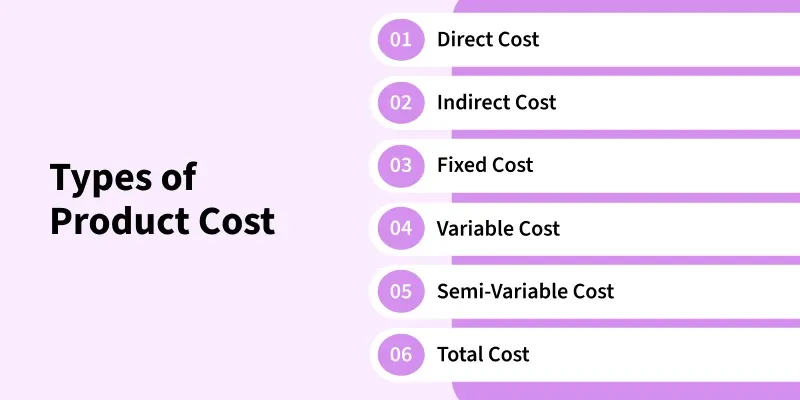
Fixed Product Costs
Fixed costs remain constant regardless of the level of production. These include factory rent, insurance, and depreciation. Even if no goods are produced, these costs are incurred. However, on a per-unit basis, fixed costs decrease as production increases because the total cost is spread over more units.
Variable Product Costs
Variable costs change directly in proportion to the level of production. The more units produced, the higher the variable cost. Examples include raw material cost, packaging material, and direct labor. Managing variable costs is essential for maintaining profitability, especially when production levels fluctuate.
Semi-Variable Product Costs
Semi-variable or mixed costs contain both fixed and variable elements. For example, electricity expenses may have a fixed charge plus a variable component that depends on usage. These costs are analyzed carefully to identify which part changes with production and which remains constant.
Step Costs
Step costs remain constant for a certain level of activity but increase once production crosses a specific limit. For instance, hiring additional supervisors after reaching a production threshold adds a new layer of cost. Step costs are important in capacity planning and resource allocation.
Objectives of Determining Product Cost
Understanding product cost serves several important objectives for a business. It not only helps in pricing and budgeting but also aids in improving operational efficiency.
Pricing Decisions
Determining the correct selling price requires accurate product cost information. Businesses typically add a desired profit margin to the cost to arrive at the final price. If costs are not measured properly, pricing decisions may lead to losses or overpricing that reduces demand.
Cost Control and Reduction
By analyzing each cost component, management can identify areas of inefficiency and take corrective measures. Regular cost monitoring ensures that waste, idle time, and unnecessary expenses are minimized.
Profitability Analysis
Product cost helps assess which products or departments contribute most to profits. Comparing costs with revenues assists management in focusing on high-margin products and improving low-performing ones.
Inventory Valuation
In accounting, product cost determines the value of closing inventory in the balance sheet. Accurate valuation ensures correct financial reporting and compliance with accounting standards.
Budgeting and Forecasting
Knowing product cost enables firms to prepare production budgets, forecast future costs, and allocate resources effectively. It also helps in assessing how cost changes may affect profitability in the future.
Product Cost vs Period Cost
While product cost relates directly to manufacturing, period cost pertains to non-manufacturing activities. Period costs are charged as expenses in the period they occur, while product costs are included in inventory until the goods are sold.
| Product Cost | Period Cost |
|---|---|
| Related to manufacturing | Related to non-manufacturing activities |
| Capitalized as inventory | Expensed in the same accounting period |
| Direct materials, direct labor, factory rent | Office rent, selling expenses, administrative salaries |
| Incurred during production | Incurred irrespective of production |
Understanding this difference is essential for accurate profit calculation and financial reporting.
Methods of Costing Product
Job Costing
This method is used when products are made against specific orders or customized requirements. Each job is treated as a separate cost unit, and costs are recorded individually for material, labor, and overheads. Common in industries like printing, furniture, and shipbuilding, it helps determine the profitability of each job.
Process Costing
Applied in industries with continuous and uniform production, such as cement, chemicals, and textiles. Costs are collected for each process or department and averaged over units produced. It simplifies cost control and helps in evaluating efficiency at different stages of production.
Batch Costing
Used when identical items are produced in batches rather than individually. The total batch cost is divided by the number of units to get per-unit cost. Common in garment, medicine, and food industries, it ensures cost consistency for similar production runs.
Contract Costing
This method is used for large-scale, long-term projects such as construction and engineering works. Each project is treated as a separate cost unit, and costs are recorded throughout its duration. It helps track progress, manage expenses, and determine profit at different stages.
Standard Costing
Involves setting predetermined costs for materials, labor, and overheads to measure performance. The difference between standard and actual cost (variance) helps identify inefficiencies. It aids in maintaining cost control and improving productivity.
Marginal Costing
Considers only variable costs in determining product cost, while fixed costs are treated as period costs. Useful for short-term decisions like pricing, make-or-buy analysis, or evaluating additional production. It helps managers focus on contribution and profit planning.
Importance of Product Cost
Determining product cost holds strategic and financial importance for every organization, irrespective of its size or industry.
Facilitates Efficient Decision-Making
Accurate product costing enables managers to make informed choices regarding pricing, production quantity, and cost control. It ensures that resources are used optimally and helps avoid overproduction or underutilization. This leads to improved profitability and a stronger competitive position in the market.
Ensures Accurate Financial Reporting
Product cost directly influences the valuation of inventory and the calculation of the cost of goods sold (COGS). Accurate costing helps present a true picture of profitability and ensures compliance with accounting principles. It also prevents under- or overstatement of profits, which is essential for fair financial reporting.
Aids in Performance Evaluation
By comparing actual costs with budgeted or standard costs, management can assess the efficiency of departments, employees, and production processes. Variance analysis helps identify problem areas and improve accountability. Regular evaluation based on product cost encourages better cost discipline across the organization.
Supports Strategic Planning
Product cost data provides valuable insights for long-term planning and policy-making. It helps decide whether to expand production, introduce new products, or discontinue less profitable lines. Accurate cost information ensures that every strategic move is supported by sound financial reasoning and profitability analysis.
Challenges in Determining Product Cost
While determining product cost is essential, the process is not always straightforward. Several challenges can make cost estimation complex.
Allocation of Overheads
Accurately distributing overhead expenses such as rent, power, and supervision costs among products is often challenging. Since these costs are not directly traceable to a single product, errors in allocation can distort the total cost and affect pricing decisions. Using suitable cost drivers helps, but perfect accuracy is rarely achieved.
Changes in Input Prices
Frequent fluctuations in the prices of raw materials, labor, and energy can make product costing inconsistent. If cost data is not updated regularly, it may lead to incorrect budgets or pricing decisions. Firms need periodic revisions to reflect the true cost of production.
Technological and Process Changes
When production methods or technology change, previously calculated costs may no longer remain relevant. Automation, for example, reduces labor costs but increases depreciation and maintenance. Hence, cost systems must be reviewed and adjusted to capture such changes accurately.
Difficulty in Estimating Indirect Costs
Indirect costs like maintenance or factory administration are not directly linked to specific products but influence overall expenses. Estimating them involves assumptions and can vary from one period to another, affecting the reliability of cost data.
Complex Multi-Product Environments
Companies producing multiple goods often find it difficult to divide shared costs fairly among them. Machinery, utilities, or factory space used for several products create overlapping expenses. This makes cost allocation more complex and time-consuming.
Numericals
1) ABC Ltd manufactures wooden chairs. The following information is provided for the month of November:
| Cost Component | Amount (₹) |
|---|---|
| Direct Material Cost | 1,80,000 |
| Direct Labour Cost | 1,20,000 |
| Factory Rent | 40,000 |
| Depreciation on Machinery | 20,000 |
| Indirect Factory Wages | 30,000 |
| Units Produced | 2,000 chairs |
Calculate the total product cost and cost per unit.
Solution
To find the manufacturing overheads:
Manufacturing Overheads = Factory Rent + Depreciation + Indirect Wages
= 40,000 + 20,000 + 30,000 = ₹90,000
To calculate the total product cost:
Product Cost = Direct Material + Direct Labour + Manufacturing Overheads
= 1,80,000 + 1,20,000 + 90,000 = ₹3,90,000
To compute the cost per unit:
Cost per unit = Total Product Cost/ Units Produced
= 3,90,000/2000 = ₹195
Thus, the total product cost is ₹3,90,000 and the cost per unit is ₹195 per chair.
2) XYZ Ltd manufactures school bags. The following expenses were incurred during the year:
| Expense Item | Amount (₹) |
|---|---|
| Cost of Fabric and Materials | 2,50,000 |
| Wages of Factory Workers | 1,40,000 |
| Factory Power and Electricity | 60,000 |
| Factory Supervisor Salary | 50,000 |
| Office Rent | 70,000 |
| Advertising Expenses | 90,000 |
Classify the following as product costs and period costs and calculate the total amount of each.
Solution
Product costs include all manufacturing expenses. Period costs include office and selling expenses.
To find the manufacturing overheads:
Manufacturing Overheads = Factory Power and Electricity + Factory Supervisor Salary
= 60,000 + 50,000 = ₹1,10,000To calculate the total product cost:
Product Cost = Direct Material + Direct Labour + Manufacturing Overheads
= 2,50,000 + 1,40,000 + 1,10,000 = ₹5,00,000To calculate the total period cost:
Period Cost = Office Rent + Advertising Expenses
= 70,000 + 90,000 = ₹1,60,000Thus, the total product cost is ₹5,00,000 and the total period cost is ₹1,60,000.
3) PQR Ltd manufactures coffee mugs. For a batch of 1,000 mugs, the following information is provided:
| Cost Component | Amount (₹) |
|---|---|
| Direct Material Cost | 80,000 |
| Direct Labour Cost | 50,000 |
| Manufacturing Overheads (charged at 60 percent of Direct Labour Cost) | — |
Calculate the manufacturing overheads, total product cost, and cost per mug.
Solution
To find the manufacturing overheads:
Manufacturing Overheads = 60% of Direct Labour Cost
= 60% × 50,000 = ₹30,000To calculate the total product cost:
Product Cost = Direct Material + Direct Labour + Manufacturing Overheads
= 80,000 + 50,000 + 30,000 = ₹1,60,000To compute the cost per mug:
Cost per unit = Total Product Cost / Number of Units
= 1,60,000 / 1,000 = ₹160Thus, the manufacturing overheads are ₹30,000, the total product cost is ₹1,60,000, and the cost per mug is ₹160.
4) MNO Ltd produced 500 units of a product. The following information is available:
| Cost Component | Amount (₹) |
|---|---|
| Direct Material Cost | 1,50,000 |
| Direct Labour Cost | 90,000 |
| Direct Expenses | 20,000 |
| Factory Rent | 40,000 |
| Indirect Factory Wages | 25,000 |
| Power & Electricity | 15,000 |
| Office and Administrative Overheads | 30,000 |
Calculate the total product cost and cost per unit.
Solution
To find the manufacturing overheads:
Manufacturing Overheads = Factory Rent + Indirect Factory Wages + Power & Electricity
= 40,000 + 25,000 + 15,000 = ₹80,000To calculate the total product cost:
Product Cost = Direct Material + Direct Labour + Direct Expenses + Manufacturing Overheads
= 1,50,000 + 90,000 + 20,000 + 80,000 = ₹3,40,000To compute the cost per unit:
Cost per unit = Total Product Cost / Units Produced
= 3,40,000 / 500 = ₹680Thus, the total product cost is ₹3,40,000 and the cost per unit is ₹680.