

Departmentation is the process of dividing the total work of an organization into smaller, manageable units called departments. These departments are formed by grouping similar or related activities together so that specialized tasks can be handled more efficiently. Once these activities are grouped, each department is placed under the supervision of a manager who is responsible for planning, coordinating, and controlling its operations.
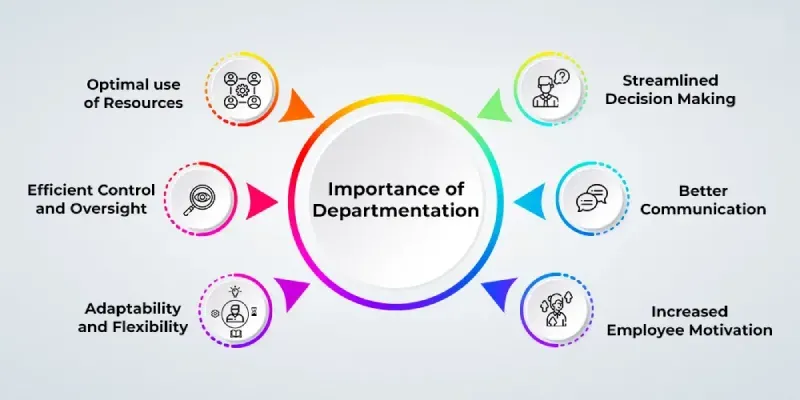
This structural arrangement helps simplify complex organizational activities and ensures that work is carried out in an organized and systematic manner. Through departmentation, the organization achieves clarity in roles, specialization of tasks, better communication, and smoother coordination among different units. Ultimately, it forms the foundation of a well-defined organizational structure.
Optimal Use of Resources
Departmentation ensures that employees with particular skill sets are allocated to suitable tasks. This approach leads to increased productivity and minimizes the unnecessary expenditure of time and resources.
Streamlined Decision Making
Departmentation simplifies the decision-making process within an organization. Managers can make well-informed decisions by consulting with expert department heads who possess a deep understanding of their respective areas.
Better Communication
Departmentation boosts communication within an organization by creating transparent communication channels between different departments. This structure results in the rapid exchange of information, ultimately enhancing overall performance.
Increased Employee Motivation
Departmentation permits employees to work in their areas of expertise, allowing them to take pride in their work and experience a sense of achievement. This atmosphere leads to heightened job satisfaction and motivation, which, in turn, contributes to the organization's success.
Adaptability and Flexibility
Departmentation equips organizations with the ability to adjust to shifting market conditions or customer demands. By having specialized departments, organizations can respond swiftly to new challenges and opportunities.
Efficient Control and Oversight
Departmentation simplifies management's task of monitoring and controlling the activities of various departments. By setting departmental goals, gauging performance, and applying corrective actions when needed, the organization remains on track to fulfil its objectives.
Need of Departmentation
The need for departmentation arises due to various reasons that contribute to an organization's overall success and efficiency. Some of the key reasons include:
Specialization
Departmentation is required to develop specialization within the organization. When similar tasks are grouped together, employees repeatedly work on the same type of activity, which helps them gain expertise. This not only increases productivity but also improves accuracy, reduces mistakes, and enhances the overall quality of output.
Better Coordination
As the size of the organization increases, activities become more complex and scattered. Without proper grouping, coordination becomes difficult. Departmentation brings related activities together, making it easier for managers and employees to understand how their work connects with others. This leads to smoother workflow, faster communication, and fewer operational conflicts.
Effective Control
An organization cannot be controlled efficiently if all activities are managed as one large unit. Departmentation breaks the work into smaller, manageable parts. Managers can set specific goals for each department, measure performance more accurately, and identify problems quickly. This structured control system helps in maintaining discipline and achieving desired results.
Clear Accountability
When roles and responsibilities are distributed without structure, employees may be confused about what they are supposed to do. Departmentation assigns clear duties to each department and its employees. This clarity enhances accountability, encourages responsible behavior, and motivates employees to meet their targets because they know exactly what is expected from them.
Organizational Growth
Expansion becomes difficult when work is unorganized. With departmentation, the organization gets a strong framework where new departments, new functions, and new employees can be added easily. It supports long term growth by ensuring that increased workload is handled systematically without disturbing the existing structure.
Efficient Resource Use
Resources such as manpower, machinery, time, and funds need to be used wisely. Departmentation ensures that employees with specific skills are placed in relevant departments, and equipment is used where it fits best. This prevents wastage, avoids duplication of efforts, and increases the overall efficiency of operations.
Process of Departmentation
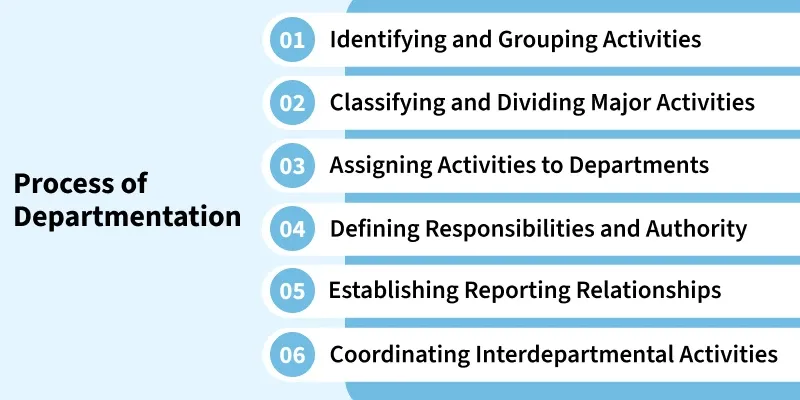
Identifying and Grouping Activities
The process starts by identifying all the activities the organization must perform, such as production, marketing, finance, HR, or customer service. These activities are then grouped based on their similarity so that related tasks can be handled together in an organized way.
Classifying and Dividing Major Activities
After grouping the activities, managers classify them into broader functional categories. For example, all marketing-related activities like sales promotion, advertising, and market research are placed under one functional group. This helps divide the total work into logical and manageable segments.
Assigning Activities to Departments
Once classification is done, each group of related activities is assigned to a specific department. A departmental head or manager is appointed to oversee operations. This step ensures that each area of work is handled by a specialized unit with clear focus.
Defining Responsibilities and Authority
In this stage, the specific responsibilities of each department and its employees are clearly defined. Along with responsibility, suitable authority is also given so that tasks can be completed effectively. This clarity reduces confusion and improves accountability.
Establishing Reporting Relationships
A proper chain of command is set so that everyone knows who they report to. Department heads report to higher management, while employees report to their supervisors. This ensures smooth flow of information and helps maintain discipline.
Coordinating Interdepartmental Activities
Finally, mechanisms are created to ensure the different departments work in harmony. Coordination helps avoid duplication, prevents delays, and ensures that one department’s output supports the next. Strong coordination keeps the entire organization functioning smoothly.
Advantages of Departmentation
Specialization and Expertise
Departmentation brings together people who share similar skills or work on related tasks. This helps employees focus on their strengths, gain deeper knowledge, and improve their expertise over time. As specialization increases, the quality of work improves, errors reduce, and efficiency rises, resulting in better overall performance.
Better Managerial Control
Dividing the organization into departments makes supervision easier. Each department has a manager responsible for planning, monitoring, and evaluating work. Since responsibilities are clearly defined, managers can track performance, identify problems quickly, and take corrective action whenever needed. This leads to smoother and more effective management.
Clear Responsibilities and Accountability
When work is divided into departments, each unit knows exactly what it has to achieve. Employees have clearly assigned roles, which reduces confusion and overlaps. This clarity increases accountability, as staff members understand how their individual tasks contribute to the organization’s goals and feel more responsible for their performance.
Improved Coordination within Departments
Grouping similar activities together allows people working in the same area to communicate and coordinate more easily. Information flows more smoothly, and teamwork becomes stronger within the department. This helps reduce delays, avoid misunderstandings, and ensures that daily operations run efficiently.
Efficient Resource Utilization
By assigning tasks to the right departments, organizations can make the best use of their human and physical resources. Skilled employees can be placed where they are most needed, and equipment can be used more effectively. This reduces wastage of resources and allows the organization to achieve more with the same inputs.
Organizational Growth and Expansion
Departmentation provides a structured foundation that supports growth. As the business expands, new departments can be added without disturbing the existing structure. Whether the organization is entering a new market, launching a new product, or increasing production, departmentation makes it easier to manage higher workloads and increased complexity.
Better Decision-Making at Department Level
Since each department handles specific and related activities, its manager becomes familiar with the details of that area. This allows faster and more informed decision-making at the departmental level. Problems are solved more quickly, opportunities are recognized sooner, and day-to-day operations become more efficient because managers do not have to depend on top management for all decisions.
Disadvantages of Departmentation
Risk of Functional Silos
When departments focus only on their own goals and activities, they may stop seeing the bigger organizational picture. This creates isolated units where employees think only about their department’s success rather than the organization as a whole. Over time, this can reduce cooperation and weaken team spirit across the company.
Coordination Problems
Even though departmentation improves internal coordination within departments, it can sometimes create barriers between different departments. Each unit may have its own priorities and timelines, which can cause delays when tasks depend on interdepartmental cooperation. Without strong communication channels, the entire workflow may slow down.
Duplication of Efforts
Different departments often perform similar administrative or support activities separately. For example, each department may maintain its own records, purchase small equipment, or handle its own training. This repetition leads to unnecessary duplication of work, which wastes both time and organizational resources.
Higher Costs
With separate departments come additional managers, assistants, coordinators, and support staff. Each department also needs its own equipment, space, and sometimes separate systems. All of this increases the overall administrative and operational costs of the organization.
Slow Decision-Making at Top Level
Because each department sends multiple reports, requests, and proposals to top management, the decision-making process becomes longer. Senior managers may need to analyze information from many departments, which increases their workload and slows down strategic decisions.
Conflict of Interests
Departments may develop competing interests, especially when it comes to securing budgets, manpower, or recognition. For example, marketing and production may argue over deadlines or quality standards. Such conflicts can create tension, reduce cooperation, and negatively affect overall organizational performance.
Difficulty in Maintaining Uniform Policies
As departments grow, they may adopt their own working styles, rules, and practices that suit their specific needs. This sometimes leads to inconsistency in employee policies or customer service standards across the organization. Maintaining uniformity becomes challenging and may affect the company’s image.