

Coordination is the process of bringing people and departments together to work effectively toward a common goal. It helps ensure that everyone understands their roles and responsibilities, uses resources properly, and avoids conflicts or duplication of work. Good coordination improves communication, increases productivity, and helps organizations achieve goals efficiently and on time.
Types of Coordination
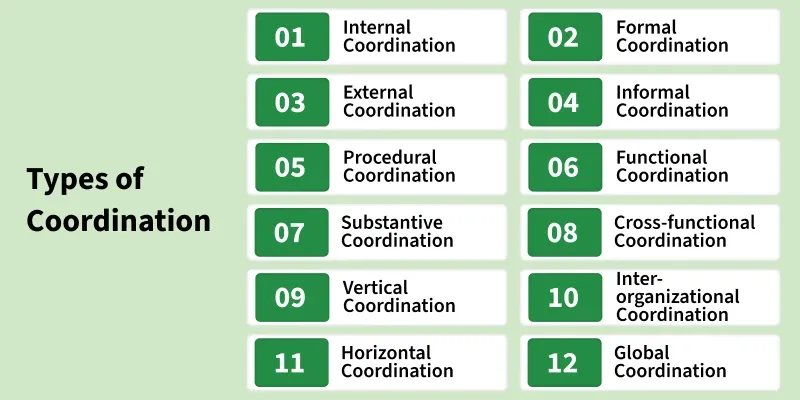
Different forms of coordination are used in various settings and professions. These are a few of the common types of coordination that are used in numerous organizational and different situations. Depending on the circumstance, the following are some of the common types of coordination used-
Internal Coordination: Internal coordination is the practice of coordinating operations and efforts within a company to accomplish shared goals. To maximize productivity and accomplish desired results, it involves making sure that all departments, teams, and individuals work well together.
External Coordination: External coordination is the management of interactions and relationships with external stakeholders, including clients, partners, suppliers, and governmental bodies. In order to accomplish mutual objectives and maintain positive relationships, it involves coordinating activities with external organizations.
Procedural Coordination: Procedure coordination refers to the methods used by various organizations or agencies to coordinate their activities. This includes establishing communication channels, exchanging information, establishing goals and deadlines, developing decision-making procedures, and evaluating growth in performance.
Substantive Coordination: The alignment of procedures, goals, and policies among different organizations or institutions is referred to as substantive coordination. Setting up guidelines for decision-making and problem-solving is also a part of substantive coordination. It can include making sure that rules and practices are uniform across all organizations and resources.
Vertical Coordination: This kind of coordination takes place between several organizational levels within a team or an organization. It involves the communication between managers as well as employees in terms of information, instructions, and feedback. Vertical coordination makes sure that tasks and activities fit with the organization's ultimate goals and strategies.
Horizontal Coordination: Horizontal coordination takes place between individuals or departments at the same hierarchical level within an organization. It involves working together, communicating, and sharing resources to accomplish common objectives. Effective teamwork, resolution of disputes, and efficiency all depend on horizontal coordination.
Formal Coordination: In any organization, formal coordination is formed by formal systems, processes, and structures. It consists of formal reporting channels, regulations, and procedures. The following are a few examples of formal coordination systems: meetings, documents, job descriptions, and performance appraisals.
Informal Coordination: Within a company, networks, relationships, and social interactions all play an important role in establishing informal coordination. It depends on people's relationships, mutual trust, and understanding. Informal coordination can be flexible and impulsive, and it frequently takes place through social interactions, casual talks, or electronic platforms.
Functional Coordination: Functional coordination refers to the coordinating activities among specific functional areas or departments, for example, finance marketing human resources, etc. It makes sure that the efforts of each department are directed towards the same ultimate goal of the organization.
Cross-functional Coordination: Cross-functional coordination refers to coordinating activities between different functional areas or departments. To accomplish shared objectives, an organization required contributions from many functions. It needs collaboration, communication, and integration of efforts. For projects, product development, and improvement of systems, cross-functional cooperation is an important element.
Inter-organizational Coordination: Inter-organizational coordination is the process by which various organizations or groups collaborate to achieve a single goal. Collaboration, sharing of information, and taking decisions together are all involved. Supply chains, partnerships, alliances, and joint projects all require inter-organizational coordination.
Global Coordination: Coordinating activities and operations across different countries or geographical regions is referred to as global coordination. It requires handling various cultural, legal, and operational situations while assuring consistency and compliance with international standards and strategies.
Need for Coordination
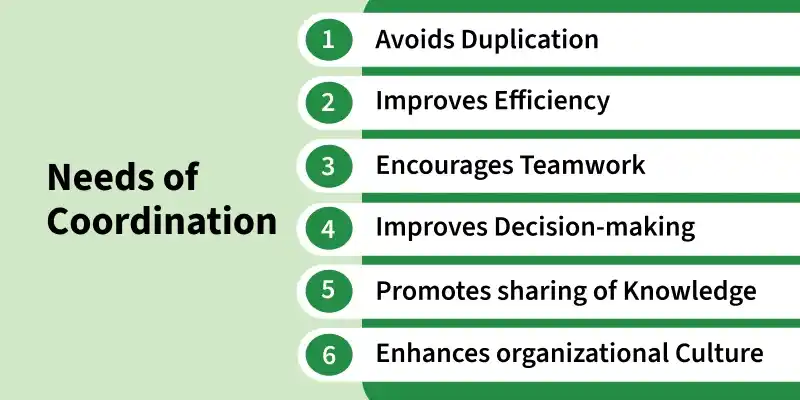
Any action or activity involving several people or organizations requires coordination. It makes sure that everyone is pursuing the same objectives and that their efforts are supportive rather than competitive. Some of the needs or significance of coordination are as follows-
Avoids Duplication: Individuals or organizations who work separately without coordination run the risk of duplicating activities, which wastes time, money, and energy.
Improves Efficiency: Coordination of activities can provide more efficient and successful outcomes. When everyone is working in unity, organizations and individuals may use each other's strengths and respond to their differences.
Encourages Teamwork: Effective coordination involves effective collaboration and communication. It promotes teamwork, idea sharing, and mutual support for each other's efforts.
Improves Decision-making: In any organization, the decisions of stakeholders are often better than those of individuals. Where there is coordination, there is a unity of stakeholders, who can take decisions more efficiently and informatively.
Promotes sharing of Knowledge: When people work together, they share their knowledge and skills. As a result, the team becomes more knowledgeable and can prepare themselves better to handle difficulties and challenges.
Enhances organizational Culture: Coordination helps in developing a culture inside an organization that encourages the open exchange of ideas, mutual respect, and appreciation for other viewpoints. This helps employees last longer and stay loyal and motivated to the team.
Thus, coordination is important for successfully achieving organizational goals. It leads to improved efficiency, increased productivity, and better decision-making which makes the functioning of an organization easier.
Significance of Coordination
Teamwork: It allows people and organizations to cooperate to achieve a common objective. When people work together, they can share ideas and talents and find different points of view and strategies. As a result, problem-solving is made easier and more effective, which can help people make better decisions.
Unity in Diversity: Coordination plays an important role in achieving Unity in diversity. When people with different backgrounds and talents join together to work towards a common objective, good coordination is necessary to make sure that everyone is pursuing the same goal.
Conflicting Goals: When different people or groups have different objectives, there is always a possibility of conflict. In such situations, coordination might help to end the dispute by finding a beneficial solution. Coordination can reduce misunderstandings and promote cooperation by establishing clear communication channels and a framework for decision-making.
Growth in Size: when an organization grows in size, it gets more complex and challenging to maintain communication and order among different departments in an organization. Coordination helps maintain efficiency and proper communication among different departments.
Specialization: Effective coordination enables individuals or teams to collaborate effectively, allowing them to specialize in their fields of expertise while continuing to work towards the organization's goals. To guarantee that everyone is on the same page, coordination often requires effective collaboration, clear communication, and the use of suitable tools and processes.
Interdependence: Coordination recognises the interdependence of various departments and teams within an organization. It emphasises the need for teamwork and shared responsibility to make sure that tasks and objectives are coordinated, enabling effective functioning and the achievement of desired results.
Differentiation and Integration: Coordination finds a balance between allowing differentiation in roles and functions while promoting integration towards common objectives. It facilitates coordinating and harmonizing various units, teams, or individuals, promoting specialization and organizational unity.
Limitations to Coordination
Coordination surely makes work and management easier but at the same time, it can also have some limitations to it. Following are some of the constraints of coordination:
Differences in Goals: Every department has its own objectives—for example, production wants efficiency, while marketing wants higher sales. These differing priorities can create conflicts and make coordination challenging. Managers must align these goals so that all departments support the organisation’s overall objectives.
Specialisation: Modern organisations have highly specialised departments and experts. While specialisation improves efficiency, it also makes people focus only on their own tasks. This narrow outlook reduces understanding of other departments’ needs, creating coordination gaps.
Large Size of Organisations: As organisations grow, the number of employees, departments, and layers of authority increases. More people and more processes make it harder to synchronise activities and maintain smooth communication across the entire organisation.
Communication Barriers: Coordination depends heavily on clear communication. Misunderstandings, delays, incomplete information, or lack of proper communication channels can lead to confusion and poor coordination.
Human Factors: Individual behaviour, attitudes, personalities, conflicts, and resistance to change can weaken coordination. If employees do not cooperate or lack trust, maintaining harmony becomes difficult.
Interdependence of Departments: Departments often rely on each other—like production depending on procurement for materials. High interdependence means that if one department delays or fails, the entire chain suffers, making coordination more complex.