

Business buyer behaviour refers to the decision-making process and attitudes of organizations and their employees when purchasing goods and services for business use.
- It emphasizes strategic acquisitions that enhance profitability and operational efficiency by securing the highest-quality raw materials, equipment, and services to optimise production and maximise returns.
- Designated purchasing managers act as business buyers and follow a formal process involving need identification, alternative evaluation, and supplier selection, with decisions driven by company goals, priorities, budget constraints, and long-term organisational requirements.
Types of Buying Situations
A buyer may often encounter three different types of buying circumstances. One extreme of this circumstance is a straight rebuy which includes a regular purchase, and the other extreme is a new task, which requires extensive research. Modified rebuy exists at the middle level and takes considerable research. Below is a full description of each buying situation :
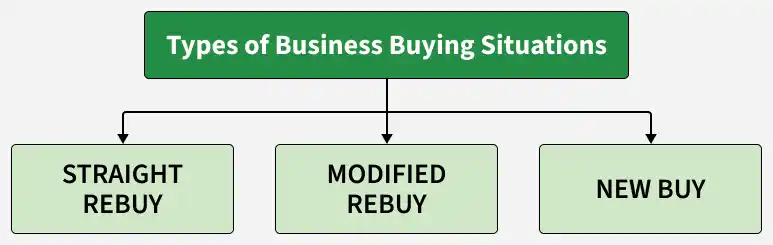
1. Straight Rebuy
- A Straight Rebuy occurs when a buyer purchases the same goods in the same quantities from the same supplier with no changes. Post-purchase reviews are usually skipped unless quality, delivery, or other issues arise.
- Sellers prefer straight rebuys as they provide a stable, predictable revenue stream with minimal effort. However, sellers must continue delivering excellent and reliable service to maintain the relationship.
For example: If an account is very large and significant, the seller may go so far as to station personnel at the customer's place of business to ensure that the client is satisfied and the straight-rebuy condition is maintained. IBM and the management consultancy business Accenture have staff stationed at their customers' offices and facilities all around the world.
2. Modified Rebuy
- A Modified Rebuy occurs when a buyer purchases the same type of product as before but with some changes. These changes may include customization, different quantities, packaging, delivery terms, or other specifications.
- This situation requires the buyer to evaluate options and the seller to adapt, making it more involved than a straight rebuy.
For Example: a buyer can opt for a modified rebuy because of the high price of a product or raw material. Suppose, a company wants to reduce its operating cost and wants to achieve this objective by optimising its purchase cost and raw materials. In order to do so, the company can choose to change the vendor who can provide the company with raw materials at a better price.
3. New Task
- A new-task buying situation occurs when a company purchases a product or service for the first time. Since the decision often involves higher cost or risk, multiple people participate in the buying process and gather detailed information.
- These purchases usually take more time because companies compare different suppliers, products, and may issue RFPs before making a final choice.
For example: A school district owns properties. When a new high school is needed, there may not be anyone in the administration who has expertise in developing new schools. That buying circumstance is a new task for everyone concerned.
Participants in Business Buying Process

- Users: Users are those employees of the company who utilise the benefits of the good or service. Since they are the product's first consumers, they initiate the demand for it and help the other participants with queries regarding its specifications.
- Influencers: Influencers often supply information for assessing alternatives as well as assistance in defining specifications. Influencers in the technical field are especially important.
- Buyers: The formal authority to place the order and choose the terms and conditions for purchase belongs to the buyer. Selecting and negotiating with suppliers is the buyer's primary responsibility. When buying an advanced product, the top executives of the organisation are involved.
- Deciders: The final vendors may be chosen or approved by the decision-maker formally or informally. In routine purchases, buyers frequently make decisions or at the very least approve them.
- Gatekeepers: Information transfer to other people is regulated by gatekeepers.
Major Influences on Business Buyers
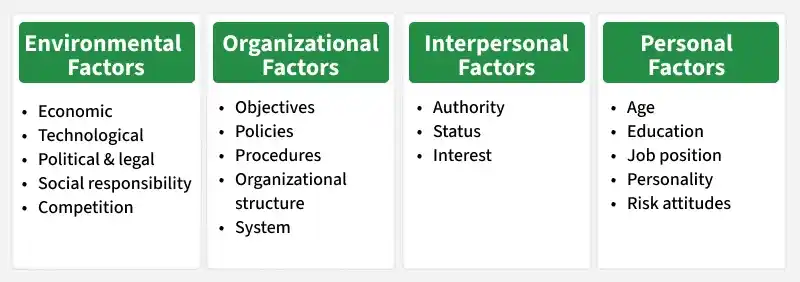
Business buyers are influenced by both economic and human factors when making purchase decisions. While some focus only on price, quality, and service, buyers are also affected by personal, social, and organizational considerations.
- Environmental Factors: These include economic conditions, demand levels, economic forecasts, interest rates, material shortages, and technological, political, and competitive developments. Cultural and customs also significantly influence buyer behaviour, especially in international markets.
- Organisational Factors: Each organization has its own goals, policies, procedures, structure, and systems. Marketers must understand who is involved in buying, their evaluation criteria, and the company’s purchasing rules and limitations.
- Interpersonal Factors: The buying centre involves multiple people who influence each other. Factors such as authority, expertise, personal relationships, and group dynamics affect decisions. These influences are often subtle but important.
- Individual Factors: Each buyer brings personal attributes like age, education, income, personality, risk attitude, and buying style. Some buyers are technical and analytical, while others focus on negotiation and getting the best deal.
Types of buyer behaviour
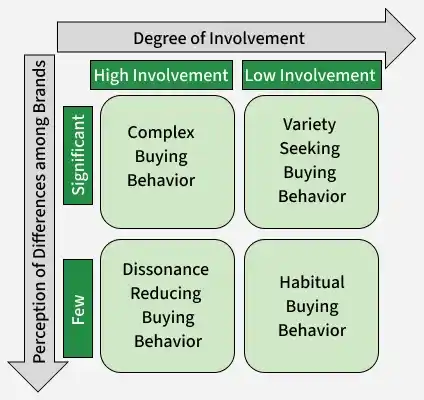
- Complex Buying Behaviour – This occurs when consumers are highly involved in a purchase and perceive significant differences among brands. It is common for expensive, risky, or infrequently purchased products such as cars, houses, or laptops. Buyers spend considerable time researching and comparing options before making a decision.
- Dissonance-Reducing Buying Behaviour – This happens when consumers are highly involved in a purchase but see little difference among brands. Since the purchase may be expensive or risky, buyers may feel uncertainty after buying and seek reassurance that they made the right choice.
- Habitual Buying Behaviour – In this type, consumers have low involvement and perceive few differences among brands. Purchases are made out of habit and routine, such as buying everyday items like salt, soap, or toothpaste.
- Variety-Seeking Buying Behaviour – This occurs when consumers have low involvement but perceive significant differences among brands. Buyers often switch brands for the sake of variety and experimentation rather than dissatisfaction with the previous product.