

tRNA, also known as transfer RNA, is a subtype of RNA that helps in the protein synthesis process. tRNA carries the amino acid to the ribosome, which is the molecular machine that assembles the protein, and ensures that the amino acid is incorporated into the growing protein chain in the correct order.
The different types of tRNA, each with a unique sequence and structure, allow them to recognize a specific amino acid. Specific amino acids are incorporated into the protein sequence via specific tRNA.
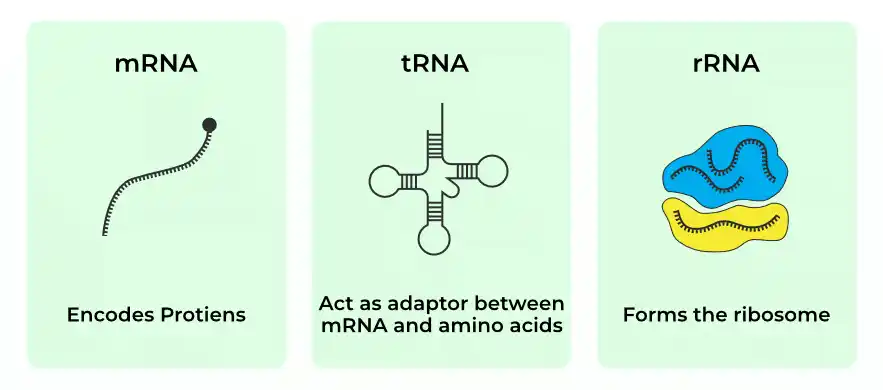
Ribonucleic acid (RNA) is a single-stranded, non-hereditary (except for retroviruses) molecule that helps in the synthesis of proteins.
It is classified into three types—messenger RNA (mRNA), transfer RNA (tRNA), and ribosomal RNA (rRNA); on the basis of the function and molecular size of the nucleic acids.
Structure of the t-RNA
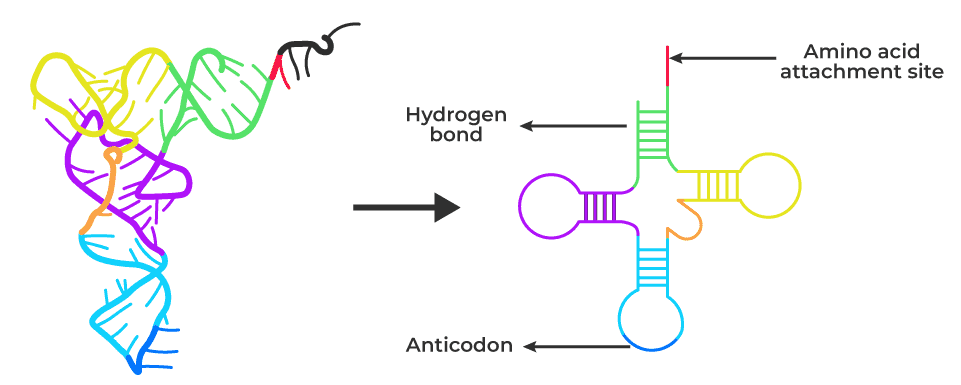
The tRNA molecule has two ends: the 5’ and 3’ ends. The 5’ end consists of a phosphate group, which is attached to the 5th carbon atom of ribose sugar, while the other 3’ end has a free OH group on the 3-carbon atom.
So, there are two types of structure of tRNA: the 2D cloverleaf model and the 3D L-shaped model.
Cloverleaf Model
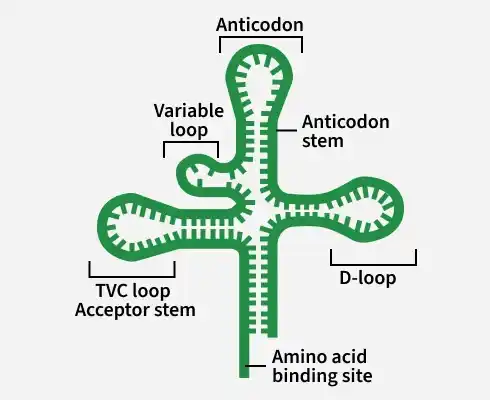
A tRNA molecule consists of 70-80 nucleotides that fold like a cloverleaf. A 2D tRNA molecule appears like a cloverleaf. As clove has the following ends, the t-RNA molecule also has four ends:
1. Acceptor end: It is called the "acceptor end" as it accepts the specific amino acid. It is made up of 7-9 nucleotides. It has two ends—3' and 5'. It is the 3’ end that consists of a base triplet CCA with an OH group, whereas the 5' end consists of a phosphate group. At this OH at the 3' end, the COOH group of amino acids joins.
2. Anti-codon end: It is made up of 5 base pairs and consists of codons that are complementary to the codon present on mRNA, therefore known as an anticodon. Anticodon is the triplet base sequence in tRNA that binds with the codon at the time of translation. There is a specific tRNA for a particular amino acid. Base pairing between the codon and anticodon helps in the synthesis of proteins. There are no tRNAs for stop codons, but there are specific tRNAs for initiation codons.
3. Enzyme site/DHU end: It is present on the lateral side of the molecule that recognizes aminoacyl-tRNA synthetase, which activates the amino acids and catalyzes the binding of a specific amino acid to a tRNA molecule. It consists of 3-4 base pairs and is called a D loop because it consists of a modified nucleotide called dihydrouridine.
4. Ribosome recognition end: It is on the other lateral side of the molecule. It is meant for attachment to a ribosome.
- TΨC Loop end: It is known as the T arm. It consists of 4-5 base pairs and a loop consisting of modified uridine called pseudouridine.
- Variable Loop: This loop is of variable size and ranges from 3 to 21 base pairs. It is present between the anticodon and TΨC loop. It recognizes tRNA molecules.
L-shaped model
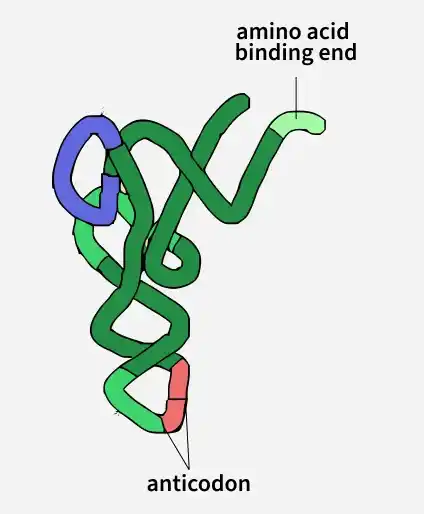
3D tRNA looks like an L-shaped molecule that has two functional ends:
- The acceptor stem: Site of attachment of specific amino acid (3’ end of the molecule)
- Anticodon loop: Site where codons are read on mRNA (5’ end of the molecule)
Functions
- It helps in the synthesis of proteins and also helps in aminoacylation, which is the first step of protein synthesis.
- It transfers the specific amino acid from the amino acid pool to the mRNA to form a polypeptide to make proteins.
- It helps amino acids link with mRNA to form proteins and also helps in the recognition of specific amino acids and carries them to the ribosomal unit for translation.
- The ribosome site, where the polypeptide chain grows, has three binding sites of tRNA-aminoacyl (A-site), peptidyl (P-site), and exit (E-site).
- It consists of an anticodon, which decodes the amino acid code for a specific amino acid present in mRNA.