

Reducing and non-reducing sugars are two categories of carbohydrates distinguished by their ability to undergo chemical reactions with other substances.
- Reducing sugars, like glucose and fructose, possess free aldehyde or ketone groups that enable them to undergo chemical reactions.
- Non-reducing sugars lack these groups and remain inert to such reactions.
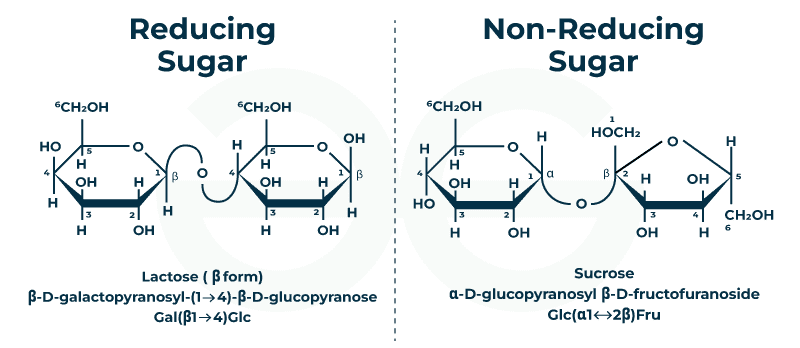
Reducing Sugar
A reducing sugar donates electrons to another chemical substance and is characterized by a free aldehyde or ketone group in the sugar molecule. These functional groups can undergo oxidation-reduction reactions.
An example includes glucose and maltose. They have an open-chain form with an aldehyde group or a free hemiacetal group. The anomeric carbon of sugar can be used to identify the sugar type. It is a reducing sugar if it has an OH group in its anomeric carbon.
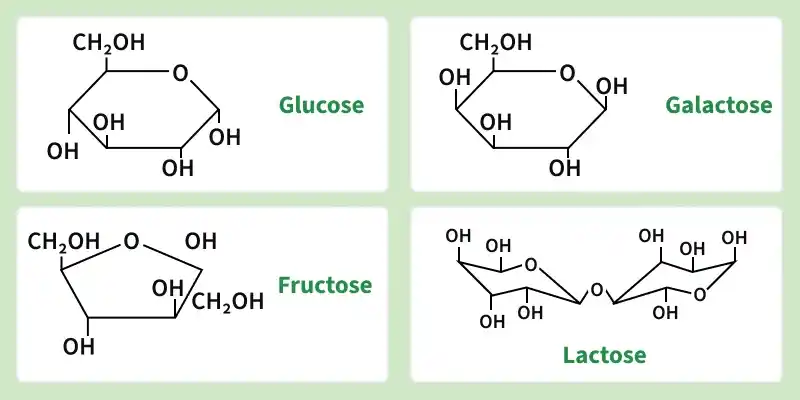
Features of Reducing Sugar are given below:
- Reducing sugar contains free aldehyde or ketone groups as functional groups that allow them to undergo redox reactions.
- It can donate electrons or act as a reducing agent.
- As the reducing sugars can donate electrons, they are susceptible to oxidation reactions.
- Reducing sugars include all monosaccharides and some disaccharides.
- Reducing sugars participate in the Maillard reaction that takes place between amino acids and reducing sugars. It results in the browning and flavour development in the cooked food.
- Reducing sugars can reduce copper ions in Fehling's test or Benedict's test from Cu2+ to Cu+ and result in the formation of a coloured precipitate (typically orange or red).
- Examples: Glucose, Fructose, Galactose and Lactose.
Reaction of Reducing Sugar
The working of the reducing sugar can be explained by taking an example of glucose undergoing an oxidation reaction. Glucose (C6H12O6) reacts with oxygen (O2) in the presence of the alkaline solution and heat to produce carbon dioxide (CO2) and water (H2O).
C6H12O6 + 6O2 → 6 CO2 +6H2O
Benedict's Test (For Reducing Sugars)
A positive result is indicated by a colour change from blue to green, yellow, orange, or red, depending on the concentration of reducing sugars. Example: Glucose, fructose, and maltose are reducing sugars and would give a positive Benedict's test.
Non-Reducing Sugar
A non-reducing sugar does not have a free aldehyde or ketone group and, therefore, cannot donate electrons in a redox reaction. All the carbonyl groups of the non-reducing sugar are involved in glycosidic linkages, thus forming a closed ring that prevents the molecule from acting as a reducing agent. Some examples of non-reducing sugars include Stachyose, Sucrose, Verbascose, Trehalose, Raffinose, and Gentianose. Non-reducing sugars can be converted into reducing sugars through acid hydrolysis or enzymatic hydrolysis.
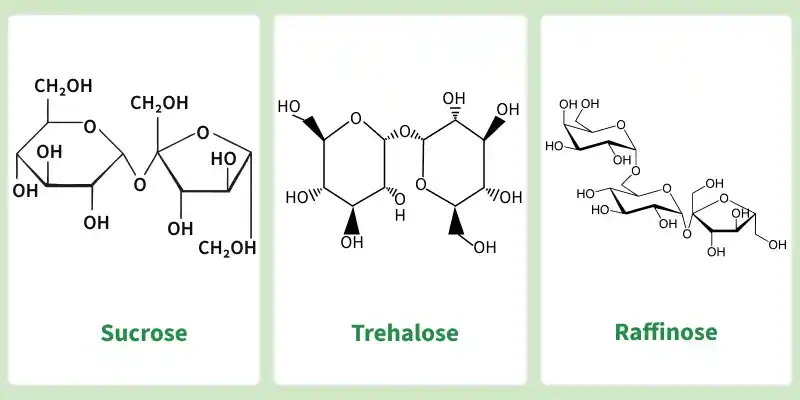
Features of Non-Reducing Sugar are given below:
- Non- Reducing sugar lacks free aldehyde or ketone groups as a functional group that prevents them from undergoing redox reaction.
- It cannot donate electrons or act as a reducing agent.
- As the non- reducing sugar lacks free reducing ends, they can not be oxidised.
- Non-reducing sugars include most disaccharides and simple polysaccharides.
- Non-reducing sugars have a closed ring structure that hinders their involvement in the Maillard browning reaction.
- As they lack a free reducing group, non-reducing sugars do not react with Fehling's test or Benedict's test.
- Examples: Sucrose, Trehalose, and Raffinose
Reaction of Non-Reducing Sugar
Non-reducing sugars can be converted into reducing sugars via hydrolysis. Under acidic conditions or in the presence of the enzyme sucrase, sucrose can be broken down into glucose and fructose.
Sucrose + H2O → Glucose + Fructose
Hydrolysis Test (For Non-Reducing Sugars)
A positive result in the Benedict's test after hydrolysis indicates the presence of non-reducing sugars that have been converted into reducing sugars. Example: Sucrose is a non-reducing sugar. After hydrolysis, it breaks down into glucose and fructose, both of which are reducing sugars.
Functions of Reducing and Non- Reducing Sugars
The functions of Reducing and Non- Reducing Sugars are as follows:
- Reducing sugar acts as a primary source of energy in living organisms.
- As reducing sugar undergoes a redox reaction, it plays an important role in various biochemical processes.
- Non-reducing sugar provides structural support. For example, Non-reducing polysaccharides like cellulose in plant cell walls.
- Non-reducing sugar stores the various forms of carbohydrates.
Importance of Reducing and Non-Reducing Sugar
The importance of reducing and non-reducing sugars is as follows:
- Reducing sugar can donate an electron; therefore, it is important in various biochemical processes, including cellular respiration.
- It is an important source of energy for living organisms and supports cellular functions. For Example: Glucose
- Reducing sugar takes part in the Maillard reaction and contributes to flavour and browning in cooked foods.
- Tests like Benedict's distinguish reducing sugars, aiding analysis in biochemistry and food science
- Non-reducing sugars, e.g., sucrose, offer chemical stability, resisting spontaneous reactions.
- Non-reducing sugar is used in food products for sweetness without contributing to browning or caramelisation.
The difference between reducing and non-reducing sugars is as follows:
| Characteristic | Reducing Sugars | Non-Reducing Sugars |
|---|---|---|
| Definition | Capable of reducing other substances by donating electrons. | Lacks the ability to donate electrons in redox reactions. |
| Functional Group | Contains a free aldehyde or ketone group. | The carbonyl group is involved in a glycosidic linkage. |
| Examples | Glucose, fructose, maltose, lactose, etc. | Sucrose (table sugar), trehalose, etc. |
| Fehling's Solution Reaction | Reduces copper ions in Fehling's Reaction. | Does not react in Fehling's Reaction. |
Benedict's Solution Reaction | Reduces copper ions in Benedict's solution | Does not react with Benedict's solution. |
Colour Change (Positive Test) | Forms a coloured precipitate (orange/red). | No colour change observed |
Oxidation Susceptibility | Can be oxidised | Cannot be oxidised |
Barfoed's Test | A positive result indicates reducing sugars | May give a slower positive result for disaccharides compared to monosaccharides |
Chemical Structure | Contains a free aldehyde or ketone group. | Lacks a free aldehyde or ketone group. |
| Glycosidic Linkage | Does not have a glycosidic linkage between the monosaccharide units. | Has a glycosidic linkage between the monosaccharide units. |
| Role in Laboratory Tests | Shows a positive result in tests for reducing sugars. | Does not show a positive result in tests for Non-reducing sugars. |